
- By Bhawana
- 26 Nov 2025
The Uttan–Virar Sea Link: The Mega Project That Will Redraw Mumbai’s North–South Connectivity Forever
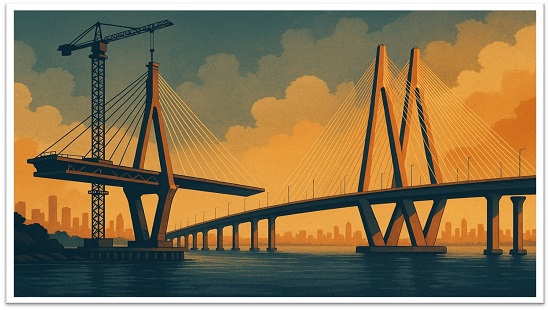
The Maharashtra government’s approval of the Detailed Project Report (DPR) for the Uttan–Virar Sea Link marks one of the most consequential mobility decisions taken for the Mumbai Metropolitan Region in over a decade. For a city that loses nearly 1.4 crore commuter hours every day to congestion, this project is more than another piece of infrastructure; it is a structural rethink of how Mumbai moves, grows and integrates its rapidly expanding northern suburbs.
The proposed Uttan–Virar Sea Link is not a standalone corridor. It is the missing northern stretch in Mumbai’s long-envisioned western coastal ring road, a network that would enable seamless, high-speed travel from Nariman Point all the way to Virar and eventually Palghar. Once combined with the Mumbai Coastal Road, the Bandra–Worli Sea Link, the Bandra–Versova Sea Link and the Versova–Bhayandar elevated corridor, the city will witness its first uninterrupted coastal highway capable of transporting people across 70–80 kilometres in under an hour.
A High-Speed Coastal Spine for the MMR
Designed as an eight-lane north–south expressway, the Uttan–Virar Sea Link (UVSL) consists of a 24.35 km sea bridge supported by nearly 31 km of approach roads, making Phase 1 a 55.12 km mega corridor. It will connect Uttan near Bhayandar to Virar through three major access routes: the 9.32 km Uttan connector, the 2.5 km Vasai connector and the 18.95 km Virar connector.
The project’s scale is reflected in its estimated cost of Rs 58,754 crore. The Mumbai Metropolitan Region Development Authority (MMRDA) has been authorised to raise Rs 44,332 crore from international lenders, with Japan’s JICA being actively considered. The remaining amount will be contributed through a mix of state government taxes, land acquisition expenditure and MMRDA funding.
By extending the corridor further north to the upcoming Vadhvan Port, the UVSL also becomes part of a far larger vision: a continuous coastal expressway from South Mumbai to a major deep-draft port in Palghar, fundamentally reorganising freight, logistics, mobility and urban development patterns in the region.
Why the Sea Link Matters Even Before It Opens
The Uttan–Virar Sea Link will not directly connect to South Mumbai in its first phase. Its significance lies in the fact that it completes the last major missing piece in the western coastal road chain. Only when paired with the remaining links currently under construction will Mumbai truly reap the mobility benefits of this corridor.
Once the chain is complete, travel patterns across the region will change dramatically. Today, commuters from Vasai, Virar and Bhayandar often face 90 to 120 minutes of travel to reach South Mumbai, navigating chokepoints like Dahisar Check Naka, Mira Road flyovers and the chronically congested Western Express Highway. With an uninterrupted coastal expressway, these travel times could shrink to 45–55 minutes from Virar and as low as 30–40 minutes from Vasai or Uttan. Time savings of this magnitude indicate a step change in urban mobility, rivalling some of Asia’s fastest coastal corridors.
Easing Pressure on Mumbai’s Overburdened Arteries
The Western Express Highway carries nearly 3.2 lakh vehicles daily, often operating at more than double its designed capacity. SV Road and Link Road face similar saturation levels. The coastal chain is designed to absorb a significant portion of this long-distance traffic, acting as a parallel high-speed alternative that bypasses densely built-up inland corridors.
This shift is not merely about convenience. Reduced congestion translates into lower fuel consumption, better emission profiles, economic productivity gains and significant logistical efficiencies. For a city where mobility directly shapes economic competitiveness, the coastal route becomes a backbone for future growth.
Integrating the Northern Suburbs into the City’s Core
For residents of Bhayandar, Vasai and Virar, the sea link offers a structural change in access to opportunity. These suburbs have some of the fastest-growing populations in the MMR, yet historically remain disconnected from the economic heart of Mumbai. Faster travel to employment hubs, financial districts and tertiary healthcare facilities will not only enhance quality of life but also rebalance the residential load across the metropolitan region.
Faster connectivity will also influence real estate patterns. Traditionally perceived as distant, the far-north suburbs could witness accelerated housing demand, improved land values and increased investor interest, similar to the transformation seen along the Mumbai Coastal Road in the south.
A Direct Gateway to the Delhi–Mumbai Expressway
One of the most significant dimensions of the UVSL is its linkage to the Delhi–Mumbai Expressway. Through the Virar connector, long-distance vehicles from Delhi, Gujarat and other western regions will enter Mumbai through the coastal corridor rather than through the heavily congested western suburbs. This is expected to reduce highway bottlenecks, streamline freight entry and improve travel reliability for inter-state movements.
It also repositions Mumbai strategically as the final, efficiently connected node on one of India’s longest expressways, strengthening trade flows and logistics competitiveness.
Enabling Vadhvan Port and Western India’s Freight Future
The UVSL is envisioned as the southern anchor of the proposed expressway that will eventually reach Vadhvan Port, one of India’s most ambitious port developments. Once operational, Vadhvan will handle massive cargo volumes, reducing the load on JNPT and opening new maritime trade lanes.
A direct high-speed road from Virar to Vadhvan will allow freight to bypass suburban roads entirely. Heavy trucks moving through residential zones have long contributed to congestion and accelerated road wear. This coastal freight spine will address both issues simultaneously, improving safety and cutting travel times for commercial cargo.
Economic Ripples Across the Western Belt
The Uttan–Virar stretch is rich with untapped economic potential. Improved connectivity could accelerate tourism in beachside areas like Uttan, boost fisheries-linked livelihoods, support new warehousing clusters, and encourage industrial and service investments along the corridor. As happened with the Mumbai–Pune Expressway and the Bandra–Worli Sea Link, mobility improvements often catalyse broader development cycles.
By enabling more predictable and faster travel, the project makes the northern belt more attractive for businesses, residents and investors. Over time, the corridor could emerge as a fully integrated extension of Mumbai’s urban and economic landscape.
A Transformational Project for Mumbai’s Next Growth Curve
The Uttan–Virar Sea Link is not just a transport project. It is a redesign of Mumbai’s mobility geography, a north–south spine capable of shifting economic gravity, urban development patterns and commuter behaviour. Once completed alongside the rest of the coastal network, it could become one of the city’s most consequential infrastructure achievements since the Western Express Highway.
A faster, more seamless Mumbai is not a distant vision anymore. It is being built in concrete, steel and sea, one link at a time.