
- By Mahesh
- 02 Feb 2026
Why Mumbai Cannot Afford to Lose Its Wetlands Anymore
As climate risks rise, the city’s forgotten natural infrastructure may be its strongest line of defence
Mumbai’s environmental debate often swings between big-ticket infrastructure and reactive disaster management. What gets far less attention is the city’s oldest and most cost-effective infrastructure: its wetlands. Built not by planners but by geography, these ecosystems once dictated how water flowed, where people settled, and how the city absorbed the monsoon. Their steady disappearance now explains much of Mumbai’s recurring urban distress.
Long before Mumbai became India’s financial capital, it was a network of creeks, mudflats, mangroves and marshes stitched together by tides and rainfall. These wetlands regulated floods, filtered water, cooled the local climate and supported fisheries and birdlife. As land values rose, they were gradually treated as vacant real estate rather than functioning ecological assets.
The result is visible every monsoon.
Flooding Is Not a Rainfall Problem Alone
Mumbai receives heavy rainfall, but rainfall by itself does not cause flooding. Cities flood when water has nowhere to go. Wetlands act as natural reservoirs, holding excess rainwater and releasing it slowly into creeks, rivers and the sea. When these spaces are filled or constricted, rainwater is forced into drains that were never designed to handle such volumes.
The city’s geography worsens this vulnerability. Large parts of Mumbai are low-lying and tidal. Wetlands and mangroves once buffered tidal surges and storm impacts. Their removal has exposed dense urban settlements directly to water stress, making floods faster, deeper and harder to manage.
In policy terms, Mumbai has replaced flexible natural systems with rigid concrete solutions that fail under extreme conditions.
Mangroves: The City’s Invisible Coast Guard
Among Mumbai’s wetlands, mangroves perform an especially critical function. They stabilise shorelines, reduce erosion, slow tidal waves and protect against storm surges. In a coastal megacity facing sea-level rise, mangroves are not environmental luxuries—they are insurance.
Mumbai still has one of the largest mangrove covers among major Indian cities, but pressure from infrastructure projects, transport corridors and real estate development remains intense. Where mangroves are protected and monitored, flood intensity reduces measurably. Where they are cut or degraded, the costs surface quickly through damage, disruption and recovery spending.
Biodiversity That Keeps the System Alive
Wetlands are often misunderstood as stagnant or unproductive spaces. In reality, they are among the most biologically active ecosystems. They support fish nurseries, migratory birds, insects, amphibians and plant species that keep coastal food chains intact.
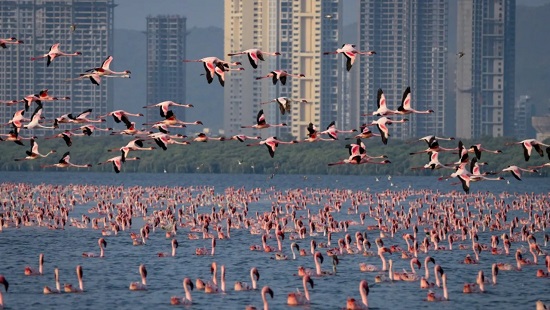
Mumbai’s wetlands sit along major migratory routes, making them seasonal homes to thousands of birds. The now-iconic flamingos of Thane Creek are not an anomaly; they are indicators of an ecosystem still functioning despite pressure. When biodiversity declines, it is usually a signal that water quality, sediment flow and ecological balance are breaking down.
Nature’s Water Treatment Plants
In a city where rivers often function as open drains, wetlands quietly perform filtration work that no treatment plant can fully replicate. Wetland vegetation slows water flow, traps pollutants, absorbs nutrients and allows sediment to settle before water enters creeks or the sea. This improves water quality, recharges groundwater and reduces pollution loads downstream.
Ironically, degraded wetlands are often blamed for health risks, when the real problem is neglect. Healthy wetlands circulate water and maintain balance. Destroyed wetlands create stagnant, polluted zones that worsen disease risk and environmental damage.
Policy Exists, Implementation Lags
India has legal frameworks such as the Wetlands (Conservation and Management) Rules, 2017, and international commitments under the Ramsar Convention. Mumbai has also seen targeted success stories, including mangrove protection initiatives and the Ramsar recognition of Thane Creek.
But enforcement remains uneven. Wetlands continue to face pressure from transport projects, commercial development, waste dumping and ad-hoc land-use changes. Environmental clearances often focus on compliance rather than cumulative impact, allowing gradual erosion of ecological capacity.
Why the Economic Case Matters
Protecting wetlands is often framed as an environmental issue. It is equally an economic one. Flood damage, infrastructure repair, traffic disruption and health costs impose recurring financial burdens on the city. Wetlands reduce these costs silently, year after year.
From a governance perspective, investing in wetland protection delivers long-term returns that outperform most grey infrastructure projects. The challenge is that these returns are preventive, not headline-grabbing.
Citizens as Stakeholders, Not Spectators
Sustainable protection requires more than regulation. Citizen awareness, local monitoring, scientific research and responsible engagement can turn wetlands from “forgotten land” into shared assets. Guided walks, citizen science projects and community partnerships help people see wetlands not as obstacles to growth, but as enablers of a resilient city.
Mumbai’s future will not be decided only by what it builds, but by what it chooses not to destroy. Wetlands are no longer optional. They are the city’s quiet, indispensable partners in survival.