
- By Medhavini
- 26 Nov 2025
26/11 Mumbai Attack: How Indian AI Startups Are Quietly Rebuilding the Future of Counterterrorism
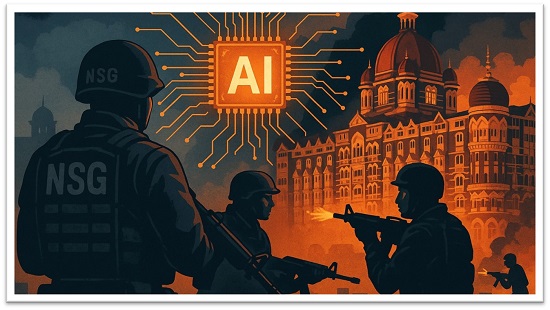
Seventeen years after the 26/11 Mumbai terror attack, India’s counterterrorism landscape looks fundamentally different. What was once a domain dominated by conventional policing, intelligence gathering, and manual surveillance has now expanded into a new frontier powered by artificial intelligence. As Mumbai marks the anniversary of one of the most horrific nights in its history, India’s startup ecosystem has emerged as an unexpected but formidable force in shaping modern defence capabilities.
The shift is not incidental. With threats becoming more decentralised, urban, and technologically enabled, India’s security architecture required tools that go beyond human speed and cognitive limits. AI-driven analytics, drone intelligence, underwater robotics, threat pattern recognition, and predictive surveillance have now become integral layers of national defence. Over the past decade, several Indian startups have quietly built capabilities that align closely with the lessons of 26/11: better situational awareness, faster response, and deeper predictive intelligence.
The Rise of Predictive Counterterrorism
One of the biggest learnings from the 2008 attack was the need for anticipatory systems that can detect risk indicators before they materialise into violence. Urban security today deals with enormous data volumes: CCTV networks, social media chatter, maritime activity, digital communications and open-source intelligence. No human team can manually process these signals at scale.
AI bridges that gap. Machine learning models identify anomaly patterns, cross-reference behavioural data, and deliver threat predictions based on historical attack vectors. According to industry estimates, major Indian metros now collectively operate over 1.3 million CCTV cameras; a fraction of their feed, if processed manually, would require tens of thousands of trained personnel. AI reduces that dependency, allowing security agencies to focus on decision-making instead of raw monitoring.
This shift has positioned Indian AI startups at the heart of the country’s counterterrorism framework. Their products are no longer experimental prototypes, many are already deployed in police units, coastal security operations, and military programmes.
Staqu Technologies: Video Intelligence Built on Real Crisis Data
Delhi-based Staqu Technologies has emerged as a standout player in video analytics. Its flagship platform, Jarvis, uses machine learning to predict crowd unrest, identify suspicious behaviour, and flag anomalies from CCTV footage. What makes it particularly relevant to the 26/11 context is that some of its models are trained on siege-style scenarios inspired by the attack’s pattern.
With more than 500 deployments across Indian states, Staqu’s platform is now being expanded into biometric threat scoring and predictive policing interfaces. The company was also selected among the 10 AI startups for the Government of India’s AI Accelerator Programme in Paris, marking global recognition of its approach.
EyeROV: Underwater Robotics for Coastal Defence
One of the weakest links exposed during 26/11 was coastal vulnerability. EyeROV, a Kerala-based marine robotics startup, has filled this gap by building autonomous underwater drones capable of navigating depths up to 300 metres. These drones come equipped with sonar, high-resolution cameras, and robotic arms designed for naval inspections and underwater threat detection.
The Indian Navy has already placed orders for EyeROV systems, recognising their utility in maritime surveillance, underwater reconnaissance, and hull inspections. As infiltration routes evolve, the underwater domain is becoming a new security frontier, and EyeROV is helping India prepare for it.
ideaForge: Drones that Redefine Urban and Coastal Surveillance
Born out of IIT Bombay, ideaForge is one of India’s most advanced drone manufacturers. Its UAVs integrate machine learning models for autonomous threat detection and movement pattern recognition. The company gained national prominence with its contributions to Maharashtra’s drone policy, enabling aerial surveillance fused with ground sensors for real-time monitoring.
ideaForge’s drones are used by multiple security agencies for perimeter security, coastal scanning, and crowd monitoring, bridging the surveillance gaps exposed in 2008.
Armory: AI-Powered Counter-Drone Systems
With the global proliferation of rogue drones, traditional counterterror frameworks now require airborne threat defences. Gurugram-based Armory has built an AI-enabled counter-drone system capable of detecting, tracking, and neutralising unauthorised drones. Its Indigenous C-UAS, powered by the Samaritan OS, offers real-time drone classification and interception.
Such systems are crucial today as drones are used for reconnaissance, payload delivery, smuggling, and cross-border disruption. Armory’s work positions India competitively in the counter-UAV space, a technology domain once dominated by a few global players.
Vehere: AI-Led Intelligence for Cyber and Signals Surveillance
Veher¬e, headquartered in Delhi, focuses on SIGINT solutions for national security agencies. Its platforms provide cyber defence, lawful interception, and deep network analysis using AI. In counterterrorism, Vehere’s systems help agencies monitor digital communication patterns, decode threats across networks, and detect malicious activities before they escalate.
As terror organisations increasingly rely on encrypted communication and digital anonymity, SIGINT has become more central to security operations. Vehere’s tools allow faster data interpretation and threat correlation across large digital ecosystems.
CloudSEK: Monitoring the Internet’s Darkest Corners
Bengaluru-based CloudSEK operates in a domain that sits at the intersection of cybersecurity and national security. Its AI platform, XVigil, monitors the dark web, forums, and social media for early indicators of coordinated attacks or extremist mobilisation. For security agencies, this intelligence is invaluable, offering insights into attacker behaviour, intent, and planning cycles.
The company’s models observe threat chatter patterns, something increasingly important as radicalisation and operational planning move online.
How AI Is Transforming Counterterrorism Beyond Startups
Beyond individual companies, India’s AI push has created a broader ecosystem for predictive defence. Several machine learning systems today are trained on declassified datasets from attacks like 26/11 and the more recent Red Fort incident. These models recognise behavioural signatures such as unusual crowd movement, pre-attack communication spikes, or coordinated misinformation patterns.
When integrated with vast CCTV networks, maritime sensors, and urban IoT systems, AI can generate risk scores in real time, sometimes identifying threats in minutes rather than hours.
A Future of Promise and Caution
AI is not infallible. Models can misread signals, overlook context, or behave unpredictably under adversarial manipulation. Human intelligence and on-ground decision-making remain irreplaceable components of counterterrorism.
What AI does offer, however, is scale. And scale is what modern counterterrorism demands.
On this anniversary, Mumbai stands not just as a reminder of what was lost but as a blueprint for what has transformed. India’s AI startups are no longer peripheral players, they are co-architects of a security future designed to ensure that a night like 26/11 never repeats.