
- By Medhavini
- 03 Dec 2025
New Zealand Minister’s Visit Highlights India’s Rising Strength in Global Skill Development
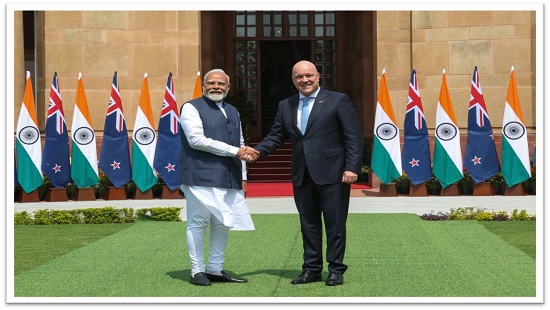
New Zealand’s Minister for Trade, Investment, Agriculture and Forestry, Todd McClay, offered strong praise for India’s accelerating progress in skill development during his visit to the Atal Bihari Vajpayee Skill Development Centre in Kandivali, Mumbai. His remarks reflect a growing international recognition of India’s evolving role as a global skills powerhouse, a role shaped by sustained investments, modern training ecosystems and deepening industry linkages. The visit also underscores a widening horizon for bilateral cooperation between India and New Zealand across education, technology and workforce development.
The Skill Development Centre, operationalised under Prime Minister Narendra Modi’s vision of building India into a global hub for high-quality talent, offers training across domains such as cyber security, retail services, hotel management, white goods servicing and apparel manufacturing. These courses are part of a broader national series of programs designed to enhance employability, uplift productivity and support India’s growing digital and manufacturing economy.
A Global Endorsement of India’s Skill Infrastructure
During his tour of the facility, Minister McClay interacted with instructors and trainees, reviewed classroom modules, and examined India’s training methodologies firsthand. He highlighted the modern infrastructure, technology-enabled teaching frameworks and strong collaboration with industry partners. According to him, the skill ecosystem he witnessed aligns with global standards, particularly in sectors where workforce adaptability and digital readiness are critical.
His remarks come at a time when India is positioning itself as a major contributor to global talent pipelines. With a workforce that will account for nearly one-fifth of the world’s working-age population by 2030, the country is moving rapidly to bridge skill gaps and meet the evolving demands of global employers. McClay’s appreciation serves as an acknowledgment of India’s progress and as a signal to global industries that India’s skill ecosystem is increasingly internationally competitive.
A Shared Vision for Deeper India–New Zealand Collaboration
The visit also strengthened the bilateral dialogue between the two nations. McClay noted that New Zealand views India as a priority partner, particularly in the areas of education, agriculture, technology and sustainable development. Skill development emerged as a central theme, offering opportunities for joint programs, institutional partnerships, research exchange and academic mobility.
He highlighted that discussions on a balanced Free Trade Agreement (FTA) between the two countries are progressing well. A mutually beneficial FTA could open new pathways for collaboration in education services, agricultural innovation, food processing technologies and sustainable resource management. For both nations, deeper trade and skill ties would reinforce economic resilience and support long-term developmental interests.
India already hosts several New Zealand educational institutions through collaborative programs, while thousands of Indian students pursue advanced studies in New Zealand each year. Aligning skill development goals could allow both countries to build stronger bridges between training, workforce participation and innovation.
A Training Centre That Reflects India’s Changing Economic Priorities
The Atal Bihari Vajpayee Skill Development Centre itself represents a shift in how India is modernising its talent pipeline. The facility focuses on high-demand skills aligned with current economic transitions, digital security, hospitality excellence, retail engagement and precision manufacturing. By offering practical, modular training with industry-recognised certifications, the centre seeks to enhance job readiness for youth in and around Mumbai.
Such centres are part of a nationwide effort to drive inclusive growth by diversifying skill offerings and improving local access to professional training. They also serve as nodes in a larger ecosystem that integrates apprenticeship opportunities, private-sector partnerships and outcome-driven training modules.
Strengthening People-to-People Ties Through Sports and Cultural Engagement
Earlier in the day, McClay joined Union Commerce and Industry Minister Piyush Goyal to inaugurate the Doctors’ Cricket Tournament under the MP Sports Festival in North Mumbai. The event served as a reminder that cultural and sporting engagement often strengthens diplomatic ties beyond formal trade and economic discussions.
Minister Goyal noted that the tournament aligns with India’s broader sporting vision, one that supports preparation for the 2030 Commonwealth Games and contributes to India’s ambition of hosting the 2036 Olympics. Sports diplomacy has emerged as an increasingly important dimension of international engagement, fostering collaboration and goodwill at a human level.
For New Zealand, a nation with a strong sporting tradition and a deep cultural affinity for cricket, such events build familiarity and reinforce long-standing people-to-people connections.
A Moment That Reflects India’s Emerging Global Profile
The positive observations offered by Minister McClay signal more than bilateral goodwill, they reflect India’s steadily rising profile in global talent conversations. As the world transitions toward digital-first industries, resilient supply chains and sustainability-driven production, countries are looking for reliable skill partners. India, with its demographic advantage and growing training capabilities, is positioning itself as one of these partners.
The Kandivali centre, designed with global benchmarks in mind, showcases how India is reshaping its approach to workforce development. It emphasises future-ready skills, industry integration and international collaboration, all essential components of a modern skill economy.
Looking Ahead: A Stronger India–New Zealand Partnership
McClay’s visit is likely to accelerate discussions on academic collaboration, joint training initiatives and policy alignment between India and New Zealand. As both nations explore new avenues for partnership, skill development will remain a strategic connector, capable of strengthening economic ties while generating long-term societal value.
For India, moments like this reinforce its standing as a country that not only supplies talent but also shapes global skill standards. For New Zealand, they offer pathways to engage with one of the world’s most dynamic and youthful workforces.
As India continues investing in modern centres, cross-border partnerships and technology-driven training, its journey toward becoming a global skill hub gains further momentum, and international recognition.