
- By Diya Sogani
- 12 Feb 2026
Supreme Court Hearing on March 15: Can MHADA Unlock Redevelopment for 13,091 Old Buildings in Mumbai?
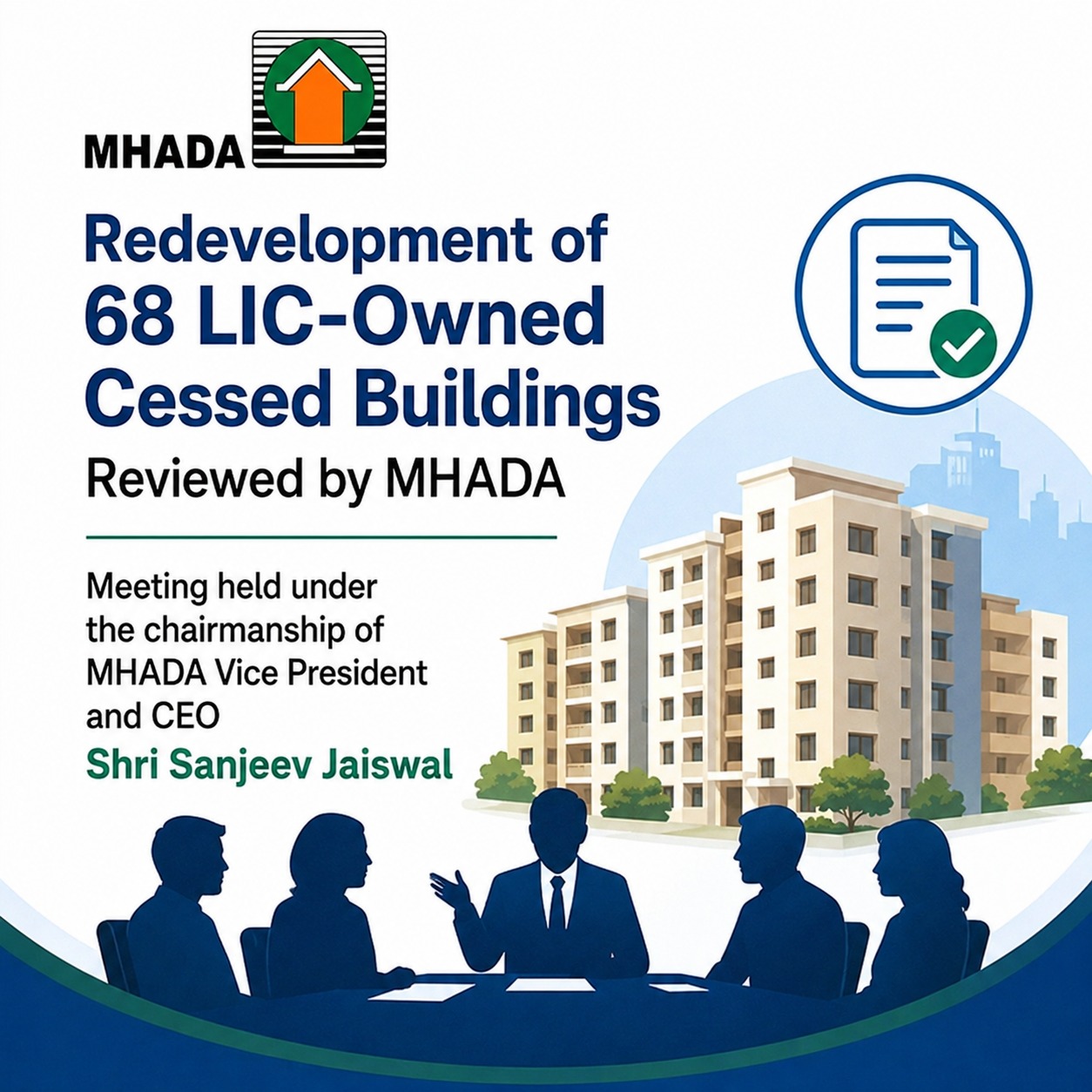
Under the leadership of IAS Sanjeev Jaiswal, Vice President and CEO of MHADA, the Maharashtra Housing and Area Development Authority has taken decisive steps to resolve one of Mumbai’s most pressing urban challenges—stalled redevelopment of aging buildings. With 13,091 old buildings in South Mumbai still awaiting redevelopment, MHADA’s move to approach the Supreme Court signals a strategic attempt to break legal deadlocks while preserving due process.
Mumbai’s housing crisis is not merely about supply; it is about safety, aging infrastructure, and urban resilience. According to official figures, South Mumbai alone had 19,642 old buildings. Of these, 13,091 remain stuck in the redevelopment pipeline. More concerning is the age profile: 11,950 buildings were constructed before 1940, 963 between 1940 and 1950, and 1,294 between 1951 and 1969. In urban planning terms, this represents a structural risk cluster concentrated in high-density neighborhoods.
The Legal Impasse and MHADA’s Response
The Mumbai Building Repairs and Reconstruction Board had earlier issued notices to 935 old buildings where redevelopment had not progressed. The objective was straightforward: encourage owners to initiate redevelopment, empower residents’ associations if owners failed to act, and as a last resort, consider land acquisition under statutory authority.
However, the High Court stayed these notices after accepting arguments that MHADA lacked authority in this context. This effectively froze several redevelopment efforts, prolonging uncertainty for residents.
Instead of allowing paralysis to set in, MHADA has escalated the matter to the Supreme Court, with a hearing scheduled for March 15. The move reflects institutional confidence in legislative amendments made to strengthen redevelopment powers while ensuring accountability.
Legislative Reforms: Strengthening Urban Governance
Recognizing structural delays, the state introduced amendments to the MHADA Act:
- Section 77 empowers MHADA to take over incomplete or stalled redevelopment projects.
- Section 79-A enables redevelopment of buildings declared dangerous under Section 354 of the Municipal Act.
- Section 91-A reduces the mandatory consent threshold from 70 percent to 51 percent of residents.
These amendments are not arbitrary expansions of power. They are calibrated responses to a structural urban challenge: how to prevent minority obstruction from jeopardizing public safety in aging buildings.
In dense cities like Mumbai, delayed redevelopment increases risks. Structural fatigue, outdated utilities, and seismic vulnerability compound over time. From a public policy perspective, time is not neutral—it amplifies risk.
Consent-Based Redevelopment: A Practical Path Forward
Importantly, the High Court clarified that where building owners, developers, and tenants are in agreement, redevelopment proposals can proceed. This nuance is critical. It means projects based on consensus are not legally frozen.
IAS Sanjeev Jaiswal has confirmed that MHADA has already begun processing such mutually agreed redevelopment proposals. This approach balances judicial caution with administrative pragmatism.
Rather than framing the court stay as a setback, MHADA’s strategy positions it as a legal clarification phase. Projects with consensus can move forward immediately. Disputed cases await final clarity from the Supreme Court.
Why This Matters for Mumbai’s Housing Ecosystem
Redevelopment in South Mumbai is not just about replacing old structures with new towers. It is about:
- Enhancing structural safety for thousands of residents.
- Improving fire safety and evacuation standards.
- Modernizing utilities such as drainage and electrical systems.
- Increasing housing supply without horizontal urban sprawl.
With 13,091 buildings awaiting redevelopment, even incremental progress can significantly impact housing supply and urban safety metrics.
Moreover, stalled redevelopment ties up capital, delays occupancy certificates, and increases litigation costs. Unlocking these projects could release economic activity across construction, finance, and ancillary services.
Institutional Accountability and Transparency
MHADA’s move to seek Supreme Court intervention reflects procedural transparency rather than unilateral action. Instead of circumventing judicial scrutiny, the authority is pursuing legal clarity at the highest level.
Citizens and stakeholders are advised to rely exclusively on verified information from MHADA’s official channels and public notifications. In matters involving redevelopment, court proceedings, and statutory amendments, accuracy is essential to avoid misinformation that could influence property decisions.
A Leadership Model Focused on Resolution
Urban governance often gets trapped between legal caution and administrative urgency. The current approach reflects a structured attempt to reconcile both. By combining legislative amendments, judicial engagement, and consent-driven approvals, MHADA is attempting to unlock redevelopment while respecting due process.
The upcoming Supreme Court hearing on March 15 could be pivotal. If the stay is lifted or clarified, thousands of redevelopment projects may move forward, accelerating structural upgrades in one of India’s densest urban cores.
For Mumbai, where land scarcity meets aging infrastructure, redevelopment is not optional—it is inevitable. The question is whether it happens systematically or sporadically. The present initiative signals a shift toward systematic resolution.
In urban policy, momentum matters. With legal clarity, administrative resolve, and resident consensus, the redevelopment of 13,091 buildings may transition from backlog to blueprint.