
- By Medhavini
- 10 Dec 2025
Navi Mumbai’s 7,000-Runner Marathon That Is Quietly Redefining Clean Cities and Community Leadership
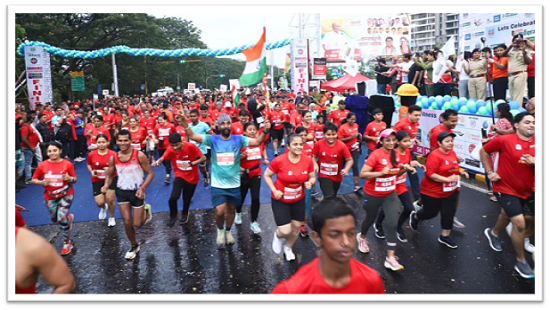
The early hours of a Sunday morning rarely produce citywide mobilisation, yet at 4:30 am on Palm Beach Road, more than 7,000 citizens assembled for the Swachh Navi Mumbai Half Marathon 2025. What appeared at first glance to be a fitness event evolved into something far more consequential: a template for how urban India can strengthen civic participation, accelerate behavioural change, and reinforce public trust. The marathon, organised in collaboration with Let’s Celebrate Fitness to commemorate the 350th martyrdom anniversary of Guru Teg Bahadur Sahib Ji, became a demonstration of how cities can convert collective energy into civic purpose.
While commemorative events often remain symbolic, this marathon turned symbolism into action. Multi-generational participation across the 5 km, 10 km, 21 km, and 32 km categories created an atmosphere of shared responsibility, where fitness intersected with environmental awareness. For Navi Mumbai, a city known for its planned spaces and evolving governance model, such citizen-led mobilisation offers insights into how attitudes, not just infrastructure, shape urban outcomes.
Leadership in Motion: Why the Commissioner’s 32-km Run Matters
One of the event’s most compelling moments was the participation of Municipal Commissioner Dr Kailas Shinde, who completed the full 32 km stretch. Behavioural economists often argue that leadership by example is more persuasive than leadership by instruction. Dr Shinde’s decision to run alongside citizens served as a symbolic alignment of government priorities with public aspirations. In cities where administrative distance often weakens trust, visible leadership helps repair that gap.
His participation also reframed civic messaging. Instead of conventional appeals urging residents to support cleanliness drives, the marathon delivered the same message through demonstration. When a top administrator completes 32 km for a cause linked to cleanliness, accountability transforms from a bureaucratic requirement into a shared pursuit. This shift, subtle but powerful, is the foundation on which modern cities build credibility.
Scale, Density, and the Power of Collective Behaviour
The presence of more than 7,000 runners is not simply a statistic; it represents behavioural density. Studies in public policy show that high-density participation increases message penetration, making it easier for campaigns to travel through social networks, neighbourhoods, and workplaces. Events with large physical turnout generate emotional resonance, which digital campaigns often struggle to match.
In Navi Mumbai’s case, the marathon became a megaphone for the cleanliness mission. Families, youth groups, seniors, and first-time runners converged with a unified purpose, transforming the event from an isolated effort into a citywide conversation. When behavioural change becomes socially contagious, cities move faster than regulations alone could ever push them.
Participation by persons with disabilities added another dimension of inclusivity and moral depth. Their presence sent a clear message: civic contribution is not defined by physical ability but by willingness. Such inclusiveness broadens the sense of ownership citizens feel toward public initiatives, making cleanliness and sustainability shared values instead of administrative goals.
Cleanliness, Fitness, and Community Spirit as a Single Ecosystem
In his post-run remarks, Dr Shinde described the response was overwhelming and inspiring. The statement illuminated an evolving philosophy in urban governance: cleanliness, fitness, and community spirit are not siloed pursuits; they form one ecosystem capability. The cities that consistently perform well globally are those that integrate public health, environmental responsibility, and civic pride into a single narrative.
The marathon offered a three-part reinforcement loop. Fitness motivated participation, participation amplified cleanliness messaging, and the shared experience strengthened community cohesion. This triad created a multiplier effect, demonstrating that cities progress not through isolated projects but through interconnected frameworks of engagement.
The Strength of Civic Coalitions
Events of this scale rely on organisational alignment, and Navi Mumbai’s marathon exemplified how coalitions drive outcomes. Along with Let’s Celebrate Fitness, the Navi Mumbai Gurudwara Supreme Council, Gurudwara Shri Dashmesh Darbar, and numerous community groups anchored the event. These partnerships signal a crucial shift: sustainable civic campaigns require distributed ownership. When community organisations, religious institutions, and civic bodies collaborate, the message becomes culturally rooted and institutionally reinforced.
This shared ownership model reduces the burden on government machinery and increases the cultural durability of public initiatives. Citizens respond more readily when initiatives feel like “ours” rather than “the government’s.” The marathon succeeded precisely because it bridged that psychological divide.
Administrative Alignment and Public Trust
The presence of senior civic officials, including Additional Commissioner Sunil Pawar; Deputy Commissioners Kisanrao Palande, Dr Prashant Javade, Dr Ajay Gadade, Somnath Potre, Sanjay Shinde, and Dr Amol Palve; and Additional City Engineer Arvind Shinde, reinforced institutional commitment. Former MP Sanjeev Naik and representatives of the Gurudwara Supreme Council added political and social breadth, creating a rare moment where administration, community, and civil society converged around a common purpose.
Such alignment is often the missing link in urban India. When departments operate in silos, public initiatives lose momentum. When leadership at multiple levels participates visibly, as it did here, citizens perceive coherence, and coherence is a powerful accelerant of trust.
A New Urban Playbook Emerging from a Morning Run
The Swachh Navi Mumbai Half Marathon leaves behind a series of insights that extend far beyond fitness. Catalytic events can accelerate behavioural change more effectively than policy directives. Public leadership must be visible, not distant, if urban governance aims to cultivate citizen ownership. And community coalitions are emerging as the most reliable engines of large-scale civic mobilisation.
The run across Palm Beach Road was therefore more than a marathon. It became a working model for how Indian cities can anchor progress in participation rather than prescription. If the energy of 7,000 runners is any indication, Navi Mumbai’s momentum toward becoming a cleaner, healthier, and more cohesive city is strengthening not through mandates, but through collective movement.