
- By Sanvee Nagpal
- 09 Dec 2025
Navi Mumbai’s Traffic Revolution Begins: Zero-Cost Intelligent System Could Redefine Urban Mobility
Navi Mumbai is entering a pivotal phase in its evolution as a modern smart city. With the upcoming pilot launch of the Intelligent Traffic Management System (ITMS) on Palm Beach Road, the city is preparing for a transition that blends data, automation and public–private governance into a single mobility ecosystem. What makes this project particularly noteworthy is its zero-cost PPP framework, proving that urban innovation does not always demand heavy public expenditure; sometimes it simply requires alignment, accountability and intelligent design.
Across India’s large urban clusters, traffic congestion has become more than a lifestyle frustration; it is a macroeconomic inefficiency. Various transport studies estimate that Indian cities lose billions of rupees annually due to idle traffic time, fuel wastage and productivity delays. For a planned city like Navi Mumbai, home to over 1.2 million residents and rising vehicular density, the timing for a data-driven intervention could not be more appropriate. The ITMS project, therefore, is not merely a technological upgrade but a governance shift toward measurable efficiency.
Adaptive Signal Optimization: A Data-Driven Core
At the heart of the new system is adaptive signal optimization. Instead of fixed signal cycles that ignore on-ground conditions, ITMS uses real-time vehicle counts, high-capacity cameras and intelligent sensors to continuously calibrate traffic lights. Research in global metro corridors shows that dynamic signaling can reduce waiting time by 20 to 40 percent in peak hours, especially in mixed-traffic environments like India. For commuters, these gains translate directly into smoother movement, fewer braking points, better fuel efficiency and shorter travel windows, micro improvements that compound into a healthier urban rhythm.
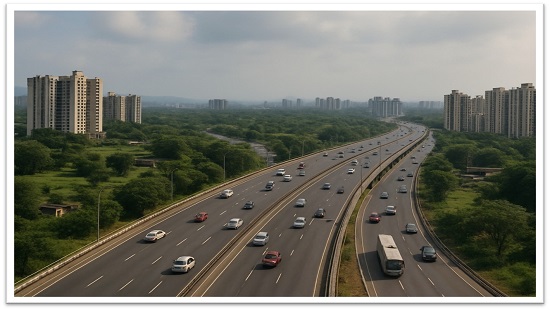
Palm Beach Road, a high-speed arterial stretch connecting residential, commercial and coastal zones, is an ideal testing ground. With high daily volumes and multiple junctions, even minor delays amplify quickly. The ITMS pilot aims to stabilize these fluctuations by preventing unnecessary stoppages, distributing loads intelligently and pre-empting choke points before they escalate. If successful, the model will be replicated across 58 major junctions in the city, creating a uniform digital backbone for mobility governance.
Building a Safer and More Predictable Urban Environment
Safety is another core pillar of this initiative. Traditional traffic monitoring depends heavily on manual reporting, where delays in detection often become delays in response. In contrast, the upcoming system is designed to identify accidents, stalled vehicles and road emergencies within seconds. Automated alerts will be routed to the control room and relevant agencies, enabling faster dispatch of police, medical or mechanical assistance. Given that the golden hour after an accident often determines outcomes, such capabilities are not just operational improvements; they are life-saving interventions.
Pedestrian and cyclist safety, typically the most neglected element in Indian traffic systems, has also been given focused attention. Dedicated signal features, improved timing and more predictable flow patterns can help reduce vulnerability for non-motorized users. In cities worldwide, safer streets correlate strongly with increased walkability and healthier mobility choices. Navi Mumbai’s effort aligns with this global shift toward people-centric urban design rather than vehicle-centric planning.
Empowering Commuters Through Real-Time Information
Information access is a critical layer of any smart mobility ecosystem. Commuters will soon have real-time insights through digital screens and a mobile platform, allowing them to avoid congested routes or adjust timing before entering high-density corridors. As more data accumulates, the system will be able to model patterns, anticipate surges and refine travel advisories. In many countries, such traveller information systems have shown to reduce peak-hour bottlenecks by influencing commuter decision-making, an example of soft infrastructure shaping outcomes without physical expansion.
Emergency response is poised for a major upgrade as well. The ITMS will enable automated green corridors for ambulances and fire engines, guiding them through synchronized signals and LED-based route displays. States that have piloted similar features have recorded reductions of 20 to 30 percent in emergency transit time, underscoring the value of coordinated urban infrastructure. For Navi Mumbai, which hosts multiple industrial clusters, dense residential pockets and fast-growing commercial districts, every minute saved can have outsized impact.
A PPP Model That Redefines Urban Governance
From an administrative perspective, the project demonstrates an evolution in municipal governance. The partnership with Poonam Trading Corporation allows full-scale deployment of digital screens and ITMS infrastructure without capital spending by the civic body. In return, advertisement revenue generated from these screens provides economic viability for the private partner while keeping public expenditure at zero. Such models, when implemented transparently, can unlock innovation at scale while maintaining fiscal discipline, a balance most urban governments aspire to but seldom achieve.
Executive Engineer Pravin Gade summarizes the ambition well: the system is expected to enhance mobility, reduce time and monetary costs for residents and reinforce Navi Mumbai’s identity as a forward-looking smart city. His statement underscores a broader reality: cities today compete not just for investment or infrastructure but for liveability. Efficient traffic movement, predictable commute times and rapid emergency response are now key parameters that shape public trust and investor confidence alike.
Scaling the Vision: From Pilot to Citywide Transformation
As technology becomes more embedded in governance, the true test will lie in execution and adaptability. ITMS deployments worldwide succeed when they evolve continually, absorbing new datasets, integrating emerging mobility modes and refining algorithms based on citizen feedback. For Navi Mumbai, this pilot is the first step in building a scalable urban mobility network capable of learning and improving over time.
Ultimately, what the city is attempting is not merely a technological shift but a behavioural one. When commuters experience reduced congestion, when emergency vehicles move faster, when travel decisions become data-informed, and when the administration operates with measurable transparency, a new social contract begins to take shape, one where efficiency becomes a shared responsibility.
If the Palm Beach Road pilot performs as expected, Navi Mumbai could emerge as a national reference point for intelligent, cost-efficient mobility management. At a time when urban India needs scalable solutions more than grand announcements, this initiative offers a blueprint rooted in practicality, partnership and performance.