
- By Bhawana
- 10 Dec 2025
Massive 24-Hour Water Shutdown Signals Mumbai’s Urgent Push to Modernise Its Ageing Pipeline Network
Mumbai’s water infrastructure rarely makes headlines unless something goes wrong. But the city’s latest announcement, a planned 24-hour shutdown across multiple wards on December 12 and 13, signals not crisis, but transition. The Brihanmumbai Municipal Corporation (BMC) is undertaking large-scale pipeline connection and replacement work across K East, H East and G North wards, a move that marks one of the most extensive maintenance efforts in recent years. For a metropolis that depends on more than 4,200 km of underground water pipelines, periodic overhauls are not just technical interventions; they are essential investments in safety, reliability and long-term resilience.
The shutdown, stretching from Friday morning to Saturday morning, will suspend water supply in several neighbourhoods while causing low pressure in others. While disruptions are never welcome, the context behind these upgrades reveals an ambitious restructuring of a system that has been under pressure for decades. Mumbai’s rapidly growing population, high-density construction patterns and ageing pipelines, some nearly 75 years old, have long posed risks ranging from contamination to road cave-ins. The work scheduled for December is therefore less about inconvenience and more about preventive engineering.
A Dense Network of Pipelines Undergoes a Rare Overhaul
The connection work spans major main lines, including the 1,800-mm Tansa West, 1,200-mm lines, the 2,400-mm Vaitarna pipeline and the 1,500-mm network segments. These diameters typically form the backbone of the city’s water distribution system, responsible for moving millions of litres across long distances. Upgrading such massive structures requires precision, coordination and controlled shutdowns.
Residents in Jogeshwari, Andheri East, Khar, Bandra East and Dharavi will feel the impact most directly, as the BMC prepares to link new pipeline segments into the existing grid. These interventions ensure that future repairs become less frequent and that vulnerabilities, especially around leak-prone older joints, are significantly reduced.
Citizens have been urged to store adequate water, ration usage and boil and filter water for the next few days. Such advisories serve both as precautionary health measures and reminders of Mumbai’s dependency on uninterrupted hydraulic networks that operate invisibly beneath the city’s busiest streets.
Replacing 75-Year-Old Pipelines: A Structural Upgrade Long Overdue
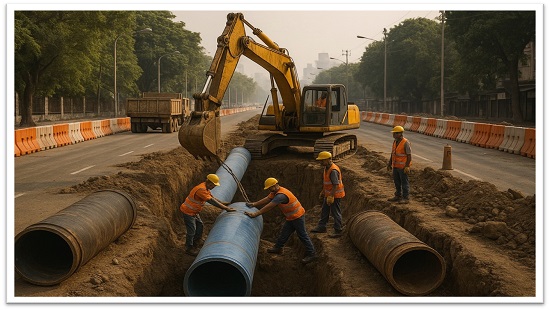
One of the most important aspects of the current initiative is the systematic replacement of decades-old pipelines. The process began earlier this week with the removal of dilapidated 75-year-old lines that were vulnerable to contamination, seepage and sudden bursts. These issues, when left unattended, not only waste thousands of litres daily but also contribute to road collapses, one of the city’s most persistent civic hazards.
The replacement of the massive 2,750-mm pipeline that carries water from Tansa Dam to the Bhandup Water Treatment Plant was completed within 28 hours. The scale and speed of this achievement underline the increasing sophistication of Mumbai’s engineering teams. Such work is highly complex, involving controlled pressure handling, safety protocols and round-the-clock logistics. The urgency reflects the broader pressures Mumbai faces as an ageing city in need of infrastructure renewal.
The effort represents a necessary shift from reactive repairs to proactive modernisation. By introducing higher-quality materials, more resilient joints and improved corrosion-resistant features, BMC is strengthening a system that must serve a population approaching 20 million.
Understanding the Impact: Why Strategic Shutdowns Matter
A 24-hour suspension may feel disruptive, but such concentrated periods of work reduce the need for multiple smaller cuts scattered through the year. For a city with high commercial dependency, predictable downtime is more manageable than unpredictable failures. This approach mirrors global best practices where large cities schedule major shutdowns during periods of lower economic activity to minimise cascading effects.
Moreover, water infrastructure is a system of interdependent segments. Strengthening one part without upgrading adjoining pipelines can create pressure imbalances. Mumbai’s current exercise shows an increasing shift toward system-wide thinking, treating the network not as a set of fragmented pipes but as a unified grid requiring coordinated strengthening.
Neighbourhoods Facing Water Cuts on December 12
Several pockets across Dharavi, Marol, Andheri East and adjoining stretches will face complete shutdown. Key affected areas include:
Dharavi Loop Road, A.K.G. Nagar, Dharavi Main Road, Ganesh Mandir Road, Dilip Kadam Road, Jasmine Mill Road, Mahim Phatak, Vijay Nagar Marol, Military Road, Vasant Oasis, Gavdevi, Marol Village, Church Road, Hill View Society and Kadamwadi.
Additional affected areas include Bhandarwada, Uttam Dhaba, the International Airport and SEEPZ precincts, followed by Mulgav Dongri, MIDC Roads 1–23, Trans Apartment, Kondivita, Maheshwari Nagar, Upadhyay Nagar, Thakur Chawl, Salve Nagar, Bhavani Nagar and Durgapada.
Chakala, Prakashwadi, Govindwadi, Malpa Dongri 1 and 2, Hanuman Nagar, Mota Nagar, Shivajinagar, parts of Shaheed Bhagat Singh Vasti and Charatsingh Vasti will also see disruptions alongside Mukund Hospital, Indira Nagar, Lelewadi, Mapkhan Nagar and surrounding pockets. Major commercial hubs such as the entire Bandra-Kurla Complex will also be without supply.
Neighbourhoods Facing Water Cuts on December 13
On the second day, areas expected to face cuts include Jasmine Mill Road, Matunga Kamgar Vasti, Sant Rohidas Road, 60-Foot Road, 90-Foot Road, Sant Kakkaiya Road, M.P. Nagar Dhorwada and Mahatma Gandhi Road.
Localities such as Omanagar, Kantinagar, Rajasthan Vasti, Sainagar, Sahar Gaon and Sutarpakadi are also included, along with Prabhat Vasti, TIS-3, Agripada, Kaleen and CST Road.
Several other zones, Hansburga Road, Vidyapeeth, CST South Side, Yashwant Nagar, Sundar Nagar, Koliwada Village, Teen Bangla, Shantilal Compound, Patel Compound, Golibar Road and areas from Khar Subway to Kherwadi, will face supply disruptions. Kherwadi, Navapada, Behram Nagar, A.K. Road and Government Vasti in Bandra East complete the list.
A Difficult Interruption Today, A Safer Network Tomorrow
Mumbai’s water network is ageing, dense and indispensable. The 24-hour shutdown and parallel pipeline modernisation mark a rare moment when the city confronts both the fragility and the future of its hydraulic infrastructure. While residents prepare for temporary inconvenience, the long-term benefit is unequivocal: a safer, more resilient and less failure-prone water system.
As climate volatility increases and urban density rises, investments in core utilities become the backbone of metropolitan stability. The work undertaken this week is not merely maintenance; it is an essential recalibration of the systems that keep Mumbai running.