
- By Medhavini
- 01 Dec 2025
The Global Youth Festival 2025 Is Emerging as India’s Most Influential Youth Movement
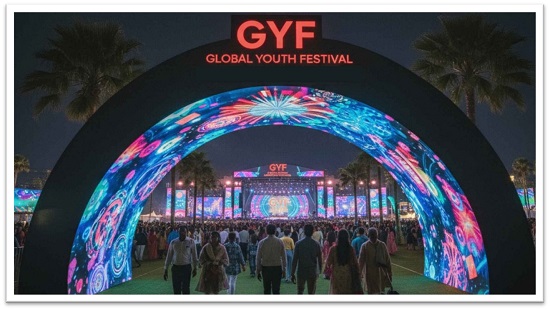
The return of the Global Youth Festival (GYF) to Mumbai in December 2025 signals a shift in how India engages with its young population. While the country adds nearly one million people to its workforce every month, the supply of meaningful platforms that blend skills, purpose, wellness, and innovation remains limited. GYF attempts to bridge this gap by offering a two-day ecosystem that focuses not only on entertainment but also on personal leadership, community impact, and experiential learning. Its sixth edition, scheduled for December 6–7 at Jio World Garden, aims to convene more than 15,000 young participants and deliver over 60 curated experiences. In a landscape where the quality of youth engagement often determines the trajectory of social and economic development, this festival deserves closer examination.
At first glance, GYF is a cultural gathering. But beneath that surface lies a structured blueprint that mirrors the evolving priorities of India’s young workforce. The organisers describe the festival as a movement rather than an event, with its parent community active across more than 20 countries and 170 cities. This transnational footprint matters because youth aspiration today is global, even when opportunity remains local. Platforms that offer exposure to global ideas, leadership perspectives, and social purpose increasingly shape how young Indians evaluate their own ambitions.
A Festival Rooted in Purpose and Responsibility
One of GYF’s most powerful differentiators is its emphasis on purpose-driven celebration. Unlike the typical festival model that maximises consumption, GYF positions itself around contribution. The principle of “lift as you rise,” central to the festival’s design, captures a mindset India urgently needs. With more than 52 percent of the population below the age of 30, the demographic advantage translates into outcomes only when young people are nudged toward responsibility and civic engagement. The festival’s decision to channel proceeds into national charitable initiatives signals an institutional attempt to embed service into mainstream youth culture.
Curation That Reflects India’s Evolving Aspirations
The programming across six major arenas highlights a thoughtful blend of learning, creativity, wellness, and impact. The Wisdom and Leadership zone will feature industry leaders such as Malaika Arora, Dipali Goenka, Nilesh Shah, Diipa Büller-Khosla, and Dr. Aarti Shah. Their presence demonstrates a transition toward accessible mentorship. Young professionals often lack the narrative scaffolding needed to decode leadership journeys. By framing role models within interactive discussions rather than linear speeches, the festival democratizes insights that are typically reserved for closed professional circles.
The Music and Culture section blends contemporary and classical influences through performances from Stebin Ben, the Mahadevan Brothers, and new indie talent. While entertainment remains a draw, the more noteworthy element is the festival’s investment in wellbeing. India’s wellness economy is projected to cross USD 70 billion by 2025, reflecting a rising appetite for preventive and mental well-being. GYF’s wellness architecture—featuring drum circles, meditation sessions, mindful movement, and what is being positioned as India’s largest outdoor sound-healing experience—responds directly to the emotional and cognitive pressures shaping urban youth.
Experiential Learning Through Challenge and Innovation
The Adventure Zone, with its neon drifter karts, obstacle courses, and bouldering walls, reflects the rising importance of challenge-based learning. Globally, companies use physical problem-solving tasks to assess behavioural competencies such as collaboration, resilience, and decision-making. By embedding these models into a youth festival, GYF normalises the idea that growth and enjoyment can coexist.
Equally significant is the Love and Care Arena, dedicated to hands-on social impact. With projects in women empowerment, education, healthcare, animal welfare, and sustainability, this zone reframes civic responsibility as a practical skill. Exposure to structured impact experiences can influence long-term citizen behaviour, especially for first-time volunteers or young students exploring community-building roles.
The Innerverse innovation arena elevates the festival’s creative identity. Built as an immersive LED-driven world blending technology, art, and consciousness, it taps into the growing demand for multisensory experiences. Digital-native audiences seek participation rather than passive viewing, and Innerverse positions GYF at the intersection of experiential tech and creative expression.
Institutional Support Strengthening Festival Credibility
The official partnership with the Department of Sports and Youth Affairs, Government of Maharashtra, reinforces the festival’s credibility. Government endorsement reduces signalling risk for participants, partners, and parents. It acknowledges that youth engagement is no longer peripheral cultural activity but a strategic investment in human capital. The involvement of senior ministers also widens the festival’s institutional reach and emphasises its role in public policy conversations around youth development.
Mumbai as a Strategic Host for Youth-Centric Innovation
Hosting the festival at Jio World Garden aligns with Mumbai’s historic role as a testing ground for ideas that later scale nationwide. When a large-format youth initiative succeeds in the financial capital, it attracts corporate participation, policy attention, and media coverage—three accelerators essential for ecosystem growth. At a time when global workforce structures are shifting due to automation and hybrid work, platforms that cultivate adaptability, creativity, and social intelligence can strengthen India’s talent pipeline.
Passes for the two-day festival are available on BookMyShow, and organisers anticipate strong participation. Whether GYF 2025 becomes a defining moment or another addition to India’s event calendar will depend on execution. But its ambition, design, and scale point to a deeper truth: India does not need more entertainment alone; it needs ecosystems that develop capability, connection, and character. If GYF delivers these outcomes, it could emerge as one of the most influential youth platforms shaping India’s next generation.