
- By Rahul
- 12 Feb 2026
First Solar Eclipse of 2026 on February 17: Date, Time & What to Know About the Annular ‘Ring of Fire’
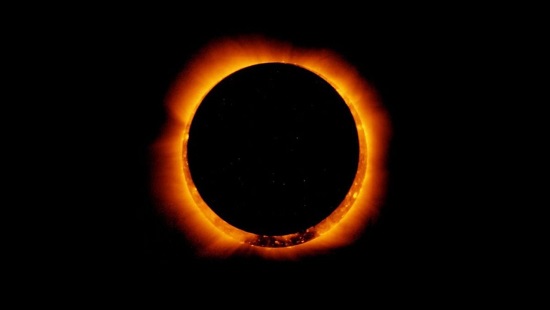
As the calendar turns to 2026, skywatchers and astronomy enthusiasts have something spectacular to look forward to: the first solar eclipse of the year. On Tuesday, February 17, 2026, Earth will witness an annular solar eclipse — a visually striking celestial event often referred to as the “Ring of Fire.”
This eclipse occurs when the Moon passes between the Earth and the Sun but does not block the Sun completely. Instead, the Moon appears slightly smaller than the Sun, leaving a bright ring of sunlight visible around its silhouette.
Here’s what you need to know about this year’s first eclipse — including the date, scientific details, visibility and cultural context.
What Is a Solar Eclipse?
A solar eclipse — known as Surya Grahan in several Indian languages — takes place when the Moon moves directly between the Earth and the Sun. This alignment causes the Moon to block all or part of the Sun’s light from reaching Earth.
There are three main types of solar eclipses:
- Partial Solar Eclipse: The Moon covers only a portion of the Sun, creating a crescent Sun shape.
- Total Solar Eclipse: The Moon fully blocks the Sun’s disk for a short period.
- Annular Solar Eclipse: The Moon is farther from Earth and appears smaller, resulting in a glowing ring around the Moon — the “Ring of Fire.”
The February 17 eclipse is an annular solar eclipse, meaning much of the Sun will be obscured but not completely covered.
Date & Key Details
- Event: Annular Solar Eclipse
- Date: Tuesday, February 17, 2026
- Type: Annular (Ring of Fire)
- Maximum Coverage: About 96% of the Sun’s center
- Duration: Around 2 minutes and 20 seconds at peak viewing along the path of annularity
During this event, the Moon’s disk will cover a large portion of the Sun, leaving a ringlike appearance that can be breathtaking for observers positioned along the eclipse’s path.
Where It Will (and Won’t) Be Visible
Despite the dramatic spectacle, this eclipse will not be visible from India. The path of annularity — where the “Ring of Fire” is seen — lies predominantly in the Southern Hemisphere. As a result, the Moon’s shadow will not pass over the Indian subcontinent.
While many parts of the world may witness the eclipse directly, skywatchers in India will need to watch live broadcasts or digital simulations to experience the event virtually.
Cultural Notes: Sutak Rules Do Not Apply
In some Indian traditions, Sutak Kaal — a period believed to affect auspicious activities — is observed before and during a solar eclipse. During Sutak, activities such as weddings, rituals or temple ceremonies are often paused.
However, according to Drik Panchang, Sutak rules do not apply on February 17, 2026 because the eclipse will not be visible from India.
This means:
- Temples will remain open
- Daily rituals and pujas can be performed as usual
- No restrictions linked to Surya Grahan will be enforced within India
Why Annular Eclipses Are Special
Annular eclipses are less common than partial eclipses and visually unique because:
- The Moon doesn’t fully cover the Sun
- A bright, glowing ring remains visible
- The effect is especially striking during midday viewing
Astronomers and eclipse chasers eagerly anticipate annular eclipses because they offer a rare opportunity to see predictable celestial geometry at work.
If you’re fascinated by astronomy or simply love watching natural phenomena, the February 2026 annular solar eclipse is worth marking on your calendar — even if you need to watch it online from India!