
- By Nirmal Ajwani
- 15 Dec 2025
CIDCO Begins Process to Appoint Consultant for Third Runway Study at Navi Mumbai Airport
Navi Mumbai:
The City and Industrial Development Corporation (CIDCO) has taken an important step toward long-term aviation planning by initiating the process to appoint a consultant for a techno-commercial feasibility study of a proposed third runway at the Navi Mumbai International Airport (NMIA). The move signals early preparation to accommodate future growth in air traffic across the Mumbai Metropolitan Region (MMR).
CIDCO has issued a Request for Proposal (RFP) inviting bids from experienced and eligible consultants, including joint ventures and consortia, to carry out the detailed study. The selected consultant will evaluate the technical feasibility, operational requirements, and commercial viability of constructing an additional parallel runway at NMIA.
According to CIDCO officials, the study is aimed at assessing aviation demand beyond the medium-term planning horizon, particularly after 2037, when existing capacity expansions at both Mumbai’s current airport and NMIA are expected to reach saturation.
Preparing for a Multi-Airport System
At present, Mumbai and the surrounding metropolitan region rely heavily on the Chhatrapati Shivaji Maharaj International Airport (CSMIA), which has a constrained annual passenger handling capacity of approximately 50 to 55 million passengers. With air traffic steadily increasing, capacity limitations at CSMIA have long been a concern for aviation planners.
Once Navi Mumbai International Airport becomes operational, the region is expected to transition to a structured multi-airport system. Combined, CSMIA and NMIA are projected to handle nearly 150 million passengers per annum. While this capacity is expected to be sufficient in the medium term, CIDCO believes that long-term planning must begin now to avoid future bottlenecks.
CIDCO Vice Chairman and Managing Director Vijay Singhal said the initiative reflects the corporation’s forward-looking approach to infrastructure development. He noted that early evaluation of additional aviation infrastructure will help ensure NMIA remains capable of meeting the region’s economic and mobility needs over the coming decades.
Focus Beyond 2037
While NMIA has been designed with phased capacity expansion in mind, aviation demand projections suggest that additional runway infrastructure may be required in the long run. CIDCO officials said the feasibility study will help determine whether a third runway is technically viable and economically justified based on projected passenger and cargo growth.
The study will examine land availability, airspace management, operational efficiency, safety standards, and financial implications associated with constructing and operating an additional runway.
Airport Design and Capacity Plans
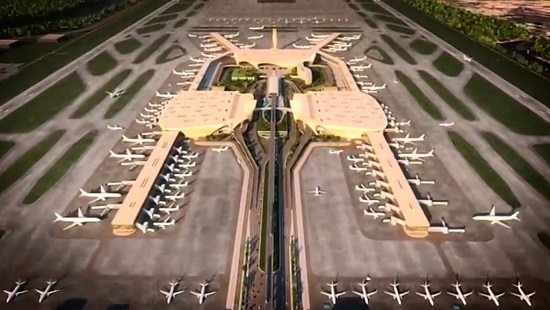
Navi Mumbai International Airport is being developed over approximately 1,160 hectares and is designed to ultimately handle 90 million passengers annually along with 3.2 million tonnes of cargo. The airport’s master plan includes two parallel and independent runways and four interconnected passenger terminals.
Terminal 1 will be capable of handling 20 million passengers annually, while Terminal 2 will have a capacity of 30 million passengers. Terminals 3 and 4 are planned to handle 20 million passengers each, bringing the total terminal capacity to 90 million passengers per year.
Phased Development Timeline
The airport is being constructed in five phases to match anticipated growth in passenger demand. Phase I and Phase II, which together will offer a capacity of 20 million passengers per annum, are scheduled to be ready for the commencement of domestic operations on December 25.
Subsequent phases will gradually expand the airport’s capacity to 50 million passengers by 2029, 70 million by 2032, and the full planned capacity of 90 million passengers by 2037.
Long-Term Vision
By initiating the feasibility study for a third runway well in advance, CIDCO aims to ensure that Navi Mumbai International Airport can evolve alongside the region’s growing population, economic activity, and travel demand. Officials emphasized that such proactive planning is essential to maintaining Mumbai’s position as a major aviation hub in the coming decades.