
- By Medhavini
- 16 Dec 2025
Central Railway Explores New Rail Lines on Kalyan–Thane Corridor to Ease Mumbai Suburban Congestion
Mumbai’s overburdened suburban rail network may soon see a major capacity upgrade as Central Railway (CR) begins studies to add two new rail lines on the highly congested Kalyan–Thane–Parel corridor. The proposal, which includes the possibility of underground sections near Dombivli, aims to improve punctuality, reduce bottlenecks, and prepare the network for future growth in the Mumbai Metropolitan Region.
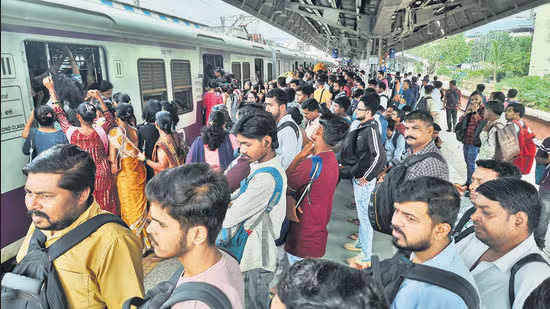
The 10.8-kilometre stretch between Thane and Kalyan is among the busiest rail corridors in the country. Nearly 1,000 local and long-distance trains pass through this section daily, while key stations such as Thane, Diva and Kalyan handle massive passenger interchange. With suburban ridership on the route estimated at over a million commuters every day, even minor disruptions can trigger cascading delays across the network.
To address these challenges, Central Railway has appointed a third-party agency to conduct a Final Location Survey (FLS) for the proposed 7th and 8th rail lines. This detailed survey will determine the exact alignment of the new tracks, identify land availability, and assess engineering requirements, including whether underground construction is feasible in certain stretches.
According to railway officials, preliminary assessments show that while there is limited scope for horizontal expansion along parts of the corridor, space constraints near dense urban pockets—particularly around Dombivli—may necessitate underground solutions. The findings of the FLS are expected by mid-2026, after which a clearer project roadmap will emerge.
The Kalyan–Thane corridor plays a critical role in Mumbai’s rail ecosystem. It is where the main Central Railway line splits toward Kasara and Karjat/Khopoli, and where the trans-harbour corridor connects services to Navi Mumbai and Panvel. Diva station, in particular, has emerged as a major pressure point, with a majority of suburban services halting there. Frequent train stoppages also impact road traffic, as level crossings often remain closed for extended periods during peak hours.
Central Railway officials believe that adding new tracks will help segregate different types of rail traffic. The long-term vision is to create dedicated corridors for suburban trains and outstation services, reducing conflicts between slow, fast, and long-distance trains. This segregation is expected to improve reliability and allow the introduction of more services as demand rises.
The proposed expansion is also linked to broader plans to strengthen rail terminals in Mumbai. Lokmanya Tilak Terminus (LTT) is being upgraded with additional platforms to handle growing outstation traffic, while Parel is being developed as a new rail terminus closer to South Mumbai. Once operational, these facilities are expected to reduce pressure on legacy stations such as Chhatrapati Shivaji Maharaj Terminus (CSMT) and Dadar.
Railway planners say the additional lines between Kalyan, Thane and Parel will create a continuous, high-capacity corridor that supports both suburban mobility and long-distance operations. However, experts caution that such infrastructure projects typically have long gestation periods and require sustained coordination between multiple agencies.
Transport analysts have also highlighted the need for parallel reforms, including smarter train scheduling and the use of advanced technologies to manage traffic more efficiently. They argue that infrastructure expansion must be complemented by operational improvements to ensure that new lines do not simply shift congestion from one section to another.
For millions of daily commuters on the Central Railway network, the proposed 7th and 8th lines represent a potential turning point. While the project is still in the planning stage, it signals a renewed focus on future-proofing Mumbai’s rail system in line with the city’s rapid expansion and evolving travel needs.