
- By Bhawana
- 12 Jan 2026
Youth-Led Walkathon At Worli Signals Growing Citizen Push For Safer Roads In Mumbai
Mumbai: On a crisp Sunday morning, Worli Sea Face transformed into a powerful symbol of civic consciousness as thousands of Mumbaikars stepped out to demand safer roads and better traffic behaviour. The large-scale walkathon, titled ‘Walk for a Cause’, brought together citizens from across age groups, with young participants forming the backbone of the movement.
Organised by the Public Concern for Governance Trust (PCGT), the initiative aimed to go beyond slogans and create real awareness about road discipline, pedestrian rights, and responsible driving—issues that continue to claim thousands of lives every year across Indian cities.
A People’s Movement For Safer Streets
Rather than being a ceremonial event, the walkathon functioned as a public classroom on urban safety. Participants walked along the scenic Worli Sea Face carrying placards that highlighted everyday traffic violations—wrong-side driving, helmet-less riding, reckless lane changes, and the neglect of zebra crossings.
Volunteers interacted with participants to explain how small behavioural changes can significantly reduce road fatalities. The emphasis was on shared responsibility, reminding motorists and pedestrians alike that safer roads are not just the job of traffic police but of every road user.
Youth Participation Stands Out
One of the most striking aspects of the event was the strong presence of young Mumbaikars. Students, early professionals, and youth groups turned up in large numbers, reflecting a growing awareness among younger citizens about civic duties and public safety.
Organisers said the enthusiasm of the youth reinforced the belief that long-term change in traffic culture will come only when the next generation internalises the importance of discipline, patience, and empathy on the road.
Senior Civic Leaders Lend Support
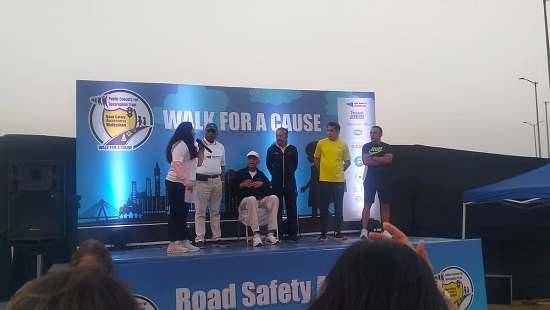
The walkathon also saw participation from senior administrators and eminent citizens, lending institutional weight to the citizen-led initiative. Julio Ribeiro, former Mumbai Police Commissioner and founder-chairman of PCGT, walked alongside participants, interacting with volunteers and stressing the urgent need for stricter adherence to traffic norms.
Mumbai Municipal Commissioner Bhushan Gagrani and industrialist Gautam Singhania were also present, underscoring the importance of collaboration between citizens, civil society, and government bodies in addressing road safety challenges.
Their presence sent a clear message: road safety is not a marginal issue but a core urban governance concern that demands sustained attention.
Grim Reality Of Traffic Behaviour Highlighted
During the event, PCGT volunteers and activists spoke candidly about the everyday traffic violations that have become normalised in Indian cities. Dhanpal Solanki, advocate and PCGT volunteer, highlighted that poor traffic etiquette is a major contributor to India’s alarming road accident statistics.
He pointed out that motorists frequently ignore basic rules such as signalling before changing lanes, stopping at pedestrian crossings, and respecting one-way restrictions. The widespread neglect of helmets and seat belts, he said, reflects a deeper problem of indifference rather than lack of awareness.
“Rules exist, but the culture of following them is weak,” Solanki remarked, adding that unless citizens voluntarily change their mindset, enforcement alone will not be enough.
From Awareness To Commitment
The walkathon concluded with participants taking a formal road safety pledge, committing themselves to follow traffic rules, respect pedestrians, and encourage others to adopt responsible road behaviour. The pledge symbolised a shift from passive awareness to active participation in making Mumbai’s streets safer.
Organisers said such symbolic commitments play a crucial role in reinforcing behavioural change, especially when supported by continuous public engagement and education.
A Step Towards Long-Term Change
PCGT officials noted that the walkathon is part of a broader effort to build sustained dialogue around urban safety. While infrastructure improvements and enforcement remain important, they stressed that behavioural reform is the missing link in India’s road safety framework.
By bringing together citizens, administrators, and public figures on a common platform, the event aimed to create momentum for long-term change rather than one-day visibility.
As Mumbai grapples with rising vehicle numbers and increasingly congested roads, initiatives like the Worli walkathon highlight a growing public demand for safer, more humane streets. The strong turnout suggests that citizens—especially the youth—are ready to take ownership of the city’s traffic culture.
Whether this collective energy translates into lasting change will depend on how consistently awareness efforts are followed up. For now, the walk at Worli has made one thing clear: Mumbai’s roads are no longer just a governance issue—they are a shared civic responsibility.