
- By Bhawana
- 24 Nov 2025
Mumbai’s New 104 Meter Snorkel Set to Redefine High-Rise Firefighting Capabilities
Mumbai’s vertical skyline has grown faster than its emergency infrastructure, creating a widening gap between high-rise construction and rescue readiness. As towers continue to rise past 50 and even 60 floors, the city’s fire and safety systems must evolve in parallel. The Mumbai Fire Brigade’s plan to procure a 104-metre hydraulic platform marks a pivotal shift toward addressing this challenge. Far beyond a routine equipment upgrade, the new snorkel represents a long-term strategic investment in urban safety, operational efficiency, and disaster preparedness.
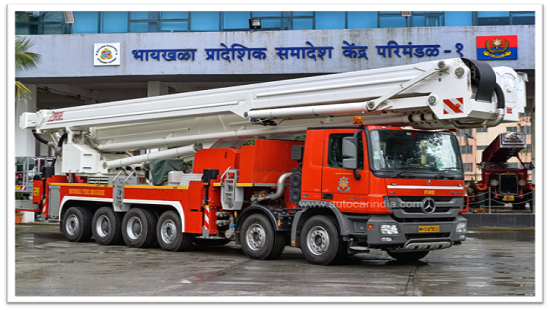
Mumbai currently operates a 90-metre snorkel acquired in 2015. That unit, capable of reaching approximately 30 floors, is equipped with a turntable ladder and elevated water pumps. While it was one of the tallest aerial platforms in Asia at the time of its induction, the city’s rapid vertical expansion has outpaced its reach. With more than 3,000 high-rises above 40 floors across the metropolitan region, the need for extended-reach firefighting equipment has become urgent rather than optional.
The Procurement Vision, A 104-Metre Platform Built for Future Demands
According to the new Mumbai Fire Brigade (MFB) specifications, the incoming 104-metre hydraulic platform will be procured with a two-year guarantee and a five-year Comprehensive Service and Maintenance Contract. The jump from 90 metres to 104 metres may seem incremental on paper, but in practical terms it enables access to buildings exceeding 35 floors, an essential capability in a city where skyscrapers frequently breach the 150-metre height mark.
The well-defined procurement structure reflects the MFB’s shift toward lifecycle-based asset management. Instead of focusing solely on acquisition, the new model ensures consistent operability across the equipment’s most critical years. Firefighting assets are only as valuable as their reliability, and the inclusion of long-term maintenance guarantees operational continuity in peak emergencies.
Ensuring Reliability, How the CSMC Strengthens Long-Term Readiness
The Comprehensive Service and Maintenance Contract extend for five years beyond the initial two-year guarantee period, offering complete technical servicing, component replacement, and performance oversight. This ensures that the equipment remains fully functional through seven years of demanding field use.
In traditional procurement models, fire brigades often face delays when equipment malfunctions and repairs require outsourcing or lengthy approvals. The CSMC bypasses these bottlenecks by mandating rapid, vendor-led maintenance, which reduces downtime and preserves operational readiness. For a city with thousands of fire calls annually, many involving high-rises even for minor incidents, this reliability becomes essential.
In a dense urban environment like Mumbai, where seconds can determine life or death, an uninterrupted service schedule becomes as important as the machine itself. By institutionalizing long-term maintenance, the MFB is future-proofing its high-rise rescue capability while setting a precedent for other Indian metros managing similar vertical risks.
Understanding the Technology, what a Hydraulic Platform Really Does
A hydraulic platform, commonly referred to as a snorkel, is a specialized fire truck equipped with a long, extendable and articulated boom. At the end of this boom is a caged rescue platform capable of carrying firefighters, equipment, and sometimes even victims during evacuation. This design enables responders to access upper floors externally, bypassing interior obstructions, collapsed staircases, or smoke-filled corridors.
The telescopic arm provides both elevation and horizontal outreach, allowing firefighters to position themselves precisely where needed, even if the building’s frontage is narrow or obstructed. Equipped with water monitors, the platform can also deliver high-pressure water streams from above, a critical advantage when interior suppression systems fail.
High-rise fires present unique challenges. Wind patterns change at higher altitudes, fire behaviour becomes more unpredictable, and internal evacuation becomes difficult. Hydraulic platforms counter these variables by offering stable, elevated operating positions. They enable firefighters to attack flames from directions that are otherwise inaccessible, improving control and reducing structural damage.
Why Mumbai Needs Extended Reach, A Changing Urban Landscape
Mumbai’s skyline continues to transform. With residential towers consistently crossing 40 floors and several new developments exceeding 200 metres, vertical safety infrastructure must scale proportionately. Many older buildings lack external refuge areas, advanced sprinkler systems, or compartmentalized designs required under modern safety codes. In such cases, aerial firefighting becomes an indispensable fallback option.
Data from the Mumbai Fire Brigade shows that nearly 70 percent of emergency calls now originate from high-rise structures or densely populated residential clusters. Aerial platforms provide direct access to balconies, terraces, and external ledges where occupants often take shelter during emergencies. Increased reach therefore translates directly into improved survivability.
The new 104-metre snorkel will not replace internal firefighting systems but will complement them by providing an external intervention strategy. This hybrid approach, internal suppression supported by external access, is now considered best practice for vertical cities worldwide.
The Strategic Impact, From Equipment Upgrade to Urban Safety Transformation
The induction of the new snorkel must be viewed not simply as a machinery acquisition but as a strategic shift in Mumbai’s emergency philosophy. It aligns with international trends where fire departments prioritize reach, speed, and multi-directional access to tall structures. As urban density increases, emergency response strategies must pivot from horizontal mobility to vertical capability.
This initiative also enhances inter-agency coordination during large-scale emergencies. Hydraulic platforms are often used in rescue operations, evacuation during structural collapses, and accessing hostile environments such as industrial fires or chemical exposures. Their utility extends far beyond traditional firefighting.
A Forward-Looking Investment for a Vertical Future
The 104-metre hydraulic platform represents more than a numerical upgrade, it symbolizes Mumbai’s readiness to confront the risks associated with its growing vertical identity. By integrating advanced reach, long-term maintenance assurance, and global-standard operational capability, the MFB is strengthening the city’s resilience.
As high-rises continue to shape Mumbai’s horizon, the ability to respond swiftly and effectively to emergencies at extreme heights becomes a core component of urban safety. The new snorkel positions Mumbai not just to catch up with global megacities, but to set a benchmark for high-rise firefighting across India.