
- By Medhavini
- 29 Jun 2026
BMC Expands Mumbai Air Quality Network With Five New Real-Time Monitoring Stations
₹17.5 Crore Project Aims to Improve Pollution Tracking and Public Health Across Mumbai
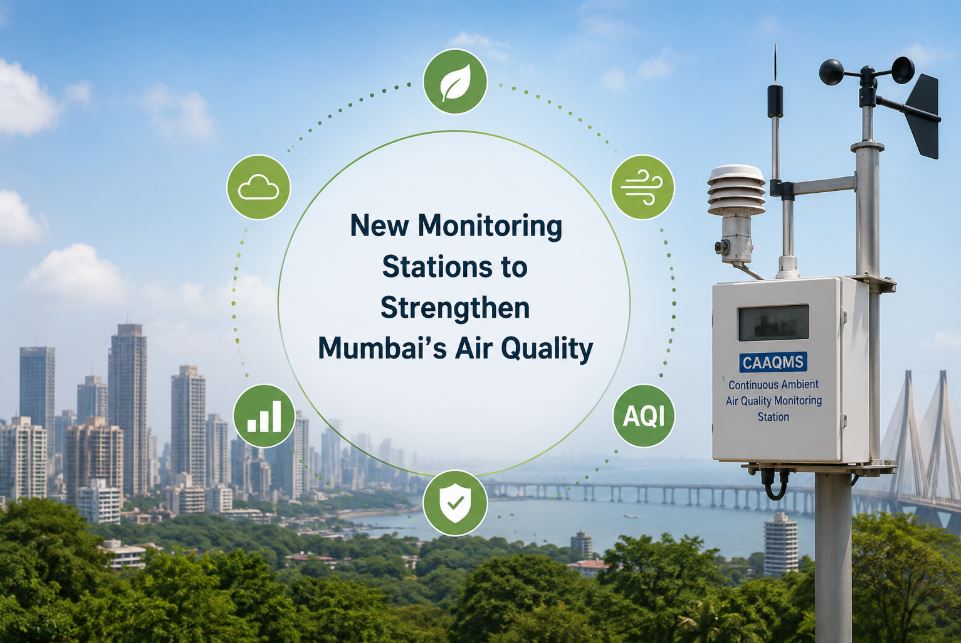
The Brihanmumbai Municipal Corporation (BMC) is expanding Mumbai's air quality monitoring network by installing five new Continuous Ambient Air Quality Monitoring Stations (CAAQMS). The civic body will invest around ₹17.5 crore in the project to strengthen pollution monitoring, improve Air Quality Index (AQI) reporting, and provide residents with accurate real-time environmental data.
The initiative is part of BMC's ongoing efforts to build a cleaner and healthier Mumbai through better pollution management and data-driven decision-making.
Five New Monitoring Stations to Strengthen Mumbai's Air Quality Network
Mumbai currently operates 28 Continuous Ambient Air Quality Monitoring Stations, making it one of India's largest urban air monitoring networks. These stations include:
- 14 managed by the Maharashtra Pollution Control Board (MPCB)
- 9 operated by the Indian Institute of Tropical Meteorology (IITM)
- 5 maintained by the BMC
All existing stations meet the standards set by the Central Pollution Control Board (CPCB) for calibration, quality control, monitoring accuracy, and data validation.
With the addition of five new stations, Mumbai will further improve its ability to measure pollution levels across different parts of the city.
New CAAQMS Locations Across Mumbai
The five new monitoring stations will be installed at carefully selected locations where there is currently no overlap with existing monitoring systems. The selected sites include:
- C.D. Deshmukh Garden, Mulund (East)
- Pramod Mahajan Park, Worli
- Aarey Garden, Chhota Kashmir, Goregaon (East)
- Dr. Babasaheb Ambedkar Recreation Ground, Dahisar (East)
- Assistant Commissioner's Office, Khar (West)
According to BMC officials, these locations will help create a wider and more balanced air quality monitoring network across Mumbai.
Stations Will Monitor Pollution and Weather Conditions Around the Clock
The new automated CAAQMS units will continuously monitor major air pollutants while also recording important weather conditions that affect air quality.
The stations will measure:
- Air pollutant concentrations
- Temperature
- Relative humidity
- Wind speed
- Wind direction
The system will analyze air quality every hour, allowing authorities to detect pollution trends quickly and respond more effectively when air quality worsens.
Real-Time AQI Data Will Be Available for Citizens
One of the biggest benefits of the project is improved public access to air quality information.
Real-time pollution data and the Air Quality Index (AQI) from each station will be published on the official BMC portal. The system will also be integrated with the Central Pollution Control Board (CPCB) server, allowing residents to view live air quality information through the CPCB's Sameer mobile application.
This transparency will help citizens stay informed about daily air quality conditions and take necessary health precautions when pollution levels increase.
Data Will Support Smarter Pollution Control Policies
Officials from BMC's Environment Department said the expanded monitoring network will provide reliable scientific data for assessing pollution across Mumbai.
The improved data collection will help authorities:
- Identify pollution hotspots
- Track changes in air quality over time
- Develop stronger pollution control strategies
- Support evidence-based environmental policies
The project also includes a three-year warranty along with five years of maintenance, ensuring long-term reliability and uninterrupted monitoring services.
Mumbai Moves Toward Cleaner Air With Better Monitoring
By expanding its Continuous Ambient Air Quality Monitoring Station network, BMC is taking another important step toward improving Mumbai's environmental management. Better monitoring, wider coverage, and real-time public access to pollution data will help both policymakers and residents make informed decisions, supporting the city's long-term goal of cleaner air and improved public health.