
- By Hitesh
- 18 Apr 2026
Motilal Nagar Redevelopment: IAS Sanjeev Jaiswal Unveils 143-Acre Master Plan in Line with CM Devendra Fadnavis’s Vision; Adani Group Partners MHADA
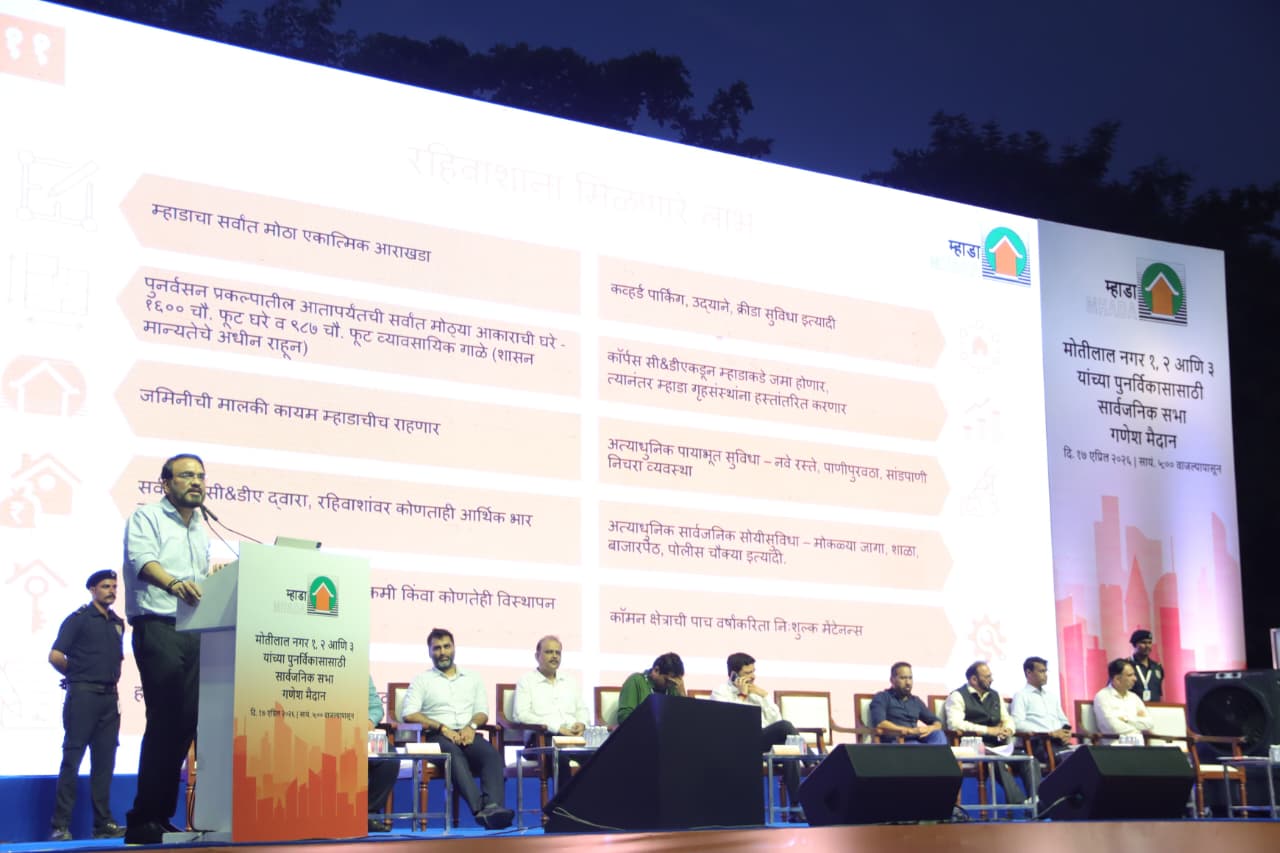
Mumbai is set to witness a transformative phase in urban development as the Maharashtra Housing and Area Development Authority (MHADA) unveils the master plan for the redevelopment of Motilal Nagar in Goregaon. Envisioned as one of India’s largest urban renewal initiatives, the project brings together scale, planning innovation, and public-private collaboration to reshape one of the city’s key residential clusters.
The master plan was presented by IAS Sanjeev Jaiswal, CEO of MHADA, marking a major milestone in the long-pending redevelopment of Motilal Nagar. The initiative has received strong policy backing from Chief Minister Devendra Fadnavis and Deputy Chief Minister Eknath Shinde, reflecting the state government’s commitment to accelerating large-scale housing and infrastructure transformation in Mumbai.
One of India’s Largest Urban Renewal Projects
Spread across nearly 143 acres in Goregaon, the Motilal Nagar redevelopment covers Motilal Nagar 1, 2, and 3, housing clusters originally developed in the 1960s. Over time, these areas have faced structural ageing and infrastructure challenges, necessitating a comprehensive redevelopment approach.
The project is being implemented under the Construction and Development Agency (C&DA) model, with the Adani Group appointed as the private redevelopment partner. Despite this collaboration, MHADA will retain full ownership and control over the land, ensuring that public interest remains central to all aspects of development.
Flexible Planning with Resident Participation
Officials have clarified that while the master plan has largely been approved, there is room for modifications based on suggestions from local residents. This flexibility reflects a more participatory approach to urban planning, where community inputs are considered integral to project success.
The state government has emphasised that rehabilitation will remain the top priority, with MHADA taking full responsibility for all eligible residents across the three Motilal Nagar clusters.
Vision of a ‘15-Minute City’
A defining feature of the redevelopment is its adoption of the “15-minute city” concept. The plan aims to ensure that essential services, such as schools, healthcare facilities, markets, and recreational spaces, are accessible within a short walking distance.
To ensure high standards in planning and execution, reputed institutions such as IIT Bombay and VJTI have been brought on board. Their involvement underscores the project’s focus on quality, sustainability, and efficient urban design.
Improved Housing and Living Standards
The redevelopment proposes mid-rise residential buildings, typically up to eight floors, ensuring a balanced approach to density and livability. Eligible residents will be provided with modern rehabilitation units, including 2BHK flats of around 800 sq ft.
These homes are being designed with improved ventilation, better natural lighting, and enhanced safety features such as multiple elevators and modern infrastructure. Additionally, there is a strong push to offer larger rehabilitation units, with some extending up to 1,600 sq ft carpet area, significantly upgrading living conditions.
Strong Regulatory Framework and Public Control
MHADA has reiterated that land ownership will remain with the authority, and will not be transferred to the private developer. The agency will oversee approvals, supervise development, and manage allotments and entitlements.
Strict safeguards have been built into the framework. The developer cannot involve third parties without MHADA’s approval, nor can the land be mortgaged. Even sale and rental components will require prior clearance, ensuring transparency and accountability throughout the project lifecycle.
Addressing Legacy Infrastructure Challenges
The redevelopment directly addresses long-standing civic issues in Motilal Nagar. Many of the existing buildings, constructed in the 1960s, have exceeded their structural lifespan. The area has also faced inadequate infrastructure, substandard road networks, unauthorised constructions, and frequent waterlogging due to its low-lying geography.
The new plan incorporates solutions such as improved drainage systems, upgraded road layouts, and enhanced water supply infrastructure, aiming to create a more resilient urban environment.
Inclusive Development with SRA Integration
The project also integrates Slum Rehabilitation Authority (SRA) provisions, with around 1,600 slum dwellers to be rehabilitated within the redevelopment. Authorities have stressed that efforts are being made to ensure minimal displacement, with residents being accommodated within Motilal Nagar itself.
Post redevelopment, the land will be leased back to housing societies, providing long-term security for residents. Occupation certificates will also be linked proportionately to rehabilitation progress, ensuring that resident interests remain safeguarded.
Sustainable Urban Design and Green Spaces
A key component of the plan is its emphasis on sustainability and open spaces. Nearly 15 acres of green areas have been incorporated, along with continuous open spaces and well-planned rehabilitation clusters.
Modern infrastructure features will include sewage treatment plants, rainwater harvesting systems, solar energy integration, and smart security solutions. These elements align with the broader “live, work, and play” philosophy, promoting a balanced and sustainable urban lifestyle.
Timeline and Future Outlook
Officials estimate that the project will take over seven years to complete, although timelines may extend given the scale and complexity. Additional Floor Space Index (FSI) generated under the project will be shared between MHADA and the developer, further strengthening its financial and operational framework.
At a broader level, MHADA’s leadership has also called for a re-evaluation of the in-situ slum rehabilitation model, identifying it as a gap in current urban planning that needs to be addressed, particularly in the context of large-scale redevelopment.
A New Benchmark for Urban Transformation
The Motilal Nagar redevelopment represents a significant step forward in Mumbai’s journey toward planned, inclusive, and sustainable urban growth. By combining strong governance, private sector expertise, and community-focused planning, the project sets a new benchmark for how large-scale redevelopment can be executed effectively.
As the project progresses, it is expected to not only transform Motilal Nagar but also serve as a model for future urban renewal initiatives across Mumbai and other metropolitan regions in India.