
- By Medhavini
- 15 Jan 2026
MHADA’s Unsold Homes Puzzle: How IAS Sanjeev Jaiswal Is Rewriting the Strategy to Unlock Thousands of Vacant Flats
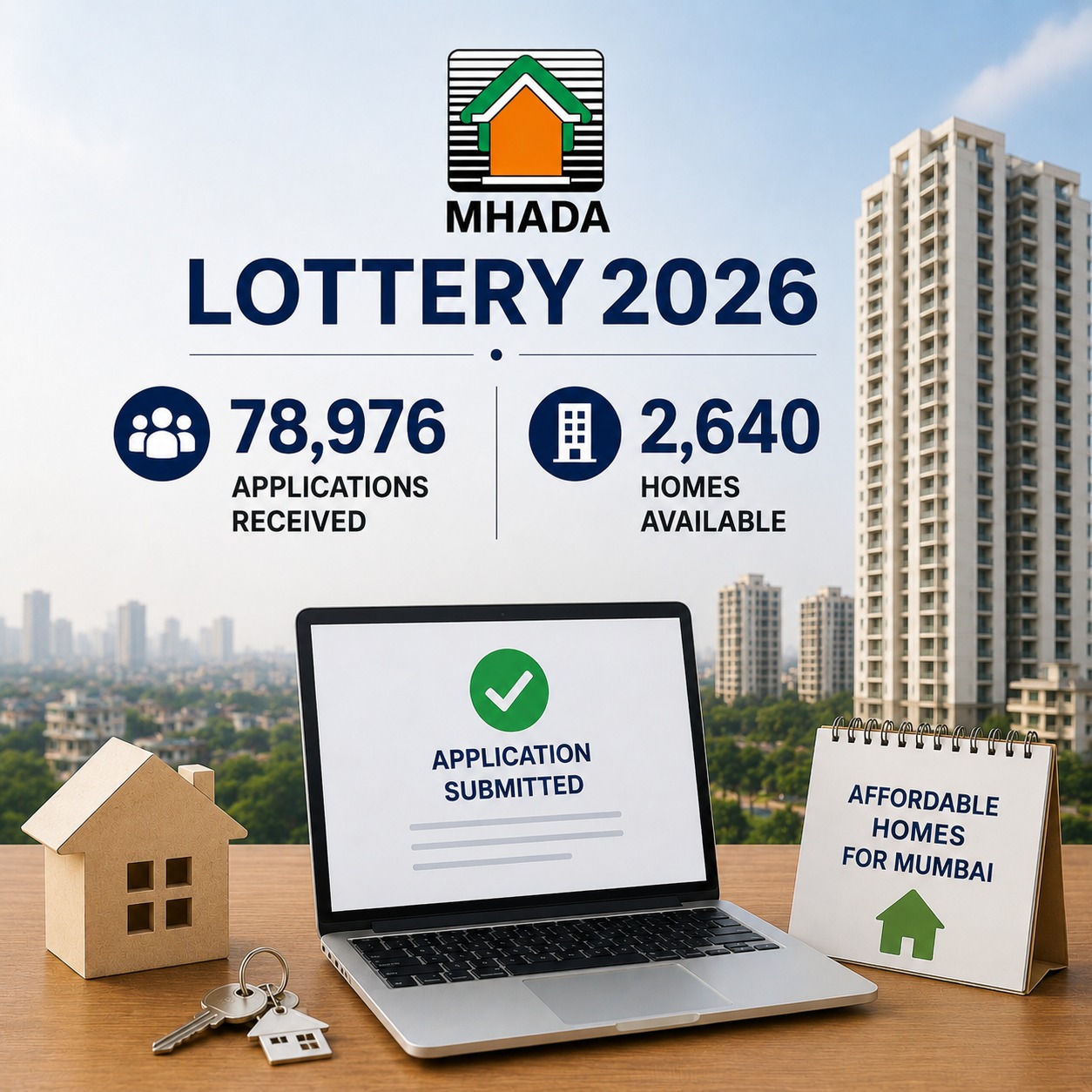
For decades, a MHADA lottery win symbolised access to affordable housing in Mumbai’s unforgiving real estate market. Today, however, the challenge has evolved. Under the leadership of IAS Sanjeev Jaiswal, MHADA is confronting a new reality head-on: thousands of completed homes across the Mumbai Metropolitan Region remain unsold, not due to lack of demand, but due to a misalignment between pricing, location, and buyer expectations.
Rather than viewing this as a failure, MHADA is now treating it as a structural correction moment. A new sales and pricing strategy is being prepared to unlock nearly 14,000 vacant homes, primarily under the Konkan Board, and convert stalled inventory into active housing supply.
Why Are MHADA Homes Lying Unsold?
The reasons are layered, not ideological.
In recent MHADA lotteries, particularly across Virar–Bolinj, Kalyan–Dombivli, and other Konkan Mandal locations, a significant number of successful applicants chose to surrender their allotted homes. The reasons are consistent:
- Rising base prices, which in some cases matched or exceeded nearby private developments
- Smaller carpet areas, especially in MIG and HIG categories
- Distance from core transport nodes, such as railway stations or employment hubs
- Perception gaps around amenities compared to private housing projects
As a result, vacancy levels in the Konkan Board alone have crossed 14,000 units, including homes under both MHADA Housing Schemes and the Pradhan Mantri Awas Yojana (PMAY).
This has led to a less visible but serious issue: locked public capital. Unsold houses mean ongoing maintenance costs, idle assets, and delayed recycling of funds into new affordable housing projects.
A Strategic Pivot, Not a Fire Sale
Under IAS Sanjeev Jaiswal’s leadership, MHADA’s response has been deliberate, not reactive.
Instead of distress sales or ad-hoc discounts, MHADA is preparing a structured marketing and pricing reset. The objective is simple: sell existing inventory within the next year while preserving institutional credibility and public value.
Key elements under consideration include:
- Revisiting price structures, especially for MIG and HIG units
- Simplifying the sales process, potentially moving beyond lottery-only formats
- Exploring direct sale or hybrid allotment mechanisms where feasible
- Partnering with financial institutions to ease home loan access for applicants
This is not about abandoning the lottery model, but about matching supply with real demand patterns.
Understanding the Demand-Supply Mismatch
Mumbai’s housing problem is often described as a shortage. In reality, it is a distribution challenge.
Demand remains strong in the Thane belt, Navi Mumbai, and closer suburban zones, while some peripheral locations struggle to attract buyers despite affordability. At the same time, buyers today are more informed. They compare MHADA prices with private developers, factor in commute time, and expect baseline amenities.
MHADA’s evolving strategy recognises this behavioural shift. Housing policy can no longer rely on historical demand assumptions. It must respond to how people live, work, and commute today.
Why This Correction Matters for Public Housing
The implications go beyond selling unsold flats.
Every MHADA home sold frees up capital for:
- Repairs and redevelopment of old cessed buildings
- New affordable housing projects
- Faster implementation of urban renewal schemes
From a governance lens, this is about capital efficiency in public housing, not just occupancy.
By addressing unsold inventory transparently and strategically, MHADA strengthens its balance sheet and restores confidence among applicants who look to the authority as a long-term housing partner.
What Applicants Should Do Now
For prospective buyers, the coming months could present meaningful opportunities.
MHADA is expected to officially announce changes through verified MHADA channels only. Applicants should:
- Track updates on MHADA’s official website
- Avoid speculative information
- Evaluate locations, connectivity, and financing options carefully
A recalibrated sales approach could make previously overlooked projects more viable for first-time buyers.
Conclusion: A Necessary Reset in Mumbai’s Housing Story
Housing policy, like markets, must evolve. The presence of unsold MHADA homes is not a sign of failure, but a signal that recalibration was overdue.
Under IAS Sanjeev Jaiswal, MHADA is responding with data, discipline, and intent. By aligning pricing, location realities, and buyer expectations, the authority is working to convert vacant stock into lived homes and locked funds into active development capital.
In a city where every affordable home matters, this reset may prove to be one of MHADA’s most important course corrections yet.