
- By Diya Sogani
- 19 Feb 2026
Maharashtra Unveils 1,000+ Urban Climate Projects, Rolls Out Finance Strategy to Back $1 Trillion Economy Vision
Mumbai: In a major policy push linking sustainability with economic ambition, the Government of Maharashtra has announced an expansive pipeline of over 1,000 urban climate action projects across 44 cities under the AMRUT mission, alongside a comprehensive Climate Finance Access and Mobilisation Strategy (CFAMS).
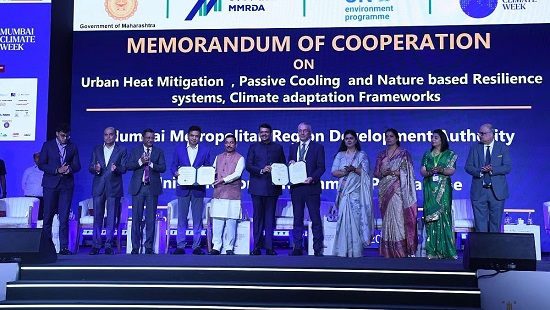
The announcement was made during Mumbai Climate Week by the state’s Department of Environment and Climate Change in collaboration with WRI India.
Officials said the twin initiatives aim to embed climate resilience at the core of Maharashtra’s growth roadmap, even as the state works toward becoming a $1 trillion economy by 2027–28.
From Climate Planning to Implementation
The large-scale project pipeline has been developed under the Climate Forward Maharashtra initiative and builds on the City Climate Action Accelerator launched in 2023. Now entering Phase 2, the accelerator is focused on transforming city-level climate plans into bankable, scalable, and measurable projects.
The initiative covers 44 cities under the Atal Mission for Rejuvenation and Urban Transformation (AMRUT), marking one of the most extensive coordinated urban climate efforts undertaken by an Indian state.
Projects have been categorised based on sector, city readiness, and financing potential — enabling faster execution and improved investor engagement.
Six Key Sectors Targeted
The 1,000+ projects span six high-impact sectors central to urban sustainability:
- Urban greening and heat mitigation
- Air quality management
- Water resource conservation
- Solid waste management
- Energy-efficient buildings
- Sustainable mobility systems
Together, these sectors aim to enhance climate resilience, reduce emissions, and improve quality of life in Maharashtra’s rapidly urbanising regions.
Climate Finance Strategy to Mobilise ₹3 Lakh Crore
Alongside the project pipeline, Maharashtra unveiled its Climate Finance Access and Mobilisation Strategy (CFAMS), developed by the State Climate Action Cell with support from WRI India and the Maharashtra Institution for Transformation (MITRA).
The strategy is designed to identify and channel funding for climate initiatives across departments, aligning financial planning with the Maharashtra State Action Plan on Climate Change (SAPCC 2.0) and the long-term vision document “Viksit Maharashtra 2047.”
Officials estimate that approximately ₹3 lakh crore will be required between 2024 and 2030 to fully implement the revised climate action plan.
Beyond Public Funding
State leaders acknowledged that public expenditure alone will be insufficient to meet climate financing needs.
To improve transparency and attract private investment, Maharashtra also announced the development of a Climate Finance Dashboard — a digital platform that will track climate-related spending, support policy decisions, and help tap into capital markets.
Praveen Pardeshi, CEO of MITRA and Chief Economic Adviser to the Chief Minister, said climate action must be treated as an economic growth driver rather than merely an environmental obligation.
Aligning Growth with Sustainability
The initiatives are aligned with the broader national vision of Viksit Bharat 2047, which seeks to transform India into a developed nation by its centenary year of independence.
By integrating climate resilience into infrastructure planning, industrial growth, and urban governance, Maharashtra is positioning itself as a national model for low-carbon development that balances economic expansion with environmental responsibility.
Officials described the 1,000+ project pipeline as a structural shift — from fragmented planning to an investment-ready, coordinated climate infrastructure framework.