
- By Diya Sogani
- 10 Jul 2026
Central Railway Activates KAVACH Safety System on Solapur–Wadi Route to Strengthen Train Safety and Prevent Collisions
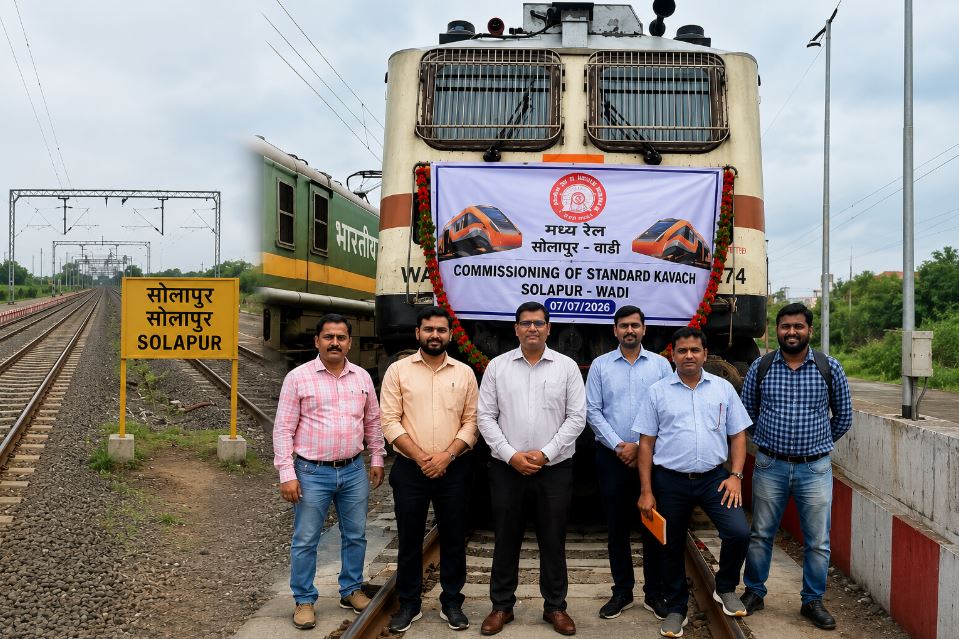
The Central Railway has taken another major step toward improving railway safety by commissioning the indigenous Standard KAVACH safety system on the 149.476-kilometer Solapur–Wadi rail section in Maharashtra. This is the first time the advanced Automatic Train Protection (ATP) system has been introduced in the Solapur Division, marking an important milestone in Indian Railways' ongoing modernization and safety initiatives.
The newly activated KAVACH system is designed to significantly reduce the risk of train collisions by continuously monitoring train movements and automatically taking corrective action whenever required. Railway officials believe the technology will improve the overall safety, reliability, and efficiency of both passenger and freight services operating on this important route.
What Is the KAVACH Safety System?
KAVACH is an indigenously developed Automatic Train Protection (ATP) system created under the Government of India's Atmanirbhar Bharat initiative. Developed with support from the Research Designs and Standards Organisation (RDSO) and Indian Railways, the technology has been introduced as a cost-effective and reliable solution to improve railway safety across the country.
The system is built to prevent both head-on and rear-end train collisions by continuously tracking train locations and speeds. If a potential danger is detected, KAVACH can automatically apply the train's brakes, even if the locomotive pilot does not respond in time.
Apart from collision prevention, the system also improves emergency communication. If a train comes to an unexpected stop within a block section, KAVACH automatically generates an SOS alert. In emergency situations, locomotive pilots can also manually send SOS messages, allowing railway control centers and nearby trains to respond quickly.
Real-Time Communication Improves Operational Safety
Unlike earlier signaling-based protection systems, the Standard KAVACH platform operates through continuous communication between KAVACH-equipped locomotives and trackside equipment. The system uses Radio Frequency Identification (RFID) technology to accurately identify train locations and monitor movement in real time.
This constant exchange of information enables the railway network to respond immediately to operational risks, improving both safety and train management.
More Than 1,200 RFID Tags Installed on the Route
To implement the project successfully, the Signal and Telecommunication Department of the Solapur Division installed and programmed 1,234 RFID tags along the Solapur–Wadi section.
Before the system became operational, it underwent extensive testing and validation under the standards established by the Research Designs and Standards Organisation (RDSO). Engineers carried out multiple field trials, including simulated head-on collision scenarios, rear-end collision prevention tests, and emergency SOS alert verification under different operating conditions.
Only after successfully meeting all required safety and performance standards was the system approved for commissioning.
Boost for Passenger and Freight Rail Services
Railway officials said the commissioning of the Standard KAVACH system represents a significant achievement in the Solapur Division's modernization program. The technology is expected to improve operational reliability, minimize accident risks, and support smoother train operations across the corridor.
The safety upgrade benefits both passenger and freight services by providing an additional layer of automated protection while helping railway operators respond more efficiently during emergencies.
Part of Indian Railways' Nationwide Safety Modernization
The Solapur–Wadi commissioning is part of Indian Railways' larger plan to expand KAVACH technology across key rail corridors nationwide. In recent years, the Ministry of Railways has accelerated the deployment of indigenous safety systems to strengthen operational safety, reduce human error, and build a smarter railway network.
With KAVACH being introduced on more routes, Indian Railways aims to improve train safety standards while supporting faster, more reliable, and technology-driven rail operations for millions of passengers and businesses across the country.