
- By Diya Sogani
- 28 Aug 2025
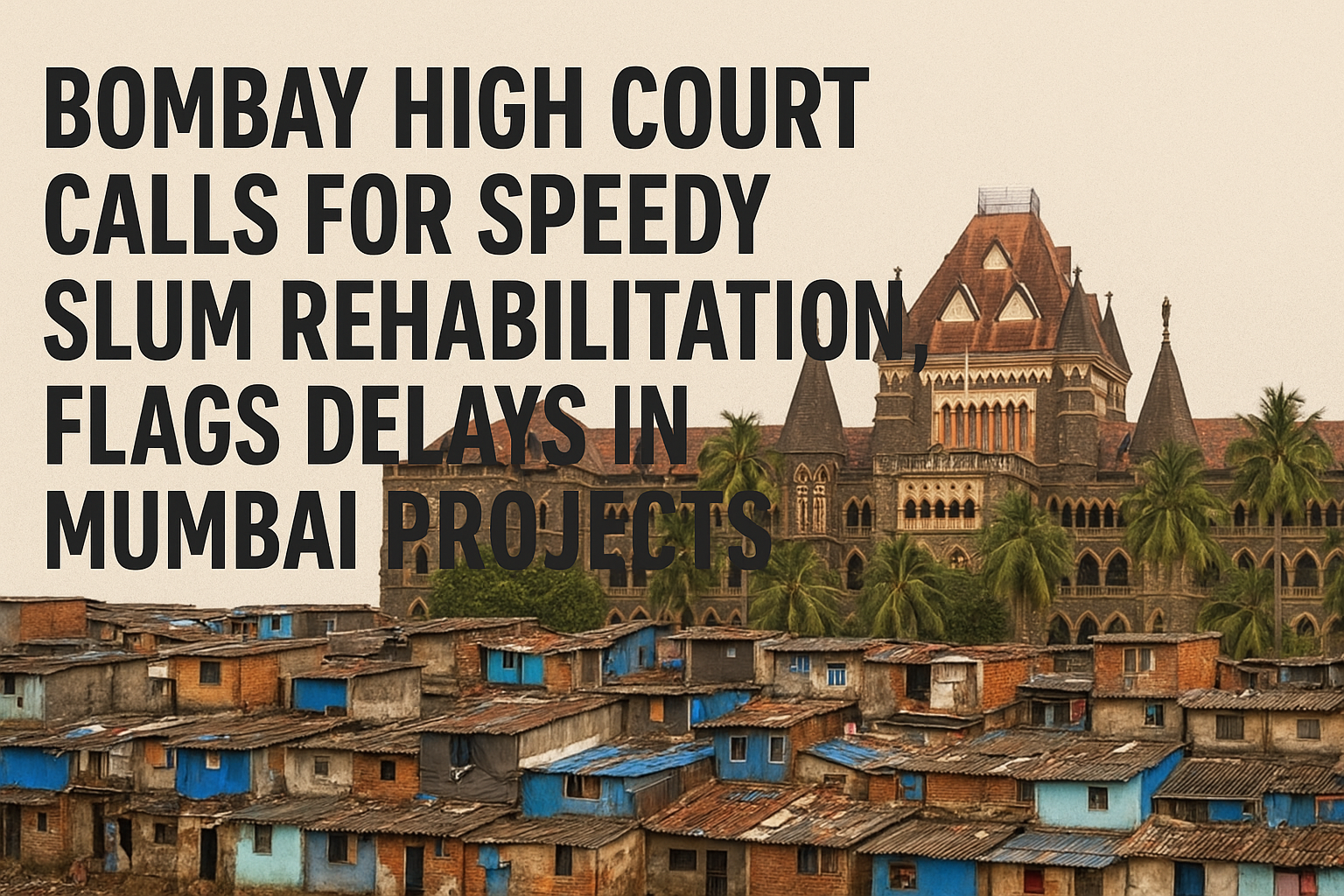
Bombay High Court Calls for Speedy Slum Rehabilitation, Flags Delays in Mumbai Projects
Mumbai: The Bombay High Court has expressed serious concern over the slow pace of slum rehabilitation projects in the city and directed the Slum Rehabilitation Authority (SRA) to accelerate its work. The court stressed that unnecessary delays not only stall redevelopment projects but also compromise the very objective of the Slum Rehabilitation Scheme, which is to provide safe and permanent housing for slum dwellers.
The Division Bench of Justice G. S. Kulkarni and Justice Arif S. Doctor was reviewing a case concerning a slum rehabilitation initiative in Vile Parle when it issued the directive. The judges underlined that statutory procedures must be strictly followed and that any disruption caused by external interference jeopardizes the rights of slum residents who continue to wait for secure housing.
Petitioners Raise Concerns of Delays
The matter came up after petitioners pointed out that despite receiving necessary approvals, the redevelopment project had been hindered. They alleged that objections from rival developers and interference by political interests were preventing the project from moving forward.
The petitioners argued that crucial permissions such as Letters of Intent (LOI) and Intent of Approval (IOA) were already in place and had been endorsed by higher courts. Yet, the lack of timely action from the statutory authority meant that essential steps like the release of commencement certificates and eviction orders were not being implemented. This, they said, left the project in limbo and caused prolonged uncertainty for residents.
Court Criticises Authorities for Inaction
In its observations, the court came down heavily on the statutory authorities for failing to carry out their responsibilities. The Bench noted that the role of the Slum Rehabilitation Authority is not merely procedural but central to ensuring the welfare of slum dwellers.
“The very purpose of the Slum Rehabilitation Scheme is welfare-oriented, aiming to provide safe housing and improved living conditions for slum residents. Any delay or failure by authorities in implementing this vision defeats the scheme’s objective,” the court observed.
The judges also remarked that authorities appeared to be favoring competing developers instead of prioritizing the welfare of slum residents. Such practices, the court stated, reflected poorly on the statutory body tasked with overseeing redevelopment projects.
Six-Week Deadline for Authorities
To break the deadlock, the court directed the SRA and other concerned authorities to complete the necessary documentation within six weeks. It also instructed them to release the commencement certificate for the rehabilitation portion of the project without further delay. Additionally, eviction orders were to be issued and implemented to prevent outside parties from obstructing the redevelopment process.
By setting a clear timeline, the court underscored the urgency of the matter, reiterating that housing rights of slum dwellers should not be compromised because of bureaucratic inaction or external pressures.
Importance of Strict Legal Adherence
The judgment highlights the importance of strict adherence to legal and statutory frameworks in slum redevelopment programs. The court noted that when authorities fail to exercise their powers in a fair and timely manner, the very purpose of the statute is compromised.
Slum rehabilitation, the Bench stressed, is not merely a development activity but a welfare initiative aimed at improving the quality of life for some of the most vulnerable citizens. Political interference and delays caused by competing developer interests only serve to stall progress and prolong the hardships faced by residents.
Broader Implications for Mumbai
The Bombay High Court’s observations are significant given the scale of slum rehabilitation projects across Mumbai. The city is home to some of India’s largest slum clusters, and redevelopment initiatives have long been touted as a solution to both housing shortages and urban renewal. However, such projects are frequently delayed due to legal disputes, opposition from developers, and lack of timely clearances from authorities.
This ruling serves as a reminder that the welfare of slum residents must remain at the heart of rehabilitation efforts. It also places renewed pressure on the Slum Rehabilitation Authority to streamline its functioning and ensure that projects move forward without unnecessary hurdles.
Conclusion
By directing the authorities to act within a fixed timeframe, the Bombay High Court has sent a strong message about accountability and efficiency in slum rehabilitation. The ruling emphasizes that statutory bodies must fulfill their roles responsibly and without undue influence from external forces.
For thousands of families in Mumbai waiting for proper housing under redevelopment schemes, the decision offers a glimmer of hope that long-stalled projects may finally see progress.