



- By Medhavini
- 14 Jul 2026
Maharashtra to Redevelop MSRTC Bus Depots Under PPP Model; CM Devendra Fadnavis Pushes Revenue-Driven Growth Strategy
Depot-Wise Redevelopment Plan Aims to Strengthen MSRTC Finances While Keeping Land Ownership With the Corporation
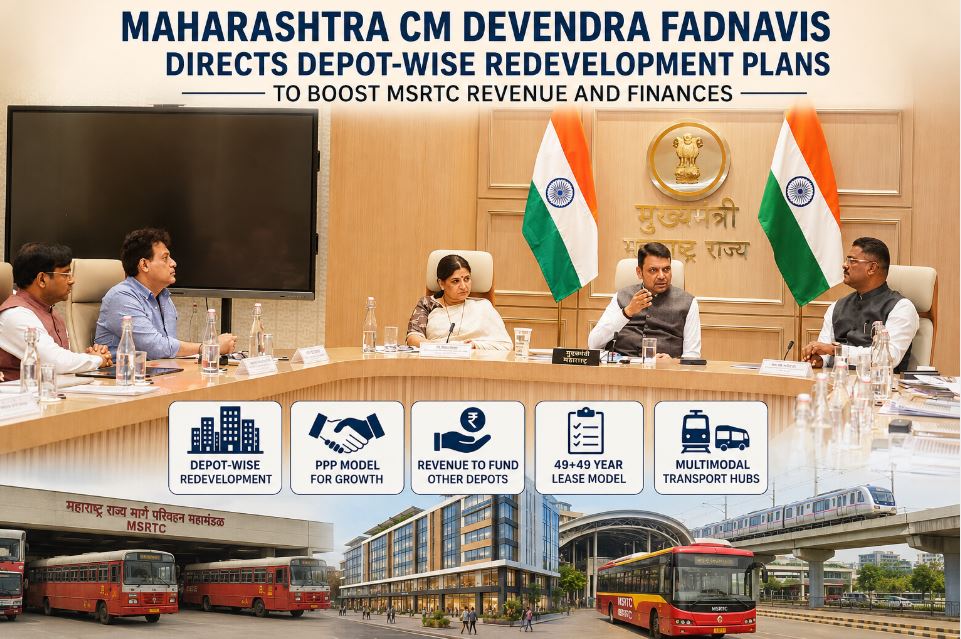
The Maharashtra government is preparing a major redevelopment strategy for the Maharashtra State Road Transport Corporation (MSRTC), with Chief Minister Devendra Fadnavis directing officials to create depot-wise plans that can unlock commercial value, improve passenger facilities, and generate long-term revenue for the state-run transport corporation.
During a high-level review meeting held at his official residence, Varsha, the Chief Minister instructed the Transport Department to move away from a one-size-fits-all redevelopment approach. Instead, each MSRTC bus depot will be evaluated individually based on its commercial potential, location, and development opportunities.
The initiative is expected to improve MSRTC's financial position while modernizing transport infrastructure across Maharashtra.
Each MSRTC Depot Will Get a Customized Redevelopment Plan
Chief Minister Devendra Fadnavis emphasized that every bus depot has different development potential. Depots located in high-demand urban areas may support commercial complexes, office spaces, retail outlets, or mixed-use developments, while smaller depots may require a different redevelopment strategy.
Officials have been directed to prepare detailed redevelopment plans for every depot, ensuring that investments match local market demand and passenger requirements instead of following a uniform model statewide.
The government believes this location-specific planning will help maximize revenue from valuable MSRTC land assets while improving public transport infrastructure.
Government to Expand Public-Private Partnership (PPP) Model
To speed up redevelopment, the Chief Minister asked the Transport Department to prepare a comprehensive Public-Private Partnership (PPP) policy for Cabinet approval.
The proposed policy will define how private developers can participate in redeveloping MSRTC properties while ensuring that public ownership remains protected.
Officials have also been instructed to examine possible incentives for developers, including financial and regulatory support, to attract greater private investment into transport infrastructure projects.
PPP-based redevelopment has already been used successfully in several public infrastructure projects across India, making it a practical model for modernizing government-owned assets without placing the full financial burden on the state.
Revenue From Profitable Projects Will Support Other Depots
One of the key features of the redevelopment strategy is the creation of an escrow mechanism for project revenue.
According to the Chief Minister's directions, earnings generated from commercially successful depot redevelopment projects will be deposited into an escrow account. These funds will then be used to finance redevelopment work at other MSRTC depots that may not have strong commercial potential but still require modernization.
This cross-funding approach is designed to ensure balanced development across the state's transport network rather than concentrating investment only in high-value urban locations.
MSRTC Will Retain Ownership of Its Land
The Maharashtra government has made it clear that ownership of MSRTC land will remain with the corporation throughout the redevelopment process.
Instead of selling land, the government is considering a long-term lease structure of 49 years with an additional 49-year extension option. This model would allow private developers to invest in commercial projects while ensuring that ownership of valuable public land stays with MSRTC.
Officials have also been asked to study the legal feasibility of offering stamp duty concessions to make redevelopment projects more financially attractive for investors.
Focus on Integrated Transport Hubs Across Maharashtra
Beyond commercial redevelopment, Chief Minister Devendra Fadnavis also highlighted the importance of improving urban mobility.
He directed officials to develop multimodal transport hubs by integrating MSRTC bus depots with Metro rail systems and other public transportation networks wherever possible.
Such integrated transport hubs can reduce travel time, improve passenger convenience, and encourage greater use of public transportation by providing smoother connections between different travel modes.
Urban transport experts have increasingly supported multimodal connectivity as an effective way to reduce traffic congestion and improve commuter experiences in rapidly growing cities.
Senior Officials Review Future Roadmap
The review meeting was attended by several senior government officials, including Transport Minister Pratap Sarnaik, Minister of State Madhuri Misal, Additional Chief Secretaries Sanjay Sethi, O.P. Gupta, and Vikas Chandra Rastogi, Planning Department Secretary A. Shaila, along with MSRTC Vice-Chairman and Managing Director Dr. Madhav Kusekar.
The participation of senior policymakers indicates that the redevelopment program is expected to become an important part of Maharashtra's broader infrastructure and public transport modernization strategy.
Why This Redevelopment Plan Matters
MSRTC operates one of India's largest public bus transport networks, connecting cities, towns, and rural communities across Maharashtra. However, like many state transport corporations, it has faced financial challenges for years due to rising operational costs and infrastructure maintenance requirements.
By monetizing underutilized land assets through carefully planned commercial redevelopment while preserving public ownership, the Maharashtra government hopes to create a sustainable revenue source that strengthens MSRTC's finances without compromising its public service mission.
If implemented successfully, the depot-wise redevelopment model could modernize bus terminals, improve commuter facilities, generate recurring revenue, and create integrated transport hubs that support Maharashtra's growing urban infrastructure needs.