



- By Mahesh
- 02 Jun 2026
Mumbai Water Crisis Deepens: Tanker Demand Surges As Lake Levels Fall Below 18% Amid Ongoing Supply Cuts
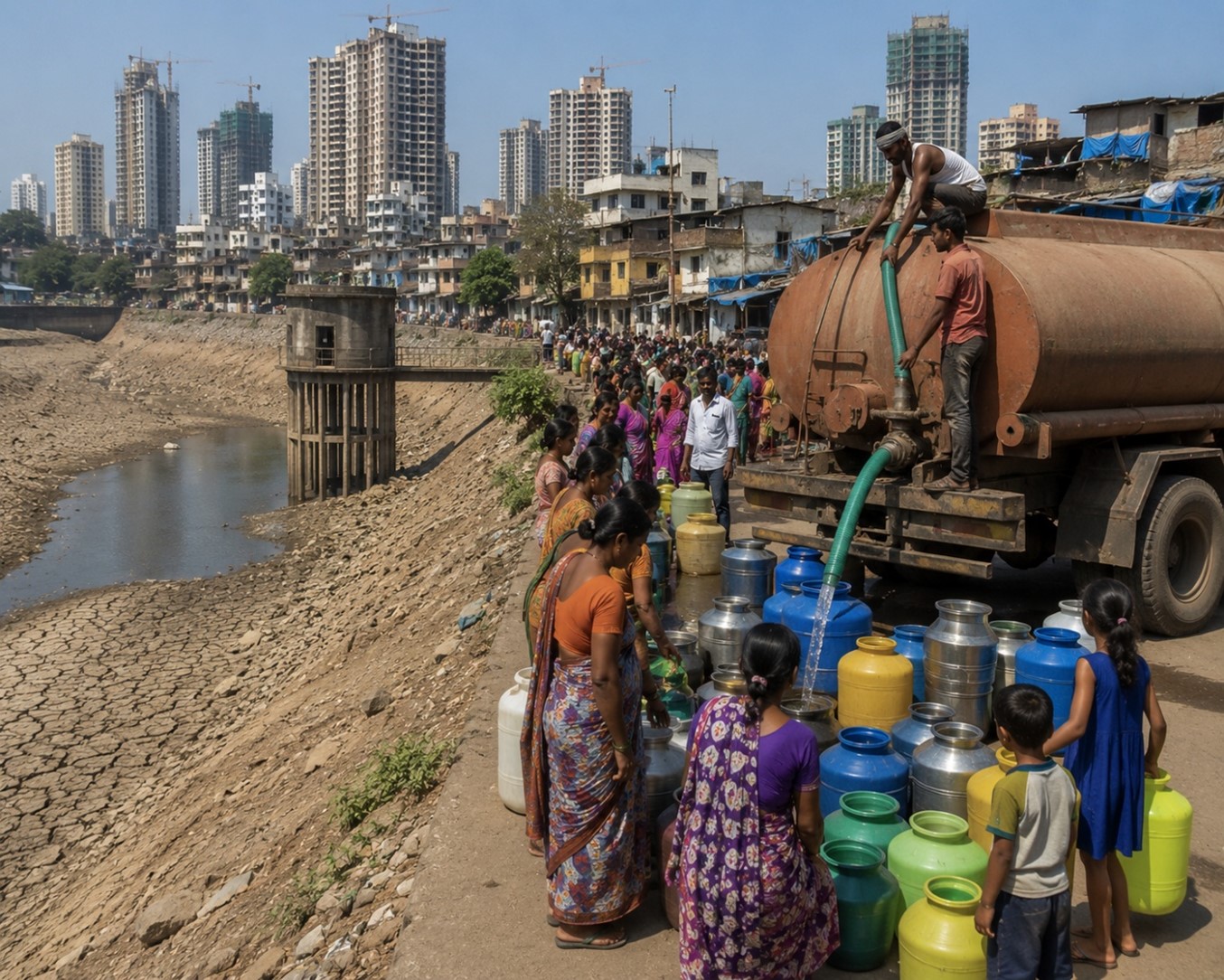
Mumbai’s water crisis is intensifying as lake storage levels supplying the city have dropped to just 17.85 per cent, forcing residents across several areas to increasingly depend on expensive private water tankers amid ongoing supply cuts and delayed monsoon rains.
With water cuts ranging between 10 per cent and 15 per cent in multiple parts of the city, the demand for tanker water has sharply increased over the past few weeks, placing additional financial pressure on housing societies and households already dealing with rising living costs.
Mumbai Residents Across Mumbai Facing Severe Water Shortages
Several localities including Mahim, Jogeshwari, Vikhroli and Govandi have been facing severe water shortages due to reduced municipal supply.
Residents say irregular BMC water distribution has left them with little option but to rely on private water tankers for daily needs.
“We have no choice but to call tankers now because the regular supply has reduced drastically,” said a resident from Govandi, highlighting the growing dependence on private suppliers across several housing colonies.
The crisis has particularly impacted lower and middle-income families, many of whom are struggling to manage additional water expenses every week.
Water Tanker Prices Rise Sharply Amid Diesel Hike
The rising demand for tanker services, coupled with increasing diesel prices, has significantly pushed up water tanker costs across Mumbai.
A 3,000-litre tanker that earlier cost around ₹900 is now being supplied at nearly ₹1,100 for borewell water.
Similarly, drinking water tankers with 2,000-litre capacity have become around ₹200 more expensive compared to previous rates.
Depending on distance, traffic conditions and location, a 5,000-litre drinking water tanker can now cost anywhere between ₹1,500 and ₹3,200 in several parts of the city.
Suppliers say longer travel times due to heavy traffic are also increasing operational costs and delaying deliveries.
Mumbai’s Lake Storage Continues To Remain Under Pressure
According to civic data, Mumbai’s seven lakes currently hold only 17.85 per cent of their total water storage capacity.
The city requires nearly 4,300 million litres of water every day, while the Brihanmumbai Municipal Corporation (BMC) is currently able to supply around 3,850 million litres.
Officials continue to closely monitor water levels as the city waits for the arrival of the southwest monsoon.
The situation has become more concerning due to weak rainfall activity and increasing summer demand across residential and commercial areas.
Housing Societies Spending Lakhs On Water Supply
Several housing societies across Mumbai are reportedly spending lakhs of rupees annually on private tanker services to manage daily water requirements.
Although most registered societies are connected to the BMC network, many receive supply only for limited hours during the day, increasing dependence on external sources.
Residents also report frequent delays in tanker availability because of extremely high citywide demand.
Water suppliers say they are struggling to source sufficient water from borewells and other supply points to meet the growing requirement.
Leakages, Evaporation And Wastage Adding To Crisis
Experts say Mumbai’s water stress is also being worsened by infrastructure-related losses.
A significant quantity of water is reportedly wasted through old leaking pipelines, cleaning operations and reservoir evaporation.
Officials estimate that nearly 8 to 10 per cent of stored reservoir water is lost due to evaporation alone.
Civic authorities believe that improving water conservation systems and reducing leakages could help ease pressure during summer months.
BMC Appeals For Water Conservation As Monsoon Approaches
With reservoir levels continuing to remain low, the BMC has once again appealed to citizens to use water carefully and avoid wastage.
Authorities have warned that Mumbai’s water demand is expected to rise sharply over the coming years and could nearly double by 2030 if consumption patterns and infrastructure challenges are not addressed.
As the city awaits monsoon rainfall, officials continue monitoring lake levels daily while residents across Mumbai brace for more difficult weeks if rains are delayed further.