



- By Diya Sogani
- 15 Jul 2026
MHADA Lottery 2026: 5,000 Affordable Homes Coming to Thane, Kalyan, Panvel and Vasai-Virar
A Bigger, Smarter MHADA Lottery Brings Fresh Hope to Homebuyers in MMR
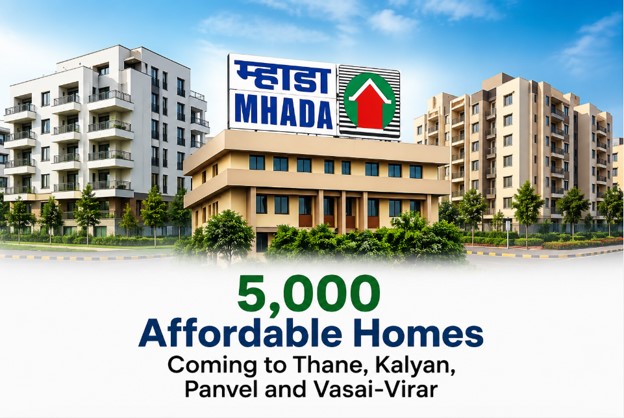
For thousands of middle-class and aspiring homeowners across the Mumbai Metropolitan Region (MMR), the upcoming MHADA Konkan Board lottery could be one of the most significant housing opportunities of 2026. After a brief technical delay from its earlier expected April timeline, the housing lottery is now scheduled to be officially announced by the end of August 2026, offering approximately 5,000 affordable homes across Thane, Kalyan-Dombivli, Panvel, and Vasai-Virar.
At the center of this transformation is IAS Sanjeev Jaiswal, whose leadership at MHADA has focused on making affordable housing more accessible through greater transparency, improved digital governance, and policies that reduce financial barriers for ordinary citizens. The 2026 Konkan Board lottery reflects that direction by combining technology with affordability, ensuring that the home allocation process is easier to access, simpler to understand, and significantly more transparent than before.
Highlight: A lower application deposit, a fully digital lottery process, and nearly 5,000 homes together signal a meaningful shift toward making affordable housing more accessible for everyday families.
MHADA's Biggest Konkan Board Housing Lottery for 2026
The Konkan Board has announced what is expected to be its largest housing lottery of the year, making around 5,000 homes available in some of the fastest-growing residential locations within the MMR.
The lottery covers homes in Thane, Kalyan-Dombivli, Panvel, and Vasai-Virar areas that continue to attract homebuyers due to expanding infrastructure, improving connectivity, and growing employment opportunities. By increasing the housing inventory while simplifying the application process, MHADA aims to widen access to affordable homeownership for different income groups.
The announcement is particularly important because affordable housing demand remains consistently strong, and MHADA lotteries have traditionally offered opportunities that many families may not find in the private housing market.
Lower Deposit Requirement Removes a Major Financial Barrier
Perhaps the most impactful reform in this year's lottery is the proposed reduction in the application deposit amount.
Previously, applicants especially those from economically weaker sections often had to arrange a substantial deposit before even participating in the lottery. For many families, this upfront financial commitment became a barrier long before they reached the home allocation stage.
For the 2026 lottery, MHADA is expected to reduce the application deposit to between Rs 10,000 and Rs 12,500.
While this may appear to be a procedural change, its implications are much broader. Lower entry costs allow more families to participate without depending on loans or borrowing money simply to submit an application. Instead of restricting access based on immediate financial liquidity, the revised deposit structure expands opportunities for deserving applicants across lower-income categories.
In many ways, affordability begins not only with the price of a home but also with the affordability of entering the buying process itself.
A 100% Online System Designed for Greater Transparency
One of the defining features of the 2026 MHADA lottery is the complete shift to the digital platform through the Integrated Housing Lottery Management System (IHLMS 2.0).
The entire process from registration and document submission to deposit payment and computerized scrutiny will be conducted online. The final computerized lottery will also be carried out digitally at the MHADA headquarters.
This end-to-end digital workflow aims to create a process that is fully transparent, minimizes manual intervention, and gives applicants greater confidence that allotments are conducted fairly.
For public housing agencies, transparency is as important as affordability. When applicants understand how homes are allocated and every stage is digitally documented, trust in the system naturally improves.
What Applicants Can Expect Between August and October 2026
The operational timeline has also become clearer.
MHADA plans to release the official advertisement during the last week of August 2026. Following the announcement, applicants will receive approximately 30 to 45 days to complete online registration, upload required documents, and submit the prescribed deposit.
After the application period closes, MHADA will carry out computerized scrutiny before conducting the digital lottery. The names of successful applicants are expected to be announced during the first or second week of October 2026.
This structured schedule provides applicants with sufficient time to prepare documents while allowing MHADA to complete verification before the computerized draw.
Four Income Categories Make the Lottery More Inclusive
A notable strength of the MHADA lottery continues to be its income-based eligibility structure.
To ensure that different sections of society receive appropriate housing opportunities, applicants are divided into four income categories.
Families with annual income up to Rs 6 lakh qualify under the Economically Weaker Section (EWS). Those earning between Rs 6 lakh and Rs 9 lakh fall under the Low Income Group (LIG), while households earning between Rs 9 lakh and Rs 12 lakh are eligible under the Middle Income Group (MIG). Applicants with annual income exceeding Rs 12 lakh can apply under the High Income Group (HIG).
This classification allows applicants to compete within comparable income groups rather than across vastly different financial capacities. It also helps align housing allocation with affordability, ensuring that the available homes reach diverse sections of society.
Why This Lottery Matters Beyond the Numbers
The significance of this lottery extends beyond the availability of approximately 5,000 homes.
The combination of reduced application deposits, fully digital processing, and clearly defined eligibility criteria reflects an evolving approach to public housing administration. Instead of focusing solely on housing supply, the process also addresses accessibility, convenience, and fairness.
For many first-time buyers, navigating housing schemes can often seem complicated. Simplifying registration, digitizing documentation, and reducing upfront costs collectively make participation easier for families who may have previously stayed away because of procedural or financial challenges.
This approach also demonstrates how digital governance can improve citizen services without changing the core objective of affordable housing.
A New Direction for Affordable Housing in the MMR
The MHADA Konkan Board's 2026 housing lottery represents more than another annual draw. It illustrates how administrative reforms can make public housing schemes more accessible while strengthening transparency throughout the allocation process.
With around 5,000 affordable homes planned across Thane, Kalyan-Dombivli, Panvel, and Vasai-Virar, a proposed application deposit of Rs 10,000 to Rs 12,500, a fully online IHLMS 2.0 platform, and a structured schedule running from late August to October 2026, the initiative offers a clearer and more citizen-friendly pathway to homeownership.
For thousands of families waiting for an affordable home in the Mumbai Metropolitan Region, the upcoming MHADA lottery may not simply be another housing announcement, it could represent the moment when owning a home becomes a realistic possibility through a process designed to be accessible, transparent, and fair.