
- By Nirmal Ajwani
- 05 Jun 2026
Why Europe’s Biggest CEOs Are Betting On India Over China And The US For Their Next Growth Phase
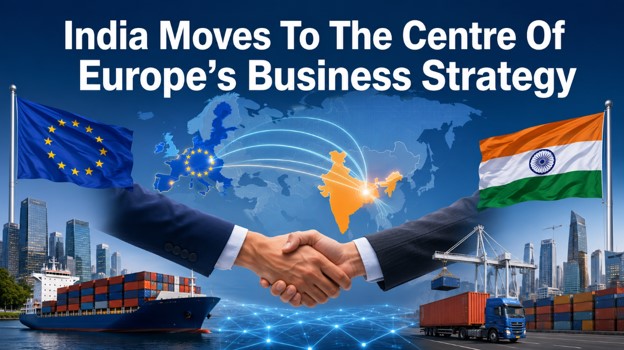
India Moves to The Centre of Europe’s Business Strategy
India is no longer being seen only as a large consumer market by European companies. It is now being viewed as a strategic business partner for trade, technology, manufacturing and global supply chain resilience. A new joint report by The Conference Board and the European Round Table for Industry shows a clear change in how Europe’s top business leaders are reading the global economy.
According to the report, 63 per cent of surveyed European business leaders have a positive view of India’s long-term business environment, while another 7 per cent described their outlook as very positive. Only 4 per cent viewed the Indian market negatively. This is a strong signal at a time when corporate leaders are becoming more careful about China, uncertain about the United States and deeply worried about Europe’s own growth prospects.
European CEOs Give India Higher Strategic Priority Than US And China
The most important finding is not just that European CEOs are optimistic about India. It is that they want the European Union to give India a very high priority in its external strategy.
As per the report, 58 per cent of respondents said the EU should give its relationship with India very high priority across trade, investment, supply chain management, technology, security and climate energy. This places India ahead of the United States, which received 53 per cent, and China, which received 42 per cent.
This ranking matters because it shows that India is no longer sitting at the edge of Europe’s corporate imagination. It is moving closer to the center. For Europe’s largest companies, India now offers three things at once: a large market, a manufacturing base and a geopolitical hedge.
India-EU Free Trade Agreement Adds Momentum
The timing of this shift is important. India and the European Union concluded negotiations for a landmark Free Trade Agreement on January 27, 2026, after talks that had moved in phases for nearly two decades. The European Commission has described the agreement as the largest trade agreement ever concluded by either side.
The EU has said the agreement is expected to eliminate or reduce tariffs on more than 96 per cent of EU goods exports to India and could potentially double EU goods exports to India by 2032. EU-India trade in goods was worth €120 billion in 2024, while trade in services reached €59.7 billion in 2023, up from €30.4 billion in 2020.
For European companies, this is not only a trade document. It is a business signal. Lower tariff barriers, wider market access and stronger rules can make India a more practical destination for long-term investments in manufacturing, technology, mobility, healthcare and services.
Modi’s Gothenburg Outreach to European Industry
The diplomatic push was visible during Prime Minister Narendra Modi’s address to the European Round Table for Industry in Gothenburg on May 17, 2026. The event was hosted by Volvo Group and attended by Swedish Prime Minister Ulf Kristersson, European Commission President Ursula von der Leyen, senior European industry leaders and representatives from leading Indian and European companies.
In his address, Prime Minister Modi highlighted India’s role as a trusted partner in a complex global environment. He invited European companies to deepen engagement with India in areas such as telecom, digital infrastructure, artificial intelligence, semiconductors, electronics, clean energy, green hydrogen, transport, logistics, healthcare and life sciences.
This matters because modern trade is no longer only about buying and selling goods. It is about trusted technology systems, secure supply chains, skilled talent and political reliability.
Why India Looks Attractive to European Companies
India’s appeal comes from a combination of market size, reform momentum and global uncertainty. European companies are looking for locations that can support production, consumption and talent. India offers all three.
The government’s pitch of “Design for India, Make in India and Export from India” directly matches what global companies are searching for. They do not want to depend too heavily on one manufacturing geography. They want flexibility, scale and risk protection.
India’s expanding digital public infrastructure, improving physical infrastructure and focus on ease of doing business are also helping its case. For European companies under pressure to diversify supply chains, India is becoming a serious option rather than a backup plan.
China Still Matters, But Caution Is Rising
The report shows that European CEOs are not completely turning away from China. China remains a major market and manufacturing power. But the mood is more cautious.
When asked about China’s business environment more than three years into the future, 34 per cent of respondents had a positive outlook, 34 per cent were neutral and 23 per cent were negative. This suggests a divided view. European companies still see opportunity in China, but they are also concerned about regulatory stability, investment conditions, systemic complexity and openness.
This is where India gains ground. India does not have to replace China completely to become more important. It only has to become a credible second pillar in global corporate strategy.
Europe’s Own Weakness Is Pushing CEOs Outward
The shift toward India is also being driven by Europe’s internal economic anxiety. The Conference Board’s earlier Europe CEO confidence work with the European Round Table for Industry has repeatedly shown that business leaders see stronger investment prospects outside Europe than within the continent.
The latest report mentioned in the source material says more than 60 per cent of surveyed executives view Europe’s long-term business conditions negatively, while only 11 per cent expect a positive development. It also says three-fourths of respondents do not believe the European single market will be completed by 2028, and 65 per cent doubt it will be completed even by 2030.
This is a serious message. Europe’s CEOs are not only chasing growth abroad. They are also responding to weak confidence at home.
Technology, Energy and Talent Will Shape the Partnership
The next stage of the India-Europe relationship will likely be decided in high-value sectors. These include artificial intelligence, semiconductors, electronics, telecom, renewable energy, green hydrogen, nuclear power, mobility, logistics, healthcare and life sciences.
This is important because these sectors are connected to future competitiveness. Europe has strong technology, design, capital and industrial experience. India has scale, young talent, digital adoption and a growing domestic market. If both sides align well, the partnership can move beyond trade and become a long-term industrial collaboration.
The proposal to hold the India-Europe CEOs Roundtable annually and create an India Desk within the European Round Table for Industry also shows that the relationship is being institutionalized, not treated as a one-time diplomatic event.
The Bigger Message for Global Trade
India’s rise in European boardroom thinking shows how globalization is changing. Companies are no longer searching only for the lowest cost. They are searching for stability, resilience and optionality.
The US remains powerful. China remains essential. But India is becoming more strategic because it offers growth without being tied to the same level of geopolitical concentration risk.
For India, this is a major opportunity. But it also brings responsibility. To convert CEO interest into real investment, India must continue improving logistics, regulatory certainty, contract enforcement, skill development and ease of execution.
India’s Moment Must Become India’s Model
The new report shows that European CEOs are increasingly placing India at the top of their strategic priority list. The numbers are clear: 63 per cent positive long-term outlook, 7 per cent very positive, and 58 per cent calling for very high EU priority toward India.
But the deeper story is not only about sentiment. It is about a world where companies are rethinking risk, countries are rebuilding supply chains and trade is becoming more strategic than ever.
India has the attention of Europe’s biggest companies. The challenge now is to turn that attention into factories, technology partnerships, skilled jobs, exports and long-term trust. If India manages that well, this moment may become one of the most important turning points in India-Europe economic relations.