



- By Shyam Singh
- 20 Jul 2026
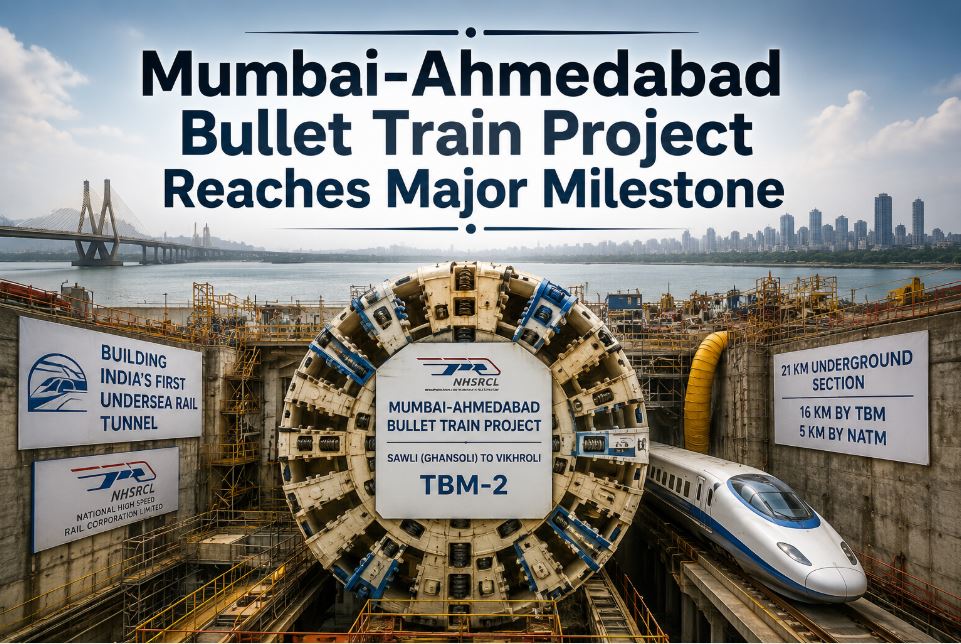
Mumbai-Ahmedabad Bullet Train Project Reaches Major Milestone as Second TBM Starts India’s First Undersea Rail Tunnel
New Tunnel Boring Machine Begins 10-Km Excavation Beneath Thane Creek
India's ambitious Mumbai-Ahmedabad Bullet Train project has achieved another major milestone with the launch of the second Tunnel Boring Machine (TBM) for the country's first undersea railway tunnel. The massive machine has started excavation from Sawli in Ghansoli toward Vikhroli, helping speed up construction of the underground section of India's first high-speed rail corridor.
The latest development marks an important phase in the project, which is expected to transform intercity travel between Mumbai and Ahmedabad with faster, safer, and more efficient rail connectivity.
Second TBM to Build 10-Km Tunnel Including 7 Km Beneath Thane Creek
The newly launched TBM will excavate a 10-kilometer tunnel, including a 7-kilometer stretch beneath Thane Creek. This section forms part of the highly complex underground route connecting Bandra Kurla Complex (BKC) and Sawli.
Earlier this month, the first TBM began excavation from Vikhroli toward BKC, allowing tunneling work to progress simultaneously from both ends. Running two TBMs at the same time is expected to improve construction efficiency and keep the project on schedule.
The undersea tunnel is considered one of the most advanced engineering achievements in India's railway infrastructure and is a key feature of the Mumbai-Ahmedabad High-Speed Rail project.
21-Km Underground Stretch Is the Most Challenging Section
The 21-kilometer underground corridor between BKC and Sawli is regarded as one of the most technically demanding parts of the entire bullet train project.
Out of the total underground section:
- 16 kilometers will be excavated using two giant Tunnel Boring Machines.
- The remaining 5 kilometers have already been completed using the New Austrian Tunnelling Method (NATM), a widely used technique for constructing tunnels in complex geological conditions.
This combination of modern tunneling methods is helping engineers safely navigate Mumbai's dense urban environment while reducing disruption above ground.
Advanced Mixshield TBM Designed for Mumbai's Complex Geology
The newly commissioned Mixshield Tunnel Boring Machine has been specially designed to handle Mumbai's mixed ground conditions.
The machine features:
- A 13.6-meter diameter cutterhead
- A total weight of approximately 3,200 tonnes
- Technology that minimizes ground settlement during excavation
- A semi-continuous excavation system that allows tunnel boring and tunnel lining installation to happen simultaneously
This advanced system is expected to improve construction speed while maintaining high safety and quality standards.
39-Meter-Deep Launch Shaft Built for TBM Assembly
Because of the TBM's enormous size, engineers constructed a 39-meter-deep launch shaft at Sawli.
Individual machine components were transported separately, lowered into the shaft, and assembled underground due to limited surface space. This carefully planned process ensured that the machine could begin excavation safely without affecting surrounding infrastructure.
Large underground launch shafts like this are commonly used for major metro and high-speed rail projects worldwide.
Modern Safety Systems Protect Workers and Infrastructure
Project officials say the TBM is equipped with several advanced safety technologies to support safe tunneling beneath one of Mumbai's busiest regions.
Key safety features include:
- Real-time gas monitoring systems
- Automatic fire detection and suppression systems
- Emergency refuge chambers for workers
- Continuous monitoring of tunnel conditions
These systems help reduce operational risks while maintaining safe working conditions throughout excavation.
Waterproof Tunnel Designed for Long-Term Reliability
Since part of the tunnel will pass beneath Thane Creek, engineers are using advanced waterproofing technology to protect the structure.
The tunnel lining will include:
- Double-layer EPDM waterproof gaskets
- Hydrophilic sealing systems
- Continuous monitoring sensors for ground movement, vibration, and structural performance
These measures are designed to prevent water leakage and ensure the tunnel remains safe and durable throughout its operational life.
Mumbai-Ahmedabad Bullet Train Project Moves Closer to Reality
The successful launch of the second Tunnel Boring Machine marks another important achievement for the Mumbai-Ahmedabad Bullet Train project.
As excavation progresses from both directions, construction of India's first undersea railway tunnel is gathering momentum. Once completed, the high-speed rail corridor is expected to significantly reduce travel time between Mumbai and Ahmedabad while introducing world-class rail infrastructure, advanced engineering, and modern transportation technology to India.
The latest progress also highlights the growing use of sophisticated tunneling technology and international engineering standards in delivering one of the country's most ambitious transportation infrastructure projects.