
- By Diya Sogani
- 01 Jun 2026
How Did the ‘Cockroach Janta Party’ Beat BJP on Instagram in Just 5 Days? India’s New Gen Z Political Phenomenon Explained
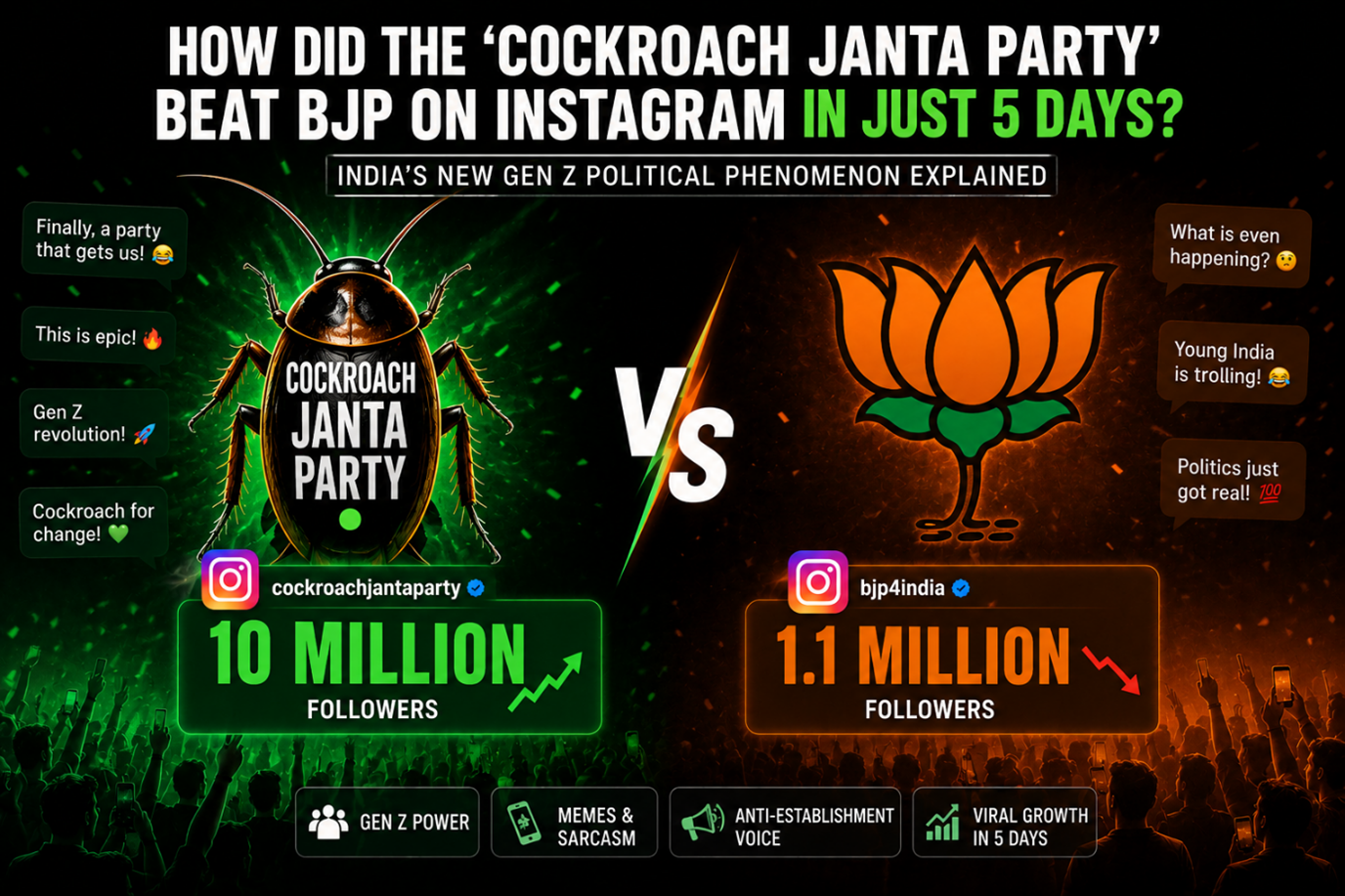
What started as an online satire campaign has rapidly turned into one of India’s biggest viral political movements on social media. The Cockroach Janta Party (CJP), a meme-driven digital campaign born out of outrage, sarcasm and youth frustration, has crossed 10 million Instagram followers in less than five days, overtaking the Bharatiya Janata Party (BJP) on the platform.
The extraordinary rise of the Cockroach Janta Party highlights how India’s political conversations are increasingly shifting toward algorithm-driven digital communities powered by Gen Z humour, meme culture and frustration around unemployment, accountability and institutional disconnect. In just a few days, the movement has managed to create a level of online engagement that traditional political parties have spent years building.
Cockroach Janta Party Surpasses BJP on Instagram
The satirical movement operates under the Instagram handle @cockroachjantaparty and crossed the 10-million follower mark on Thursday.
According to the available figures, the BJP’s official Instagram account currently has around 8.7 million followers, while the Congress account has around 13.2 million followers. The Aam Aadmi Party (AAP), founded in 2012, has approximately 1.9 million followers.
What has made the CJP’s rise particularly remarkable is the speed at which the account expanded. Reports suggest the page crossed 3 million followers within just 78 hours before rapidly moving past the 10-million mark in less than five days.
The growth becomes even more striking considering that the CJP account currently has only 56 posts, while the BJP’s Instagram account has published more than 18,000 posts over the years.
How the Cockroach Janta Party Started
The Cockroach Janta Party first surfaced online on May 16 as a satirical youth movement responding to remarks made by Chief Justice of India Surya Kant during a hearing on May 15.
During the hearing, the CJI referred to certain sections of youth by saying, “There are youngsters, like cockroaches, who don't get any employment or have any place in the profession…”
The remarks triggered strong reactions across social media and soon gave birth to the Cockroach Janta Party campaign led by founder Abhijeet Dipke.
According to Dipke, the backlash intensified because the comments came from someone viewed as a constitutional authority responsible for protecting freedom of expression.
Later, CJI Surya Kant issued a clarification stating that his remarks were directed specifically at individuals entering professions using fake or bogus degrees and not at India’s youth in general. However, the clarification did little to slow the online momentum that had already formed around the campaign.
From Meme Campaign to Digital Youth Movement
What initially appeared to be another temporary meme page soon evolved into a much larger online movement.
The Cockroach Janta Party quickly became a digital platform where users began discussing issues such as unemployment, NEET paper leaks, political accountability, youth frustration and governance concerns.
The movement describes itself as “a political front of the youth, by the youth, for the youth.”
Its rapid popularity reflects how younger audiences are increasingly engaging with political conversations through humour, satire, memes and viral social media content instead of traditional political messaging.
Influencers, Activists and Politicians Join the Conversation
The movement has also attracted support and engagement from several prominent public figures and online personalities.
Among those interacting with or expressing support for the campaign are YouTuber Dhruv Rathee, activist-lawyer Prashant Bhushan, TMC MPs Mahua Moitra and Kirti Azad, social activist Anjali Bhardwaj and former civil servant Ashish Joshi.
Senior advocate Prashant Bhushan even suggested that the movement should use its growing digital influence to raise issues such as the NEET paper leak and the demand for a Right to Employment law.
The movement has simultaneously expanded beyond Instagram as well. On X, where the backlash first gained momentum, the CJP account reportedly crossed more than 180,000 followers by May 21.
Abhijeet Dipke Says the Movement Reflects Gen Z Frustration
Founder Abhijeet Dipke has repeatedly maintained that the campaign is not merely a short-term internet trend but a reflection of deeper frustration among India’s younger generation.
According to Dipke, more than two lakh people have reportedly registered through the movement’s website, indicating wider engagement beyond social media followers alone.
Dipke has also stated that many Gen Z supporters do not want established politicians dominating the movement, viewing it instead as an alternative youth-driven platform for digital expression.
The campaign increasingly reflects decentralised participation, meme culture and frustration-driven online mobilisation.
Can Viral Popularity Translate Into Real Political Influence?
Despite the extraordinary online growth, analysts point out that digital popularity and real-world political organisation remain very different things.
Traditional political parties build influence through years of cadre development, membership expansion, ground-level organisation and electoral structures. The BJP, for instance, remains the world’s largest political party by membership, with more than 140 million members globally.
However, the rise of the Cockroach Janta Party demonstrates how modern digital influence can now emerge almost instantly through meme culture, satire and viral online engagement.
Gen Z Politics Is Changing India’s Digital Political Landscape
The success of the Cockroach Janta Party reflects a larger transformation in how younger Indians engage with political conversations online.
Instead of relying only on traditional speeches and political rallies, Gen Z audiences are increasingly participating through reels, memes, satire, online communities and digital activism.
What began as a satirical response to controversial remarks has now evolved into one of India’s fastest-growing online political phenomena.
Whether the Cockroach Janta Party remains a digital protest movement, develops into a long-term youth platform or simply becomes a defining internet moment, its rise has already shown the growing influence of Gen Z-driven political conversations in India’s evolving social media landscape.