



- By Mahesh
- 16 Jul 2026
MHADA Reviews Redevelopment Complaint at Lokshahi Din: How Citizen Grievance Hearings Are Strengthening Housing Accountability
Regular Public Hearings Show MHADA’s Focus on Faster Resolution of Redevelopment Issues
Mumbai's complex redevelopment landscape depends not only on ambitious housing projects but also on the ability of public institutions to address individual citizen concerns. This balance between large-scale development and grievance redressal was once again evident during the 19th Lokshahi Din organized by the Maharashtra Housing and Area Development Authority (MHADA). The initiative highlights how structured public hearings can improve transparency, strengthen trust, and ensure that redevelopment benefits reach the intended residents.
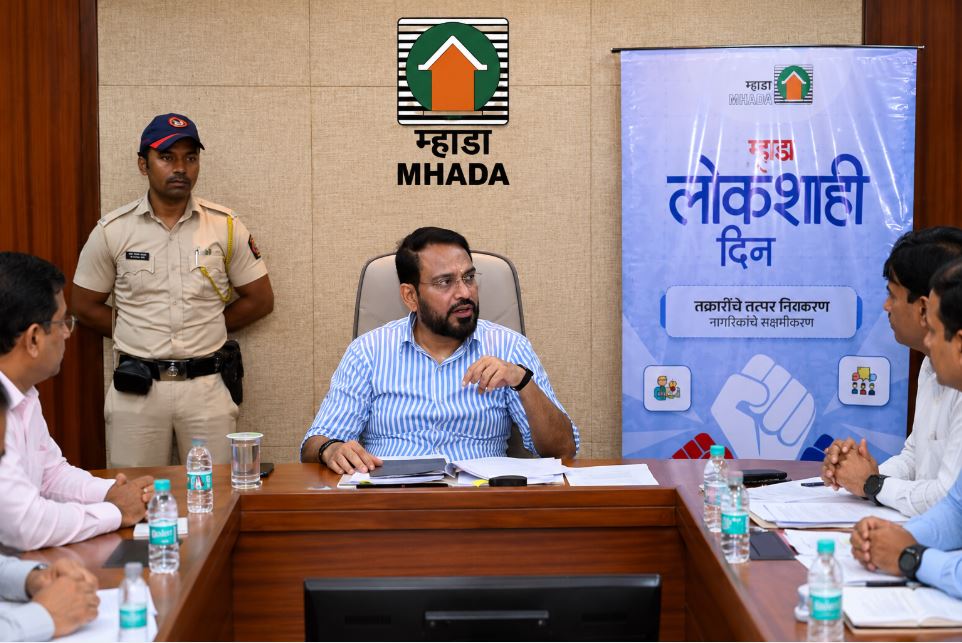
At the center of the hearing was IAS Sanjeev Jaiswal, Vice President and Chief Executive Officer of MHADA, who chaired the 19th Lokshahi Din at the authority's headquarters in Bandra (East). Under his leadership, MHADA continues to provide an institutional platform where citizens can directly present redevelopment-related concerns before senior officials. The latest hearing demonstrated the authority's commitment to listening to residents affected by redevelopment projects and reinforcing accountability within Maharashtra's housing ecosystem.
Highlight: Every redevelopment project is ultimately measured not only by the buildings it creates but also by the promises it keeps to the families it is meant to rehabilitate.
MHADA's Lokshahi Din Reinforces Citizen-Centric Governance
Lokshahi Din has evolved into an important public interface where citizens can raise issues that require administrative attention. Rather than limiting communication to paperwork and departmental correspondence, the initiative creates an opportunity for affected residents to place their grievances before MHADA's top leadership.
The 19th Lokshahi Din was held on July 13 at MHADA's Bandra (East) headquarters. During the session, the authority heard two applications, reflecting its continued effort to review redevelopment-related complaints through an organized and transparent process.
Such hearings play a significant role in improving governance because they connect policy implementation with real-world outcomes. Housing redevelopment often involves multiple stakeholders, including government agencies, developers, housing societies, and residents. Public grievance forums help identify where implementation gaps exist and allow authorities to initiate corrective action where required.
Redevelopment Complaint Highlights Rehabilitation Challenges
One of the key applications presented during the hearing came from Deepak Sonawale regarding the redevelopment of Building No. 18, a cessed building located on Fitwala Road at Elphinstone Road.
According to the complaint, the Mumbai Building Repairs and Reconstruction Board had issued No Objection Certificates (NOCs) to the developer in 2006 and again in 2009. Despite these approvals, the applicant stated that he has not yet received a rehabilitation flat following the redevelopment of the building.
The complaint further alleged that monthly transit rent has not been paid and that the Permanent Alternate Accommodation Agreement (PAAA) has also not been executed. These concerns represent some of the practical challenges that residents may encounter during long-term redevelopment projects, making institutional grievance mechanisms increasingly important.
Why Rehabilitation Accountability Matters in Redevelopment
Urban redevelopment is about far more than constructing new buildings. Its success depends on ensuring that displaced residents receive the rehabilitation benefits promised under approved redevelopment frameworks.
When projects experience delays in rehabilitation allotments or associated documentation, affected families often face uncertainty despite redevelopment progressing on paper. Mechanisms such as Lokshahi Din help bring these concerns into the administrative process, allowing authorities to examine complaints and pursue appropriate follow-up action.
By hearing such cases directly, MHADA reinforces the principle that redevelopment should deliver both physical infrastructure and administrative accountability.
A Platform That Encourages Administrative Transparency
One notable aspect of Lokshahi Din is its emphasis on direct engagement between citizens and senior decision-makers. Instead of grievances remaining confined within multiple administrative layers, the platform allows important issues to receive attention at the highest operational level of the housing authority.
This approach contributes to greater transparency by ensuring that complaints are formally presented before MHADA's leadership. It also signals to stakeholders across redevelopment projects that citizen concerns remain an important component of project oversight.
As redevelopment activity continues across Mumbai, such institutional platforms become increasingly valuable for balancing infrastructure development with resident welfare.
Strengthening Confidence in Public Housing Administration
Housing authorities are expected not only to facilitate redevelopment but also to oversee processes that protect the interests of eligible occupants. Public confidence grows when institutions demonstrate openness to reviewing complaints and maintaining continuous engagement with affected citizens.
The hearing of two applications during the 19th Lokshahi Din reflects MHADA's ongoing effort to maintain this dialogue. While each grievance requires its own administrative examination, the existence of a structured forum itself strengthens confidence in the governance process.
For redevelopment projects involving multiple approvals, legal agreements, rehabilitation commitments, and developer obligations, regular public hearings provide an additional layer of institutional oversight that benefits both citizens and the administration.
The Bigger Picture for Mumbai's Redevelopment Journey
Mumbai's redevelopment ambitions are closely tied to improving housing quality while ensuring that long-standing residents receive the benefits promised under approved schemes. As redevelopment projects continue across the city, effective grievance redressal will remain just as important as construction milestones.
The complaint presented during MHADA's latest Lokshahi Din illustrates why redevelopment requires continuous administrative monitoring alongside physical project execution. By reviewing citizen concerns through an established public platform, MHADA continues to demonstrate that governance extends beyond project approvals to include accountability during implementation.
As housing transformation accelerates, initiatives like Lokshahi Din can play a meaningful role in ensuring redevelopment remains citizen-focused, transparent, and responsive. The latest hearing serves as another example of how regular engagement between residents and public authorities can strengthen trust while supporting more effective housing governance across Maharashtra.