



- By Shyam Singh
- 10 Sep 2026
Maharashtra Launches Land Bank and Mahabhoomi Stack to Fast Track Infrastructure Projects
Digital Land Bank Maps More Than 40,000 Hectares for Compensatory Afforestation
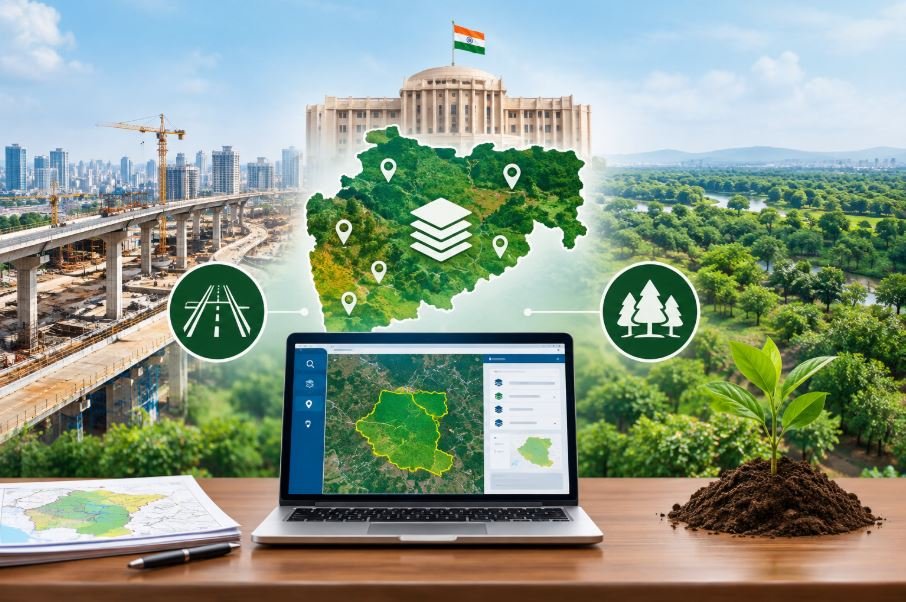
Maharashtra has launched two new digital platforms, Maharashtra Land Bank and Mahabhoomi Stack, to speed up infrastructure development and make government revenue services easier for citizens.
Revenue Minister Chandrashekhar Bawankule formally launched the initiatives with the goal of reducing delays in land-related procedures and improving transparency across the Revenue and Forest departments. The new systems are expected to support faster decision-making for major infrastructure projects while giving citizens easier access to land and revenue information.
Maharashtra Land Bank Brings Land Data Online
The Maharashtra Land Bank has identified more than 40,000 hectares of land that can be used for compensatory afforestation. This includes 33,056 hectares of degraded forest land and 7,546 hectares of non-forest land available with the Revenue Department.
The identified land has been mapped digitally and made available through an online portal. This will allow project authorities to check available land and identify suitable locations without spending significant time searching for alternatives.
The initiative is expected to benefit major projects such as highways, railway lines, bullet train corridors and power transmission networks.
Under existing rules, projects that require the diversion of forest land must provide suitable land for compensatory afforestation. Depending on the category of land involved, the requirement can include equivalent non-forest land or twice the area of degraded forest land.
Digital Land Records Could Help Reduce Project Delays
The new land bank is designed to make the process of finding and securing alternative land faster. Authorities can use the online information to identify suitable locations and move ahead with land-related clearances more efficiently.
Minister Bawankule said the system can help reduce delays that often occur because of lengthy land identification and administrative procedures.
Nashik division has the largest share of degraded forest land included in the digital bank, with 9,002 hectares. Nagpur follows with 8,109 hectares, while Amravati has 5,724 hectares, Pune 5,330 hectares, Chhatrapati Sambhajinagar 4,179 hectares and Konkan 712 hectares.
Chhatrapati Sambhajinagar Leads in Non-Forest Land
The Revenue Department's 7,546 hectares of available non-forest land is spread across several divisions.
Chhatrapati Sambhajinagar has the largest share at 2,689 hectares, followed by Nashik with 2,525 hectares. Amravati has 1,153 hectares, Pune 640 hectares, Konkan 408 hectares and Nagpur 131 hectares.
The digital availability of this information is expected to make land planning more convenient for government agencies working on infrastructure and development projects.
Mahabhoomi Stack to Make Revenue Services More Accessible
Along with the Land Bank, Maharashtra has introduced the Mahabhoomi Stack as a digital public infrastructure platform for revenue services.
The platform has been designed on a model similar to the Unified Payments Interface, or UPI, with the aim of bringing different revenue-related services and data together in one digital system.
Settlement Commissioner Shailesh Naval said the platform integrates more than 10 types of revenue-related data. Citizens will be able to access detailed information linked to a survey number online through a single point.
More Than One Crore Citizens Already Using Digital Revenue Services
The Mahabhoomi Stack builds on Maharashtra's growing use of digital revenue services. More than one crore citizens are already benefiting from services integrated into the state's digital revenue system.
By bringing multiple sources of land and revenue information together, the platform is expected to make government services more convenient, transparent and easier to access.
The Maharashtra Land Bank and Mahabhoomi Stack together mark a major step toward modernizing land administration. The initiatives are expected to support faster infrastructure approvals while improving digital access to revenue information for people across the state.