



- By Medhavini
- 29 Aug 2026
Maharashtra Plans Wider NAAT Testing to Speed Up TB Diagnosis in Rural Areas
Health Department Aims to Improve Access to Faster and More Accurate TB Tests
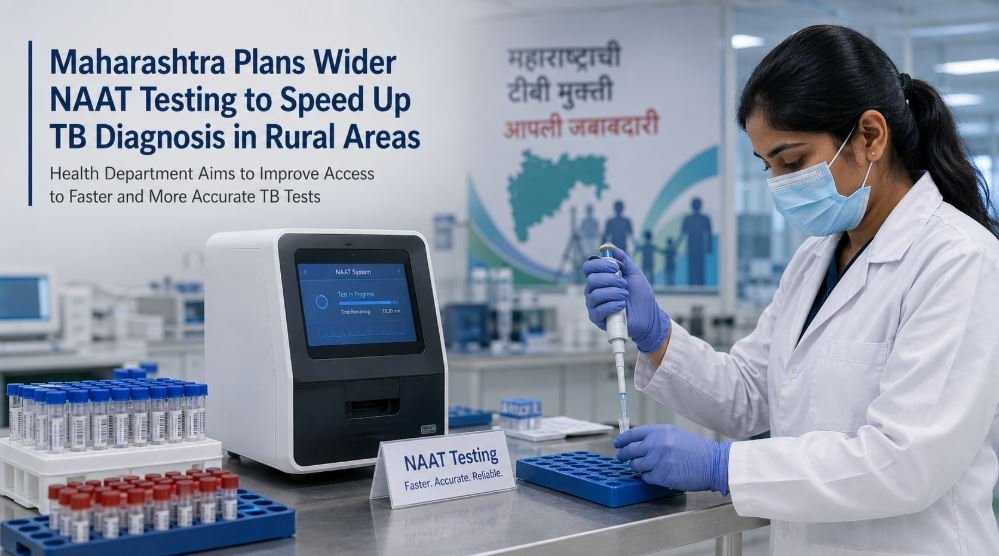
Maharashtra’s Health Department is planning to expand the use of Nucleic Acid Amplification Tests (NAAT) to help detect tuberculosis (TB) faster, especially in rural parts of the state. The move is aimed at improving access to modern diagnostic facilities and supporting earlier treatment for patients.
Data from the Health Department shows that 39.21 lakh TB tests were carried out across Maharashtra under the TB-Mukt Bharat Abhiyan between December 2024 and August 4, 2026. Of these, 21.48 lakh tests, or about 55 percent, were conducted using NAAT.
NAAT is a molecular testing method that detects the genetic material of TB bacteria in a patient sample, usually sputum. Some NAAT tests can also identify resistance to certain TB medicines, helping doctors choose the right treatment more quickly.
Rural Maharashtra Sees Lower Use of NAAT Tests
The use of NAAT remains lower in rural areas compared with Mumbai and other urban locations. Of the 28 lakh TB tests conducted in rural Maharashtra, around 13.15 lakh, or 47 percent, were NAAT tests. About 14.84 lakh tests were still carried out through conventional microscopy.
The difference is particularly visible in some districts. Solapur recorded NAAT use in only 25 percent of TB tests, while the share was 29 percent in both Washim and Beed. This means conventional microscopy continues to account for more than 70 percent of TB testing in these districts.
Mumbai, meanwhile, has much greater access to molecular testing. Nearly 88 percent of TB tests in the city were conducted using NAAT, showing the clear difference between urban and rural access to advanced diagnostic technology.
Faster Testing Can Support Early TB Treatment
Health officials involved in the state’s TB control program have emphasized the importance of NAAT for early and accurate diagnosis. Faster identification of TB can help patients begin treatment sooner and reduce the risk of spreading the infection to others.
Another major advantage of NAAT is its ability to identify drug resistance in certain cases. This can help doctors determine whether the TB bacteria are resistant to commonly used medicines and make treatment decisions earlier, particularly when multidrug-resistant TB (MDR-TB) is suspected.
Officials have also stressed that increasing the number of tests is only one part of improving TB care. Patients need access to reliable and modern diagnostic technology so that suspected cases can be confirmed accurately.
Maharashtra Focuses on Closing the Diagnostic Gap
Expanding NAAT facilities in rural districts is expected to help Maharashtra reduce the gap in access to modern TB diagnosis. Better availability of molecular testing can complement existing microscopy services and give health workers more tools to identify TB cases at an early stage.
The planned expansion is part of the state’s broader efforts to strengthen TB detection and treatment. By improving access to faster diagnostic technology in rural communities, Maharashtra aims to support timely care and move closer to its goal of TB elimination.