



- By Bhawana
- 22 Aug 2026
MHADA to Inspect 12,000 Cessed Buildings in South Mumbai: ₹50 Crore Safety Drive Could Accelerate Redevelopment
Mumbai’s aging cessed buildings are once again at the center of a major housing and public safety initiative. The Maharashtra Housing and Area Development Authority (MHADA) has decided to conduct structural inspections of more than 12,000 cessed buildings in South Mumbai, with the aim of identifying highly dangerous structures and speeding up decisions on repair or redevelopment.
At the center of this effort is IAS Sanjeev Jaiswal, whose leadership at MHADA comes at a critical time for Mumbai’s aging housing stock. The inspection drive reflects a broader administrative challenge: protecting residents today while creating a clearer pathway for redevelopment tomorrow. With four private companies now appointed and the first phase covering 750 buildings, MHADA is moving from a long-standing concern toward a structured, building-by-building assessment.
Highlight: A citywide safety concern is being converted into a measurable inspection program, creating a stronger foundation for faster housing decisions.
MHADA Structural Inspection Begins With 750 Buildings
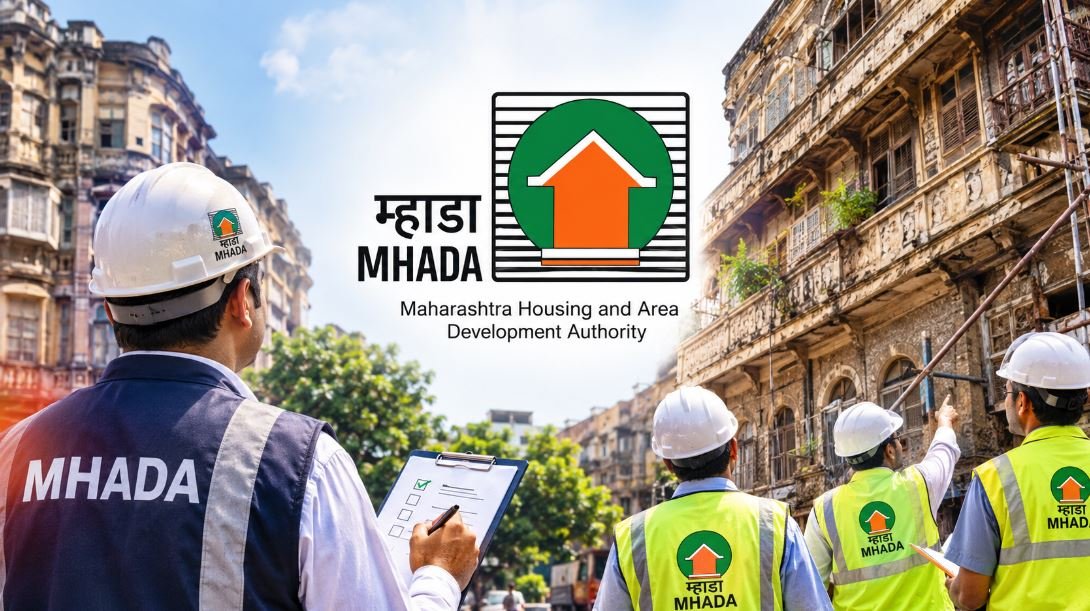
MHADA’s Mumbai Building Repair and Reconstruction Board has started the first phase of structural inspections covering 750 cessed buildings. The work began on Monday after four private companies were appointed to carry out the inspections.
The 750 buildings are distributed across divisions, with 50 buildings being inspected in each division under the initial phase. The objective is straightforward but significant: determine which buildings pose the greatest risk and decide what action is required based on their structural condition.
The board plans to complete structural inspections of more than 12,000 buildings by August 2027. Once inspection reports are available, buildings identified as repairable can be repaired, while structures found to be extremely dangerous may become candidates for redevelopment-related action under Section 79(A) or other applicable provisions.
This approach is important because it replaces a broad concern about aging buildings with a more targeted understanding of individual structures.
Why South Mumbai’s Cessed Buildings Need Urgent Attention
South Mumbai has approximately 13,800 buildings, according to the information provided by the board, highlighting the scale of the challenge facing the city’s older housing stock.
For residents, the condition of a building is not simply a redevelopment issue. It is fundamentally a question of safety, continuity of housing and confidence in the future of their homes. For MHADA, meanwhile, the challenge is to distinguish between buildings that can still be repaired and those where redevelopment may be the more appropriate solution.
The new inspection exercise can therefore play a crucial role in prioritizing intervention. Instead of treating every building in the same way, structural assessments can help authorities focus resources and administrative action on buildings where the need is most urgent.
That distinction matters financially as well as socially. Repairing a structurally viable building and redeveloping a highly dangerous one require very different approaches. A credible inspection report provides the evidence needed to make that distinction.
Section 79(A) Could Become a Key Factor in Redevelopment
The redevelopment process is also connected to the legal position surrounding Section 79(A). The final decision of the Supreme Court on the provision is awaited, according to the source material.
In the meantime, MHADA’s Repair and Reconstruction Board has chosen to identify highly dangerous buildings through structural inspections. This could allow the authority to be better prepared when the legal position becomes clearer.
The state government has also recently passed a bill giving MHADA the status of a competent authority. According to the information provided, this has made the legal pathway surrounding redevelopment more manageable and could help clear the way for redevelopment decisions.
The significance of this development is not merely procedural. Legal uncertainty can slow projects, while the absence of reliable structural information can make it difficult to prioritize them. The inspection program addresses the second problem directly by creating updated information about the condition of buildings.
Lessons From the Earlier Inspection Exercise
This is not the first attempt to conduct structural inspections on this scale. The process was originally scheduled to begin in January but was stopped after a short period due to opposition.
Only around 900 to 1,000 buildings had been inspected before the earlier process came to a standstill. MHADA has now decided to restart the exercise with four appointed companies and a defined first phase.
The restart demonstrates an important administrative lesson. Large urban housing problems rarely move forward through a single decision. They require sustained implementation, coordination and the ability to restart stalled processes when circumstances change.
For residents, the latest phase will ultimately be judged not by the number of inspections announced but by how quickly the resulting reports translate into visible action.
₹50 Crore Investment in Building Safety
The structural inspection program is expected to cost around ₹50 crore, with the expense being borne by the board.
That investment represents more than the cost of technical inspections. It is an attempt to establish a factual basis for decisions involving thousands of buildings and their residents. Identifying high-risk structures early can help authorities determine where immediate intervention is required.
The financial commitment also underlines the scale of the exercise. Inspecting more than 12,000 buildings requires systematic planning, technical expertise and sustained execution. The appointment of four private companies provides an operational structure for taking the program forward.
What the Inspection Drive Could Mean for Residents
For residents living in cessed buildings, the most important outcome will be clarity.
A structural inspection can establish whether a building requires immediate repairs, further intervention or redevelopment. That clarity can help reduce uncertainty and allow authorities to prioritize dangerous structures instead of relying only on general assessments.
If the program meets its target of completing inspections of more than 12,000 buildings by August 2027, MHADA will have a much broader structural picture of South Mumbai’s cessed housing stock. The next challenge will be ensuring that inspection findings lead to timely decisions.
This is where administration, law and implementation intersect. A technically sound report has limited value if it is not followed by action. Conversely, faster redevelopment without reliable structural assessment can create its own risks. The real opportunity lies in connecting the two.
From Structural Assessment to Safer Redevelopment
MHADA’s latest initiative should therefore be viewed as more than a routine inspection exercise. It is an attempt to build a stronger bridge between building safety and redevelopment planning.
The first phase of 750 buildings provides the immediate test. The larger goal is considerably more ambitious: inspecting more than 12,000 buildings by August 2027 and using the findings to guide repairs or redevelopment.
For a city such as Mumbai, where old buildings, limited housing space and redevelopment pressures often intersect, better information can become a powerful administrative tool. The ₹50 crore inspection program cannot by itself resolve every redevelopment challenge, but it can establish the evidence needed for more informed decisions.
The real measure of success will ultimately be whether dangerous buildings are identified early, repairable structures receive attention and redevelopment decisions move forward when legally and technically justified. With the latest inspection drive now underway, MHADA has taken an important step toward turning a long-standing urban safety concern into a structured action plan.