
- By Medhavini
- 03 Jan 2026
Mumbai Weather Update For Jan 3, 2026: Cool Morning Brings Relief, But Air Quality Remains Unhealthy
Mumbai woke up to a crisp and relatively cool Saturday morning, offering residents a brief break from the city’s usual humidity. Clear skies and mild winter winds made early hours pleasant across many parts of the city. According to the India Meteorological Department (IMD), the minimum temperature hovered around 19°C, while the maximum is expected to touch approximately 30°C, making it one of the more comfortable winter days this season.
Despite the agreeable weather, environmental concerns continued to dominate the city’s outlook, with air quality remaining firmly in the ‘unhealthy’ category.
Mumbai’s Air Quality Remains A Major Concern
Data from air quality monitoring platform AQI.in showed Mumbai’s overall Air Quality Index (AQI) at 224 on Saturday morning. An AQI in this range is classified as ‘unhealthy’ and poses increased health risks, particularly for children, senior citizens and people with respiratory or cardiac conditions.
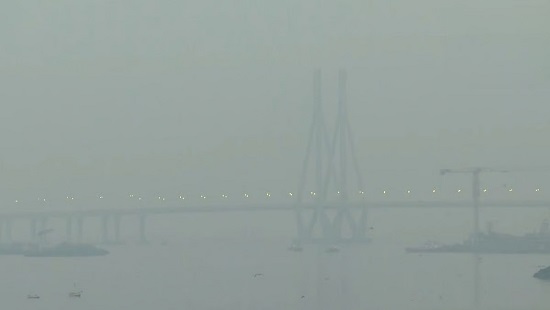
A visible layer of haze across several areas highlighted the persistence of pollution, even as temperatures dipped. Experts attribute the sustained poor air quality largely to Mumbai’s ongoing infrastructure expansion.
Dust and fine particulate matter generated by large-scale government projects—such as metro rail corridors, the coastal road, bridge construction and extensive road-widening works—continue to significantly affect air quality levels. In addition, numerous private real estate developments across the city are contributing to airborne dust, especially during winter months when dry conditions allow pollutants to remain suspended for longer periods.
Chembur Records Severe Pollution Levels
Area-wise AQI readings revealed sharp disparities across Mumbai. Chembur emerged as the worst-affected area, recording an alarming AQI of 327, which falls under the ‘severe’ category. At such levels, even healthy individuals may experience breathing discomfort, throat irritation and reduced lung function.
Wadala East followed closely with an AQI of 326, while Santacruz East recorded 305—both also categorised as ‘severe’. Govandi and Jogeshwari reported ‘unhealthy’ AQI levels of 280 and 277 respectively, remaining dangerously close to the severe threshold.
Suburban regions showed slightly better air quality, though conditions were far from ideal. Andheri East recorded a ‘moderate’ AQI of 97, while Kandivali East and Powai stood at 120 and 163, categorised as ‘poor’. Borivali East and Goregaon East reported AQI levels of 170 and 177 respectively, remaining in the ‘unhealthy’ bracket.
Understanding AQI Levels
As per standard air quality classifications, AQI levels between 0 and 50 are considered ‘good’, 51 to 100 ‘moderate’, 101 to 200 ‘poor’, 201 to 300 ‘unhealthy’, and readings above 300 are classified as ‘severe’ or ‘hazardous’.
Advisory For Citizens
Health experts advise residents, especially those in high-pollution areas, to limit prolonged outdoor activities, use masks when necessary and keep windows closed during peak pollution hours. Authorities continue to monitor air quality closely as Mumbai navigates the dual challenge of rapid infrastructure growth and environmental sustainability.