
- By Shyam Singh
- 30 Oct 2025
Mumbai’s Green Leap: Check How BMC’s 100 MW Floating Solar Power Project Could Redefine Urban Sustainability
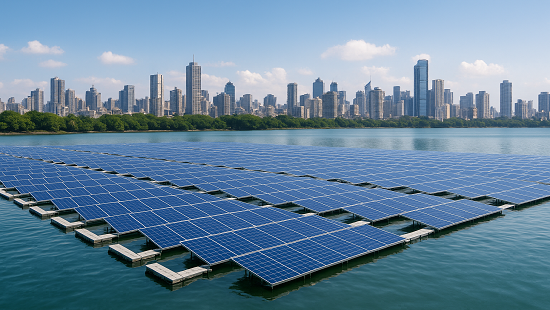
In a city where concrete often outweighs green, Mumbai’s latest initiative marks a quiet revolution in urban sustainability. The Brihanmumbai Municipal Corporation (BMC) has announced plans to set up a 100 MW floating solar power plant on the Tansa and Modak Sagar dams, a project that could save the civic body an estimated ₹165 crore in annual power costs while significantly cutting carbon emissions.
This initiative, developed under a 25-year partnership with Mahatma Phule Renewable Energy and Infrastructure Technology Limited (MahaPreit), positions Mumbai among the leading Indian cities transitioning toward renewable energy-driven urban management. It is not merely a power project, it is a long-term investment in environmental and fiscal sustainability.
The New Face of Civic Power Management
For decades, Mumbai’s municipal infrastructure has relied heavily on conventional electricity, a costly dependence that often strained the BMC’s energy budget. By introducing a floating solar power plant on water bodies that already serve as the city’s reservoirs, BMC is unlocking dual-use efficiency, generating clean energy while preserving precious land.
The 100 MW facility, expected to produce 219 million units of electricity annually, will operate under the Build, Finance, Operate, and Transfer (BFOT) model. MahaPreit will fully fund the project, an investment pegged at ₹546.07 crore, and manage it for 25 years before transferring ownership to the civic body.
The arrangement allows BMC to purchase electricity at a highly competitive ₹4.25 per unit, substantially lower than current commercial tariffs. The savings, projected at over ₹165 crore per year, will directly benefit high-consumption civic establishments like the Pise Panjrapur and Bhandup water treatment complexes, which together form the backbone of Mumbai’s water supply infrastructure.
Beyond Power Generation: A Broader Environmental Mandate
This project is not an isolated experiment. It is part of a broader renewable framework spanning the Tansa, Modak Sagar, Vihar, Tulsi, and Powai lakes, a network designed to collectively reduce the city’s dependence on fossil fuels.
According to BMC officials, the floating solar setup will be integrated with the Maharashtra State Electricity Distribution Company Limited (MSEDCL) infrastructure through open-access channels, ensuring smooth transmission and tariff optimization.
By leveraging surface water reservoirs instead of land, the project avoids displacement, minimizes land acquisition challenges, and reduces evaporation losses by shielding parts of the dam surface from direct sunlight. Each of these outcomes reflects a strategic use of limited urban resources, an approach that exemplifies pragmatic innovation rather than idealistic experimentation.
The Economics of Sustainability
From an economic perspective, the initiative highlights how renewable energy is evolving from an environmental obligation to a strategic cost-saving mechanism. Urban local bodies like BMC, which spend hundreds of crores annually on power for water pumping, sewage treatment, and lighting, can significantly reduce their fiscal burden through such partnerships.
A key advantage of the BFOT model is zero upfront capital expenditure for the civic body. MahaPreit absorbs the development risk, finances the infrastructure, and recovers costs through the long-term power purchase agreement. This structure ensures fiscal prudence while guaranteeing predictable energy prices for 25 years, a critical factor in municipal budgeting.
In a broader policy context, the project aligns with India’s National Solar Mission, which aims to achieve 500 GW of non-fossil fuel-based power capacity by 2030. Mumbai’s floating solar plant, therefore, serves not only as a city-level sustainability initiative but also as a building block in India’s climate commitment under the Paris Agreement.
Middle Vaitarna: A Parallel Experiment in Hybrid Power
Mumbai’s renewable ambitions extend beyond solar. In 2019, the State Water Resources Department approved a hybrid power project at the Middle Vaitarna dam, combining 20 MW of hydroelectric capacity with 80 MW of floating solar generation.
Approved in August 2025, this ₹546 crore hybrid facility is expected to generate around 208 million units of electricity annually, utilizing 4.90 hectares of reserved forest land. Together with the Tansa and Modak Sagar projects, it could potentially meet a significant portion of the city’s internal electricity demand, a vital step toward long-term self-reliance.
Such hybrid models, integrating hydro and solar power, allow for smoother energy output across seasons. During monsoons, hydroelectric output peaks, in dry months, solar generation compensates. This synergy stabilizes supply without overburdening the grid, a lesson Mumbai could pioneer for other dense urban regions.
Sustainability as Governance Innovation
Mumbai’s climate action framework, launched in 2022, underscores the city’s vulnerability to rising temperatures, flooding, and air pollution. Under this plan, renewable energy adoption is a core strategy to curb greenhouse gas emissions.
The Tansa–Modak Sagar solar project represents the governance innovation needed to meet those goals. It blends policy clarity with financial engineering and technological foresight, elements often missing in traditional civic initiatives.
By 2027, when the plant is expected to be fully operational, BMC could emerge as India’s largest municipal user of renewable power. The move will reduce carbon emissions equivalent to removing nearly 45,000 vehicles from the road annually, a meaningful statistic for a city battling congestion and pollution.
Charting the Future of Urban Energy
The success of this initiative will depend on execution, ensuring that environmental safeguards, technical efficiency, and long-term maintenance are not compromised. Floating solar plants, though promising, require careful anchoring systems, corrosion management, and periodic cleaning to maintain output levels.
However, if implemented effectively, this project could inspire similar models across India’s urban landscape, especially in water-rich but land-scarce cities such as Bengaluru, Chennai, and Hyderabad.
Ultimately, Mumbai’s experiment with floating solar power is more than a cost-saving maneuverer. It is a signal of a shifting urban mindset, one that views sustainability not as a constraint, but as a competitive advantage. In the process, it redefines what governance can achieve when environmental vision meets financial discipline.