



- By Shyam Singh
- 18 Jun 2026
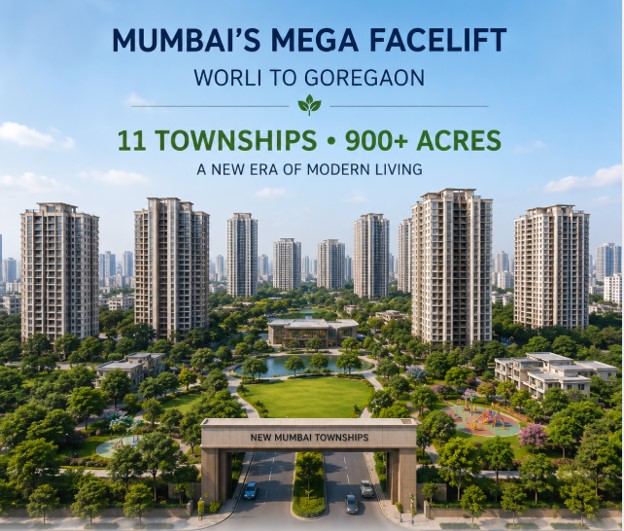
Mumbai’s Biggest Urban Renewal Push: MHADA Plans 11 Mega Township Redevelopment Projects Across 900+ Acres
From Worli to Goregaon, Large Housing Clusters Set for Transformation Under MHADA’s C&D Model
Mumbai is preparing for one of its largest urban redevelopment drives in recent years as the Maharashtra Housing and Area Development Authority (MHADA) moves ahead with plans to redevelop 11 large housing clusters across the city. Spread over more than 900 acres, the initiative aims to reshape ageing residential layouts into modern integrated townships with upgraded infrastructure and improved living conditions.
The redevelopment strategy, which gained momentum after being adopted in 2021, has evolved from a single large housing board layout model into a city-wide approach. The projects are expected to bring large-scale private investment and create a new framework for urban renewal in Mumbai.
MHADA Targets Redevelopment of 75,445 Homes with Investment Potential of Over Rs 3 Lakh Crore
According to estimates prepared by MHADA, the redevelopment of these 11 clusters could attract private investment of more than Rs 3 lakh crore and lead to the redevelopment of 75,445 tenements across Mumbai.
The authority is executing these projects through its Construction & Development (C&D) model. Under this approach, MHADA identifies large housing layouts and appoints financially strong private developers capable of handling multi-crore redevelopment projects.
The model also focuses on increasing rehabilitation benefits for existing residents while ensuring that redevelopment remains financially viable.
Highlight: Instead of rebuilding one building at a time, MHADA’s new model aims to redesign entire neighborhoods.
What Is MHADA’s Construction & Development (C&D) Model?
MHADA’s C&D model has been designed as an alternative to conventional building-by-building redevelopment.
Under this structure, private developers undertake redevelopment of entire clusters rather than individual buildings. In return, developers receive a sale component generated through available Floor Space Index (FSI) after meeting rehabilitation commitments and allocating MHADA’s share of housing stock.
MHADA benefits through a combination of financial returns and additional housing inventory, which can later be offered under its affordable housing lottery schemes.
According to MHADA Vice President and CEO IAS Sanjeev Jaiswal, many redevelopment proposals had remained stalled for years because redevelopment of standalone buildings often became commercially unviable.
He explained that the cluster approach helps unlock projects that otherwise struggled to move beyond planning stages.
From Khar to Gorai: Scale of Projects Reflects Mumbai’s New Redevelopment Vision
Among the 11 proposed redevelopment clusters, project sizes vary significantly.
The smallest proposed cluster is Ramkrishna Nagar in Khar, covering six acres.
At the other end, Gorai represents the largest planned redevelopment cluster with 256 acres.
Both projects are currently at the proposal stage.
Meanwhile, tenders have already been awarded for seven redevelopment locations:
- Abhyudaya Nagar
- GTB Nagar
- Adarsh Nagar, Worli
- Bandra Reclamation
- Motilal Nagar
- Kamathipura
- SVP Nagar, Andheri
MHADA believes that involving established developers with strong financial capacity can improve project execution and maintain construction quality standards.
Why Cluster Redevelopment Could Change Everyday Life in Mumbai
Beyond new buildings, the larger objective of the redevelopment programme is to improve urban living standards.
Traditional redevelopment of individual structures generally results in a new tower with limited shared infrastructure. MHADA’s township model aims to deliver a broader lifestyle upgrade.
Planned features under the integrated development approach include:
- Podium-level amenities
- Multi-level gardens
- Pet care centers
- Walking arenas
- Open green spaces
- Green building concepts
According to MHADA, the focus is not only on replacing old housing but also on creating better-designed communities for existing residents.
A Shift from Housing Delivery to Neighborhood Building
The significance of this redevelopment programme goes beyond real estate.
For decades, Mumbai’s redevelopment conversation has largely centered around individual societies and isolated towers. MHADA’s cluster-led strategy signals a move towards neighborhood planning, infrastructure integration and long-term urban renewal.
If executed successfully, these 11 township projects could become one of Mumbai’s most ambitious experiments in combining public planning with private investment.
For residents, the promise is not simply a new flat—it is the possibility of living in more connected, greener and better-planned urban communities.