



- By Rupendra
- 01 Jun 2026
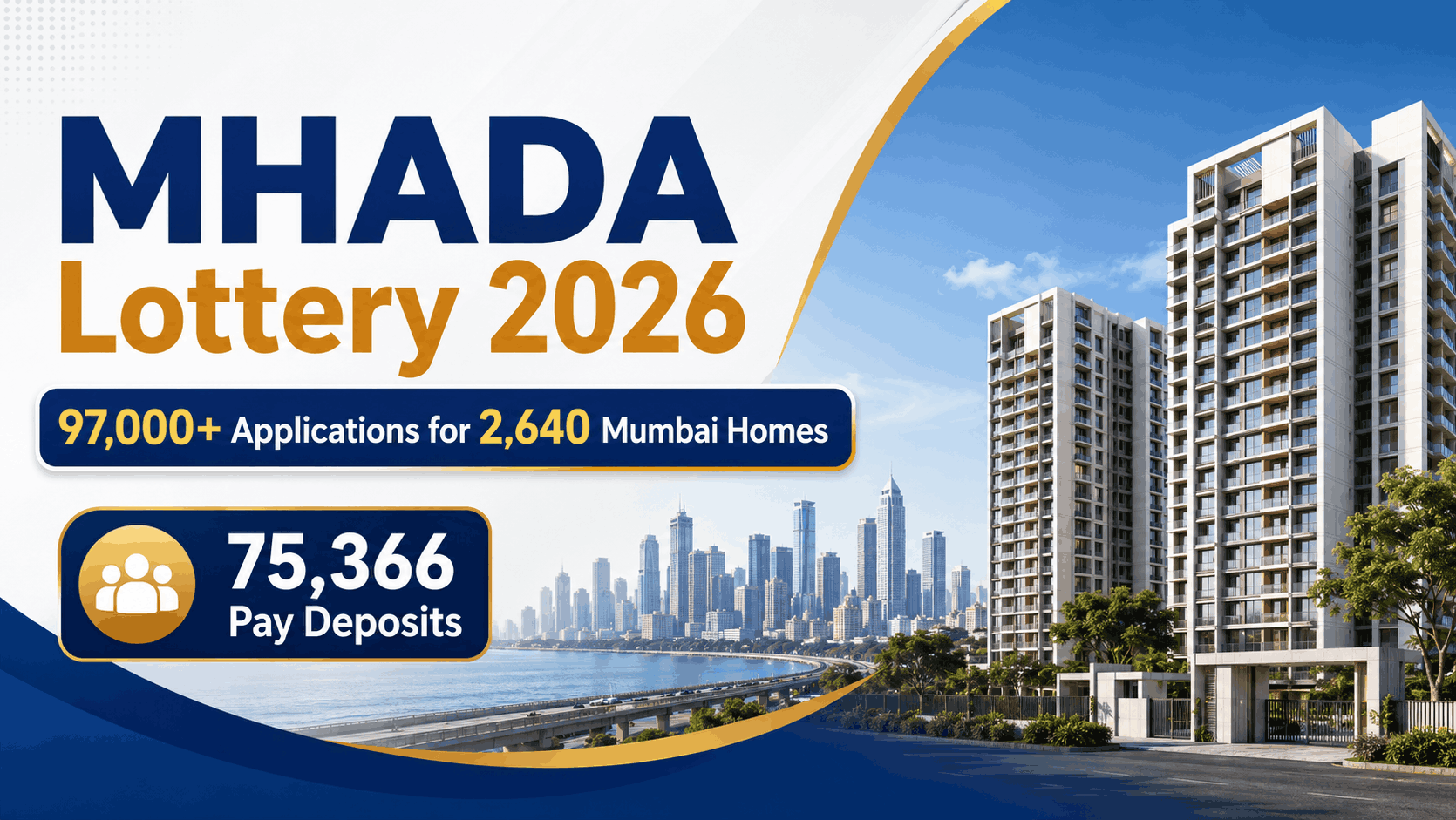
MHADA Lottery 2026 Draws Massive Interest: Over 97,000 Applications Received for 2,640 Mumbai Homes, 75,366 Pay Deposits
Demand for affordable housing in Mumbai remains remarkably resilient, with nearly 98,000 applications chasing just 2,640 MHADA homes across multiple income categories.
Mumbai's housing market has long been defined by a simple reality: demand consistently outpaces supply. The latest response to the MHADA Lottery 2026 is another reminder of this enduring imbalance. The Maharashtra Housing and Area Development Authority (MHADA) has received 97,613 applications for its lottery of 2,640 homes in Mumbai, underscoring the intense aspiration for homeownership in one of India's most expensive urban real estate markets.
Under the leadership of IAS Sanjeev Jaiswal, MHADA's housing initiatives continue to attract significant public interest. The latest lottery, despite witnessing a lower response compared to the 2024 edition, still generated substantial participation, with 75,366 applicants completing the process by paying the mandatory deposit amount before the deadline. The figures reveal not just the popularity of MHADA's housing schemes but also the persistent demand for relatively affordable residential options within Mumbai's urban landscape.
MHADA Lottery 2026: What the Numbers Reveal
The Mumbai Housing and Area Development Board previously announced the computerized lottery for 2,640 flats on March 30, 2026. To accommodate growing interest and provide additional time to prospective buyers, MHADA extended the application deadline twice.
Applicants were ultimately allowed to submit their applications until May 28, while the final date for depositing the earnest money amount was May 29.
The response was significant. MHADA received a total of 97,613 applications for the 2,640 available homes. Out of these, 75,366 applicants deposited the required amount, making them eligible for the next stages of the lottery process.
These numbers highlight an important reality. Even when economic conditions fluctuate and housing affordability remains a challenge, ownership continues to be a deeply valued aspiration among Mumbai residents. The willingness of more than 75,000 applicants to commit funds through the deposit process demonstrates serious buying intent rather than mere exploratory interest.
Why MHADA Continues to Attract Strong Demand
The MHADA lottery occupies a unique position in Mumbai's housing ecosystem. Unlike conventional real estate transactions, lottery-based allocation provides eligible buyers with an opportunity to access homes across various parts of the city through a transparent computerized process.
The latest lottery includes homes spread across several established and emerging residential locations, including Kannamwar Nagar-Vikhroli, Patrachal Siddharth Nagar-Goregaon, Juna Maga Thane-Borivali, Gorai-Borivali, Subhash Nagar-Chembur, Gandhinagar-Bandra, Girgaon, Wadala, Pahadi Goregaon, Kopri-Powai, Mazgaon, Tunga-Powai, Lokmanya Nagar-Dadar, Pantnagar-Ghatkopar and Antop Hill-Wadala.
The geographical spread is significant because it caters to diverse housing preferences. Some applicants may prioritize proximity to employment hubs, while others may seek better connectivity, social infrastructure, or long-term investment potential.
In a city where housing choices are often constrained by affordability, MHADA's projects provide an alternative pathway for individuals and families seeking homeownership.
Demand Far Exceeds Supply
Perhaps the most striking aspect of the MHADA Lottery 2026 is the scale of competition.
With 97,613 applications for 2,640 homes, demand exceeds available supply by a substantial margin. While lotteries are inherently based on chance, the application figures illustrate the intensity of housing demand in Mumbai.
The numbers also reveal an important urban planning challenge. Even though thousands of homes are being made available through the scheme, the volume of applicants indicates that the need for affordable and accessible housing remains significantly larger.
For policymakers and housing authorities, such participation levels serve as a valuable indicator of market demand. Every application represents a household actively seeking an opportunity to enter the housing market through a formal and regulated channel.
Distribution of Homes Across Income Categories
One of the notable features of the MHADA lottery system is its attempt to serve multiple economic segments rather than focusing on a single income group.
The 2,640 homes have been allocated across four categories:
- 145 homes for the Economically Weaker Section (EWS)
- 858 homes for the Low-Income Group (LIG)
- 798 homes for the Middle-Income Group (MIG)
- 839 homes for the High-Income Group (HIG)
This distribution reflects an effort to address housing needs across a broad spectrum of society. While affordable housing often receives the most attention in public discourse, the inclusion of middle-income and higher-income categories recognizes the varied nature of housing demand within Mumbai.
The largest allocation has been made for the Low-Income Group, followed closely by the High-Income and middle-income categories, suggesting a balanced approach to addressing different segments of the market.
What Happens Next? MHADA Lottery Schedule Explained
With the application and deposit phases completed, attention now shifts to the verification and lottery stages.
MHADA will publish the draft list of received applications on its official housing portal by 3 PM on June 10. This stage allows applicants to review the information and identify any discrepancies.
Following the publication of the draft list, applicants will have the opportunity to submit online claims or objections until 3 PM on June 12.
The final list of accepted applications will then be released at 3 PM on June 16. Once this process is complete, MHADA will announce the date, venue, and timing of the computerized draw for allotment of the flats.
This multi stage process is designed to enhance transparency and ensure that eligible applicants are accurately included in the final draw.
Beyond the Lottery: What the Response Means for Mumbai's Housing Market
The MHADA Lottery 2026 offers more than just a snapshot of one housing scheme. It provides a window into the broader realities of Mumbai's residential market.
The fact that nearly 98,000 applications were submitted for just 2,640 homes demonstrates that housing demand remains robust despite changing market conditions. It also highlights the continuing importance of public sector housing initiatives in creating opportunities for homeownership.
Although MHADA officials noted that the response was lower than the 2024 lottery, the overall participation remains substantial by any measure. The figures suggest that demand for well-located and comparatively affordable homes continues to be a defining characteristic of Mumbai's urban economy.