



- By Medhavini
- 20 Aug 2026
NAINA, NMIA and Metro Connectivity: CIDCO’s Big Vision for Navi Mumbai’s Next Growth Phase
Airport-Led Development Set to Transform Navi Mumbai and NAINA
Navi Mumbai is entering a major new phase of urban growth, driven by the opening of Navi Mumbai International Airport, expanding Metro connectivity and large-scale planned development around the region.
Ashwin Mudgal, Vice-Chairman and Managing Director of the City and Industrial Development Corporation (CIDCO), said the Navi Mumbai Airport Influence Notified Area, or NAINA, is expected to develop into a well-planned city around the international airport, following the broader planning principles that shaped Navi Mumbai.
Mudgal, an IAS officer of the 2007 batch, took charge as CIDCO’s Vice-Chairman and Managing Director on June 17, 2026. Before joining CIDCO, he served as Additional Metropolitan Commissioner at the Mumbai Metropolitan Region Development Authority (MMRDA).
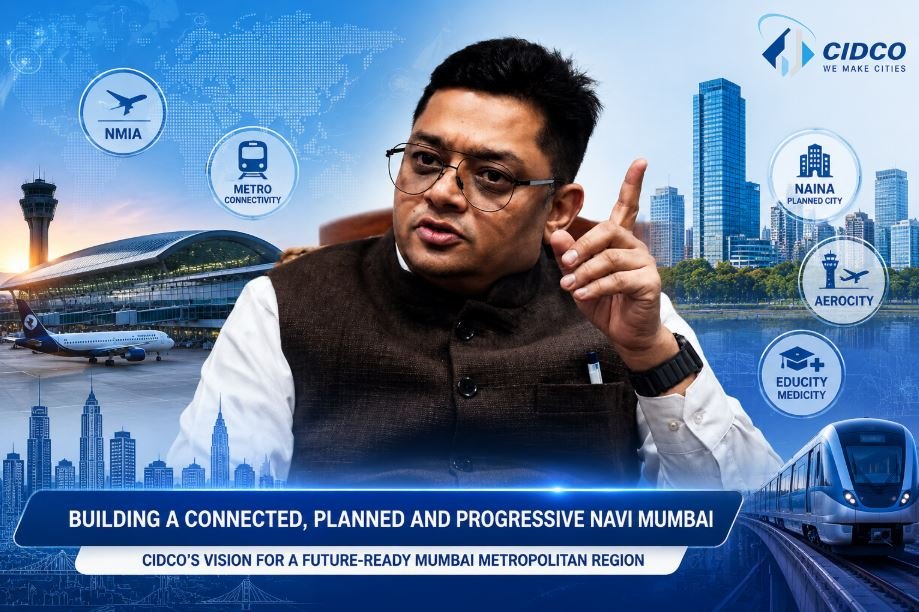
In his first interview after taking charge, Mudgal discussed the future of Navi Mumbai, NAINA, the airport, Metro connectivity, affordable housing and major projects such as AeroCity, EduCity and MediCity.
Navi Mumbai International Airport to Drive Regional Growth
The Navi Mumbai International Airport has started operations, with international flights gaining momentum and cargo services also beginning.
According to Mudgal, the airport is being developed in three phases. One runway is currently operational, while another runway, higher cargo capacity and additional facilities for ground handlers are planned as the airport expands.
The airport is eventually planned to handle 90 million passengers every year. Mumbai’s existing airport handles around 50 million passengers annually.
Mudgal said earlier projections indicated that the Mumbai Metropolitan Region could need a combined airport capacity of around 150 million to 180 million passengers by 2030. This makes Navi Mumbai International Airport an important part of the region’s long-term aviation infrastructure.
Metro Connectivity Will Link Navi Mumbai With Mumbai
For Mudgal, airport connectivity is as important as the airport itself. He said direct integration with the Metro network will be essential for passengers and the region’s future growth.
A proposed Metro connection from inside the airport is expected to link with Sagar Sangam station, near the Navi Mumbai Municipal Corporation headquarters, and then connect towards Belapur.
Another major project is Metro Line 8, also known as the Golden Line, which is planned to connect Navi Mumbai International Airport with Mumbai’s Chhatrapati Shivaji Maharaj International Airport.
The proposed route will pass through areas including Mankhurd and Chembur before reaching Mumbai Airport’s Terminal 2. This could eventually provide a direct point-to-point airport service while also supporting regular passenger services through intermediate stations.
The Detailed Project Report for Line 8 is currently under preparation. Mudgal said the DPR is expected to take around three to four months, after which the project can move towards tendering and implementation.
NAINA Planned as a New City Around the Airport
NAINA is expected to play a central role in the next stage of Navi Mumbai’s expansion.
Mudgal explained that NAINA was created as the influence area of Navi Mumbai International Airport. The idea is to develop a systematic and planned urban area around a major international airport instead of allowing unplanned growth.
NAINA was declared a Town Planning Scheme area in 2013 and covers 95 villages.
In comparison, the Karnala-Sai-Chirner New Town, located to the northeast and east of the airport, covers 124 villages.
Mudgal said NAINA has the potential to become a well-planned city similar in concept to Navi Mumbai.
Town Planning Schemes Face Ground-Level Challenges
CIDCO is currently implementing multiple Town Planning Schemes across NAINA. According to Mudgal, 12 Town Planning Schemes are either operational or at different stages of implementation, while work on other schemes, including TPS 13 and TPS 14, is continuing.
One of the biggest priorities is accurate ground verification and plot demarcation.
Mudgal pointed out that planning documents prepared without checking actual ground conditions can create serious problems. A proposed final plot could overlap with an existing home, temple or other structure, potentially resulting in lengthy legal disputes.
To reduce such issues, demarcation work has begun and affected residents are being invited to submit their representations. CIDCO aims to make suitable adjustments while securing land needed for roads, public amenities and other infrastructure.
Stronger Planning Needed to Control Unauthorised Construction
As Navi Mumbai expands, controlling unauthorised construction will remain an important challenge.
Mudgal said a strong regulatory framework is necessary to manage urban growth. Within its jurisdiction, CIDCO has powers to act against unauthorised construction and continues to take action where required.
The focus will be on ensuring that new development in Navi Mumbai, NAINA and surrounding areas follows proper planning standards.
AeroCity, EduCity and MediCity Could Create New Growth Hubs
Mudgal sees airport-led development as one of the biggest opportunities for Navi Mumbai.
The arrival of an international airport could attract a wide range of supporting industries and services, including AeroCity development, medical facilities, educational institutions, maintenance, repair and overhaul facilities, hotels, restaurants and corporate offices.
He said Navi Mumbai could potentially see a development model similar to the AeroCity concept near Delhi airport.
The Mumbai Trans Harbour Link has already improved connectivity between Mumbai and the mainland. According to Mudgal, this improved access could accelerate development across Navi Mumbai, NAINA, KSC New Town and nearby areas.
The challenge, he said, will be ensuring that this growth remains coordinated and properly planned.
EduCity Moves Ahead With University Plans
CIDCO is also progressing with its EduCity project.
Mudgal said the development model has been finalised and will be presented to the CIDCO board for approval of the policy and pricing framework. Five universities are already in the process of being considered, with selection based on criteria established by the University Grants Commission.
CIDCO is taking an institution-specific approach to infrastructure. Instead of imposing a fixed model, the authority plans to understand the requirements of each university and develop supporting infrastructure according to its master plan.
MediCity Attracts Global Interest
MediCity is another major project planned as part of Navi Mumbai’s future growth.
CIDCO has identified the site and is seeing significant interest from global healthcare players. Further progress will depend on final discussions and the completion of definitive agreements.
The broader objective is not simply to create individual hospitals or universities but to establish complete ecosystems around them.
Housing Will Remain a Key Part of Navi Mumbai’s Expansion
Rapid urban development is expected to increase demand for housing across the region.
Mudgal said CIDCO has already delivered around 1.5 lakh homes across different income categories, including Economically Weaker Sections, Lower Income Groups, Middle Income Groups and Higher Income Groups.
The authority is also working on around 67,000 additional homes under the PMAY mass housing scheme, which could significantly increase the availability of affordable housing.
This housing push will be important as new employment centres, universities, healthcare facilities and businesses attract more residents to Navi Mumbai and its surrounding areas.
Navi Mumbai Has More Scope for New Development Than Mumbai
Mudgal also highlighted a major difference between Mumbai and Navi Mumbai.
Mumbai has limited vacant land, making redevelopment one of the main avenues for future construction. Navi Mumbai, being a relatively newer planned city, still has opportunities for fresh development.
This gives Navi Mumbai and surrounding planned areas a strong advantage as the region prepares for airport-led growth.
CIDCO’s Vision Is Focused on Planned Regional Growth
The next phase of Navi Mumbai is likely to be shaped by the combined impact of the international airport, Metro connectivity, the Trans Harbour Link, NAINA’s Town Planning Schemes and new economic hubs.
Mudgal’s vision places strong emphasis on coordinated development rather than isolated projects. AeroCity, EduCity and MediCity are expected to support new employment and investment, while affordable housing will be essential to accommodate the growing population.
With better transport links connecting the two airports and wider parts of the Mumbai Metropolitan Region, Navi Mumbai could become an increasingly important economic and urban centre.
The success of this transformation, however, will depend on careful land planning, accurate ground verification, effective regulation and timely infrastructure delivery. If these elements move together, NAINA and the wider Navi Mumbai region could emerge as one of the Mumbai Metropolitan Region’s most important planned growth corridors.