



- By Sanvee Nagpal
- 24 Jun 2026
Mumbai’s ₹4 Lakh Crore Housing Reset: How MHADA’s 925-Acre Redevelopment Plan Could Redefine Urban Living
A 925-Acre Urban Renewal Mission Could Become Mumbai’s Biggest Housing Transformation Yet
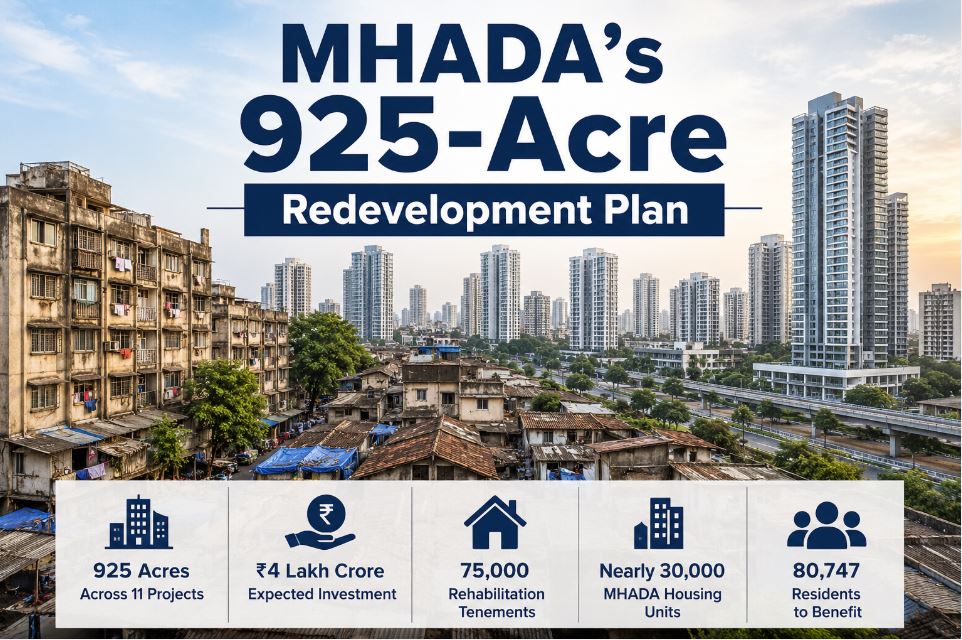
Mumbai’s redevelopment story has often been trapped between ambition and execution. Ageing housing colonies, rising population pressure, limited land availability, and fragmented project structures have repeatedly slowed meaningful urban renewal. Now, the Maharashtra Housing and Area Development Authority (MHADA) is attempting something far more structural: a redevelopment pipeline spread across 925 acres that is expected to attract nearly ₹4 lakh crore in investment and reshape how large Indian cities think about housing renewal.
At the center of this transformation is IAS Sanjeev Jaiswal, Vice President and Chief Executive Officer of MHADA, whose leadership is positioning redevelopment not merely as construction activity but as a long-term urban rebuilding exercise. Under MHADA’s Construction & Development Agency (C&DA) model, the authority aims to balance private capital with public oversight while protecting the interests of existing residents—a combination that could become an important template for future city redevelopment across India.
Highlight: This redevelopment push is not just creating new buildings—it is testing whether Mumbai can shift from fragmented housing upgrades to planned neighborhood transformation at scale.
Why MHADA’s ₹4 Lakh Crore Redevelopment Pipeline Matters
The scale alone makes this initiative significant.
MHADA estimates that the redevelopment programme will attract investments worth approximately ₹4 lakh crore across Mumbai. The expected output includes around 75,000 rehabilitation tenements, nearly 30,000 housing units for MHADA, and additional saleable inventory for private developers.
Collectively, the projects are expected to benefit 80,747 residents.
Unlike traditional redevelopment models that focus on isolated buildings or small clusters, MHADA’s current pipeline attempts to address entire residential ecosystems. The redevelopment spans 11 projects across some of Mumbai’s most densely populated and ageing neighborhoods.
This approach reflects an important shift in urban policy thinking: redevelopment is increasingly being treated as infrastructure creation rather than simply real estate expansion.
The C&DA Model: A Different Approach to Redevelopment
What makes this programme stand out is not only its size but its operating structure.
Under the Construction & Development Agency model, private developers execute projects while MHADA retains institutional oversight and responsibility for protecting resident interests.
This structure attempts to solve one of redevelopment’s oldest tensions—how to attract private investment without weakening public accountability.
According to MHADA leadership, the framework includes transit rent support for eligible families during construction and corpus provisions intended to support long-term maintenance of newly developed housing stock.
That changes the conversation.
Instead of asking residents to absorb redevelopment risk, the model seeks to distribute that burden through institutional safeguards and structured project execution.
The larger objective is straightforward: replace ageing residential stock with modern housing while reducing disruption for existing communities.
Why India’s Biggest Developers Are Showing Interest
Large-scale participation often acts as a market signal.
MHADA has already opened bids for three major cluster redevelopment projects:
Adarsh Nagar, Worli – 34.33 Acres
This project represents one of the flagship redevelopment opportunities in central Mumbai and forms a major part of the cluster-based transformation strategy.
Bandra Reclamation – 98.27 Acres
Located in one of Mumbai’s most strategically valuable urban corridors, this redevelopment carries significant long-term city planning implications.
Sardar Vallabhbhai Patel (SVP) Nagar, Andheri West – 73.89 Acres
This large residential cluster adds scale and density management to the overall programme.
These projects have attracted interest from some of India’s largest corporate and real estate groups, including Adani Group, Reliance Industries, Lodha Developers, and JSW Group.
Their participation is being interpreted as a market endorsement of MHADA’s redevelopment framework.
When major developers compete for projects governed through institutional oversight rather than pure commercial freedom, it suggests confidence in both execution mechanisms and long-term economic viability.
Beyond Three Projects: The Larger Redevelopment Map of Mumbai
The three headline projects are only part of a much broader redevelopment pipeline.
MHADA’s programme also includes:
- Motilal Nagar in Goregaon, spread across 143 acres
- Kamathipura
- Abhyudaya Nagar
- Kannamwar Nagar
- GTB Nagar
- PMGP cluster project in Jogeshwari
- Ramkrishna Nagar in Khar
- MHB Colony in Borivali
- Gorai
- Charkop in Kandivali
Together, these locations represent a cross-section of Mumbai’s ageing residential landscape.
The redevelopment strategy envisions integrated neighborhoods supported by upgraded infrastructure, open spaces, social amenities, and structured parking rather than isolated residential towers.
That distinction matters because cities rarely become more livable through housing alone—they improve when housing and public infrastructure evolve together.
Can Cluster Redevelopment Solve Mumbai’s Urban Challenge?
Mumbai’s housing pressures are not new.
An ageing building stock, increasing density, and severe constraints on developable land have pushed policymakers toward larger redevelopment frameworks.
Traditional redevelopment models have often struggled due to fragmented ownership structures, financing limitations, approval complexity, and prolonged consent processes.
Cluster-based redevelopment backed by institutional oversight offers an alternative.
By combining land value unlocking, infrastructure planning, and coordinated execution, the model attempts to generate outcomes that individual redevelopment projects have historically struggled to deliver.
Success, however, will depend less on announcements and more on delivery timelines, resident trust, and execution discipline.
Conclusion: Mumbai Is Entering a New Phase of Urban Development
MHADA’s ₹4 lakh crore redevelopment pipeline represents more than a construction programme—it signals a broader rethinking of how mature cities renew themselves.
If executed effectively, the 925-acre initiative could deliver 75,000 rehabilitation homes, create nearly 30,000 new MHADA units, improve neighborhood infrastructure, and establish a replicable public-private redevelopment framework.
For Mumbai, the opportunity is not only to build more housing.
It is to prove that redevelopment can become urban reform.