
- By Medhavini
- 05 Jun 2026
Mumbai’s One-Tree-Per-Society Plan Sounds Simple, But Experts Say Real Cooling Needs Smarter Urban Greening
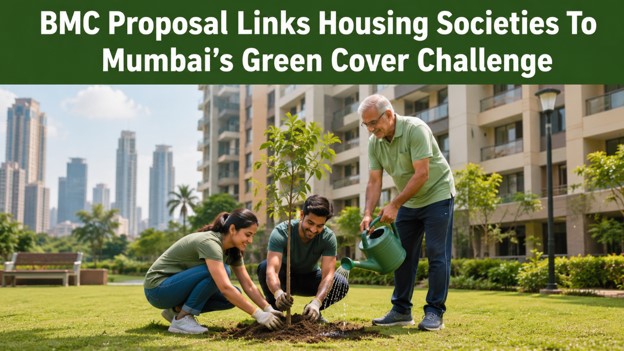
BMC Proposal Links Housing Societies To Mumbai’s Green Cover Challenge
Mumbai may soon see a civic push asking every housing society to plant at least one tree inside its premises. The proposal was made by BJP leader and BMC House Leader Ganesh Khankar during a recent Tree Authority meeting. The idea is linked to the larger concern over the loss of around 45,000 trees and mangroves expected to be affected by the Versova-Bhayandar Link Road, also known as Coastal Road North.
Khankar said the proposal received support from committee members and would be taken forward to encourage citizens to participate in improving Mumbai’s green cover. The aim is simple: involve housing societies, increase tree planting and reduce the impact of rising urban heat.
The idea comes at a time when Mumbai is facing pressure from both sides. On one side, the city needs large infrastructure projects to reduce travel time and improve connectivity. On the other, it is losing natural buffers like mature trees and mangroves, which help control heat, flooding and ecological damage.
Versova-Bhayandar Link Road And The Mangrove Loss Debate
The green compensation debate has gained attention because of the Versova-Bhayandar coastal road project. The Bombay High Court had allowed the BMC to proceed with the 26.3 km project, which may affect around 45,675 mangroves out of nearly 60,000 in the project area. The court also directed the BMC to file yearly updates for 10 years on compensatory plantation and mangrove restoration.
The Supreme Court later declined to stay the High Court order and allowed the project to move ahead under the environmental safeguards already imposed. Reports said the project cost is around ₹18,263 crore and is expected to reduce pressure on western suburban traffic.
Supporters of the project see it as an important transport link between Mumbai and Mira-Bhayandar. Environmental groups and citizens, however, have raised concerns over mangrove damage, long-term ecological cost and the effectiveness of compensatory afforestation.
Aarey Plantation Plan And Maharashtra’s 300 Crore Tree Mission
The housing society tree proposal also comes alongside a larger state-level plantation push. Maharashtra Chief Minister Devendra Fadnavis has announced a mission to plant 300 crore trees between 2026 and 2031 under the Green Maharashtra initiative. The plan aims to increase the state’s green cover and includes digital and satellite-based monitoring to track plantation and survival.
Mumbai Suburban Guardian Minister Ashish Shelar has also directed officials to prepare a plan to plant trees on 65 acres of land in Aarey as part of this larger campaign. This shows that urban greening is now becoming a key civic and political priority.
But the real question is not whether trees should be planted. The question is whether the trees will survive, grow properly and actually cool the city.
Why One Tree Per Housing Society May Not Be Enough
On paper, asking every housing society to plant one tree is a simple and citizen-friendly idea. It can create awareness and encourage people to take responsibility for their neighbourhoods. But experts say one isolated tree cannot compensate for the loss of mature trees, mangrove systems or dense green patches.
Environment activist Stalin D from Vanashakti said that a single tree inside a heat island cannot provide major ecological service. According to him, clusters of trees with a strong canopy are more effective because they cool a larger area and improve wind circulation. He also pointed out that heavy concretization has reduced the natural heat exchange between the ground and air, making both days and nights warmer in dense urban areas.
His concern is important. In many parts of Mumbai, trees are planted in tiny pits surrounded by concrete. Such trees often struggle to grow deep roots, spread canopy or absorb rainwater. Without soil, space and care, plantation becomes symbolic rather than effective.
Urban Heat Island Effect Needs Better Tree Design
The urban heat island effect happens when concrete, asphalt and glass absorb heat during the day and release it slowly at night. This makes built-up areas hotter than green or open spaces. In Mumbai, where many neighborhoods are already crowded and heavily concretized, tree planting must be planned carefully.
Research on urban greening has shown that vegetation can cool cities, but the impact depends on local climate, street design, plant type, canopy cover and the way trees are combined with shrubs and grasses. A chapter from Nature in Cities, Nurturing Cities notes that vegetation complexity can improve urban microclimates, but its effect is highly context-dependent.
Another study in Communications Earth & Environment found that the cooling effect of trees depends on climate, urban form and tree traits. It noted that trees can reduce pedestrian-level heat through shade and transpiration, but the benefits vary across cities and conditions.
This means Mumbai cannot treat tree plantation like a numbers game. A thousand poorly placed saplings may not provide the same benefit as a smaller number of well-planned, well-maintained native trees with strong canopy cover.
Experts Call For Urban Forests, Not Just Plantation Counts
Anil Pandit from the Bombay Environmental Action Group said that increasing tree cover is important, but real cooling benefits need proper species selection, canopy planning, diversity and long-term maintenance. He said the focus should shift from counting how many saplings are planted to creating well-planned urban forests.
This is a crucial point for Mumbai. Mature trees are ecological assets. They provide shade, absorb pollution, hold soil, support birds and insects, and reduce surface heat. Replacing them with small saplings cannot immediately deliver the same benefit.
Dr Pradip Awate, public health specialist and former state health surveillance officer, also supported the need for caution. He said trees are important tools against climate change, but the geography and species must be selected properly. Planting the wrong tree in the wrong place can defeat the purpose of plantation.
What Mumbai Needs For Effective Green Compensation
Mumbai’s green compensation strategy needs to move beyond one-time plantation drives. Housing societies can play a role, but they need guidance from the BMC on what to plant, where to plant and how to maintain trees.
A better model would include native species, open soil patches, tree clusters, shaded walking areas, rainwater support, survival audits and protection of existing mature trees. Societies with limited space can be encouraged to create layered green corners with trees, shrubs and ground cover instead of isolated decorative planting.
The BMC can also prepare ward-wise planting plans based on heat intensity, available open spaces and existing green cover. This will help direct plantation efforts to areas that need cooling the most.
Mumbai Needs Smarter Greening, Not Just More Saplings
The proposal to ask every housing society to plant one tree is a positive starting point. It can make citizens part of Mumbai’s climate response and bring attention to the city’s shrinking green spaces. But it cannot be seen as a full answer to the ecological impact of large infrastructure projects.
The loss of mangroves and mature trees needs serious, science-backed compensation. Mumbai needs more green cover, but it also needs the right green cover. Tree clusters, native species, canopy growth, soil exposure and long-term maintenance will decide whether these efforts actually reduce heat and improve quality of life.
For a city fighting heat, flooding and rapid construction, the success of greening will not depend on how many saplings are announced. It will depend on how many trees survive, grow and protect the people who live around them.