
- By Medhavini
- 04 Jun 2026
Mumbai’s 160 Sq Ft Chawl Homes Are Turning Into 500 Sq Ft Flats
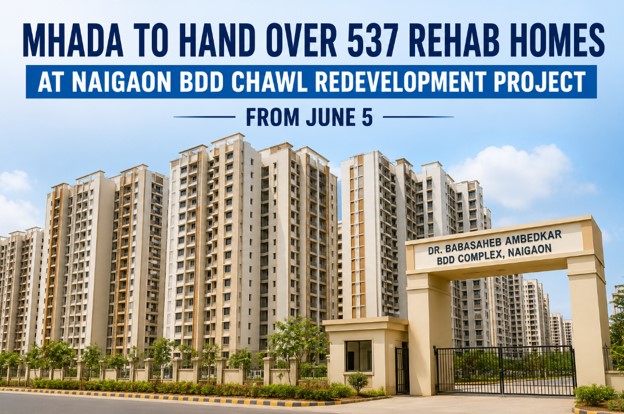
Mumbai’s housing story is often told through prices, towers and skylines. But its real test lies in whether the city can improve life for families who built their lives in ageing, crowded and unsafe neighborhoods. MHADA’s decision to begin handing over 537 rehabilitation homes at the Naigaon BDD Chawl Redevelopment Project from June 5 is therefore more than a routine possession exercise. It is a visible marker of how old public housing can be converted into modern, safer and more dignified urban communities.
For IAS Sanjeev Jaiswal, Vice-President and CEO of MHADA, the Naigaon handover represents the kind of citizen-first redevelopment that turns policy into lived change. Under his leadership, MHADA has increasingly positioned itself not only as a housing authority, but as an institution responsible for large-scale, inclusive and sustainable urban transformation.
The real success of redevelopment is not the height of the tower, but the dignity it restores to the family entering it.
MHADA Naigaon BDD Chawl Redevelopment: A Major Housing Milestone
The Maharashtra Housing and Area Development Authority will start handing over 537 rehabilitation tenements to eligible residents of the Naigaon BDD Chawl Redevelopment Project from June 5. These homes are located in Towers 1, 2 and 3 of Rehabilitation Building No. 1, which has recently received the Occupancy Certificate.
The allotment process will take place at the MHADA Project Office on the ground floor of Tower No. 5 at Naigaon-Dadar. Allotment letters will be distributed on working days between 11 am and 6 pm, excluding public holidays. The process will follow the sequence of Tower Nos. 2, 1 and 3, and the detailed schedule will be displayed at the distribution center.
This matters because redevelopment in Mumbai is not only about replacing buildings. It is about managing people, trust, documents, transition, expectations and time. A successful handover shows that the project has crossed one of its most important implementation stages.
From 160 Sq Ft Chawl Units To 500 Sq Ft 2-BHK Homes
The most powerful part of the Naigaon BDD redevelopment is the change in living space. Eligible residents who earlier lived in compact 160 sq ft chawl units are now being provided free-of-cost ownership flats measuring 500 sq ft carpet area in a 2-BHK configuration.
This shift is not cosmetic. It changes how families live, study, cook, rest and grow. In a city where space is both scarce and expensive, a 500 sq ft ownership flat gives long-time residents a stronger sense of security and permanence.
The new homes include vitrified flooring, aluminum-framed windows, granite kitchen platforms, branded plumbing fixtures and fire-safety systems. These details may sound technical, but they are important. Good materials reduce maintenance problems. Safer systems reduce risk. Better design improves daily life.
What Residents Need For The MHADA Allotment Process
MHADA has asked beneficiaries to remain personally present with the required documents. These include rehabilitation agreements, Aadhaar and PAN card copies, a notarized undertaking from transit camp residents, passport-size photographs and a family photograph.
This document-based process is essential because rehabilitation projects depend heavily on eligibility, transparency and proper verification. In large redevelopment projects, even small gaps in documentation can delay possession and create disputes. A clear allotment process helps reduce confusion and gives residents a more predictable path to possession.
Naigaon BDD Project Scale: 42 Chawls, 3,344 Tenants And 20 Rehab Towers
The Naigaon redevelopment project, now known as the Dr Babasaheb Ambedkar BDD Complex, is spread across 6.45 hectares. It currently covers 42 existing chawls and includes 3,344 residential and non-residential tenants.
The project is being implemented in two phases. It will replace old chawl structures with 23-storey rehabilitation towers supported by modern housing and community infrastructure. In total, Naigaon will have 20 rehabilitation towers across two rehabilitation buildings.
This scale explains why the project is significant. Mumbai has many old housing clusters, but very few redevelopment programmes combine heritage, density, rehabilitation and modern urban planning at this level.
Earlier Handover Of 864 Homes Added Momentum
The latest handover of 537 homes follows an earlier milestone. On March 16, 2026, MHADA handed over 864 rehabilitation tenements in five completed towers to beneficiaries. The event took place in the presence of Maharashtra Chief Minister Devendra Fadnavis and Deputy Chief Ministers Eknath Shinde and Sunetra Pawar.
Together, these handovers show that the project is moving from planning and construction into actual delivery. That is important because public confidence in redevelopment depends less on announcements and more on possession.
Modern Infrastructure Beyond Individual Flats
The Naigaon BDD redevelopment is not limited to better apartments. The new towers have been constructed using earthquake-resistant technology. They include passenger and fire lifts, CCTV surveillance on every floor, spacious staircases, stilt parking and three-level basement parking facilities.
The larger township plan also includes a school building, welfare center, sewage treatment plant, solar energy systems and rainwater harvesting infrastructure. MHADA will maintain common amenities and facilities in the rehabilitated buildings for 12 years.
This approach is important because urban renewal cannot stop at housing units. A live able neighborhood needs safety, mobility, education, water management, energy systems and community spaces. The Naigaon project tries to address these needs through a township-style model.
Transit Support And Rental Compensation During Redevelopment
Redevelopment affects families long before they receive new homes. During construction, residents have been offered either transit accommodation or rental compensation. Both residential and non-residential occupants are receiving advance rent assistance of Rs 25,000 per month for eleven months.
This support is necessary because the transition period is often the most difficult phase for families. Relocation affects children’s schooling, daily travel, household budgets and small businesses. A fair and predictable transit system can reduce stress and help residents stay connected to the project.
BDD Chawl Redevelopment Across Mumbai
The larger BDD Chawl Redevelopment Programme spans around 86 acres across Naigaon, Worli and N.M. Joshi Marg-Parel. It covers around 207 chawls and is expected to benefit 15,593 residents.
At Worli, the project will rehabilitate 9,689 residents through 34 rehabilitation towers. At N.M. Joshi Marg-Parel, the redevelopment includes 14 rehabilitation buildings for 2,560 residential and non-residential occupants. At Naigaon, 20 rehabilitation towers are being developed for 3,344 occupants.
These numbers show the wider importance of the programme. It is not a single housing project. It is one of Mumbai’s most ambitious attempts to rework old public housing into safer, better-planned urban communities.
Why The Naigaon Handover Matters For Mumbai’s Future
Mumbai cannot become a better city only by building new private towers. It must also upgrade old settlements where thousands of families have lived for generations. The Naigaon BDD redevelopment shows how public agencies can use land, planning and rehabilitation to improve living standards without pushing original residents out of the city’s social and economic fabric.
The handover of 537 homes from June 5 is therefore a strong administrative and social moment. It reflects progress in a project that combines engineering, housing policy, rehabilitation and citizen trust.