
- By Rahul
- 04 Jun 2026
Mumbai Water Supply May Get A Major Boost By 2029
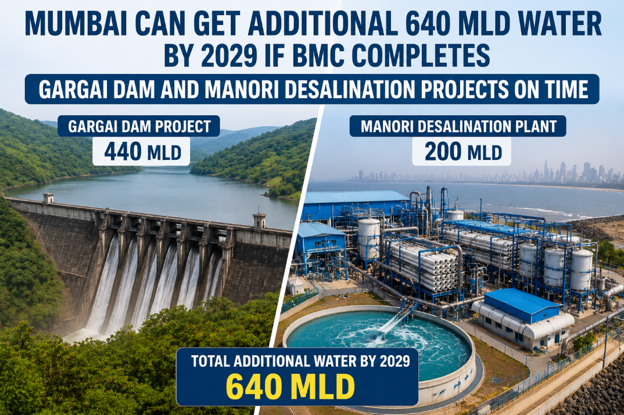
Mumbai may receive an additional 640 million litres of water per day by 2029 if the Brihanmumbai Municipal Corporation completes two major water supply projects on time. These projects are the Gargai Dam project and the Manori desalination plant.
The Gargai Dam is expected to add 440 MLD of water, while the Manori desalination plant is expected to add 200 MLD in its first phase. Together, both projects can help Mumbai reduce its water shortage and prepare for future demand.
Why Mumbai Needs New Water Supply Projects
Mumbai’s water demand is increasing because of population growth, new construction, and rising daily use. The city already faces a gap between demand and supply, especially during low rainfall years and before the monsoon.
At present, Mumbai depends mainly on lakes and reservoirs for drinking water. This makes the city highly dependent on rainfall. If rainfall is poor or lake levels fall, the BMC has to announce water cuts to manage supply.
The new projects are important because they can create additional sources of water and reduce pressure on the existing system.
Gargai Dam Project To Add 440 MLD Water
The Gargai Dam project is planned in Palghar district. It is expected to become one of Mumbai’s major new water sources. Once completed, the dam can supply around 440 MLD of additional water to the city.
The project includes the construction of a 69-metre dam and a tunnel that will carry water to the Modak Sagar reservoir. This will help connect the new water source with Mumbai’s existing supply network.
The BMC’s Standing Committee cleared the Gargai Dam project in April 2026 at a revised cost of around ₹3,065.68 crore. Earlier, the proposal had faced questions over cost, land acquisition, rehabilitation and environmental concerns.
Manori Desalination Plant To Add 200 MLD Water
The Manori desalination plant is another major project planned by the BMC to improve Mumbai’s long-term water security. The plant will convert seawater into potable water through seawater reverse osmosis technology.
In its first phase, the plant is expected to supply 200 MLD of drinking water. The project has also been planned in a way that it can be expanded to 400 MLD in the future.
The plant is planned at Manori on Mumbai’s western coastline. It is expected to help the city reduce its complete dependence on rainfall-based water sources.
BMC Targets Completion By 2029
According to civic officials, both projects are expected to be completed by 2029 if work moves as planned. For the Gargai Dam, the BMC is waiting for important permissions related to forest and wildlife clearances.
Once the required approvals are received, the corporation is expected to begin on-ground work. The Manori desalination plant is also expected to take around four years for completion after execution starts.
Consultants And Technical Support For Complex Projects
The BMC has said that these water projects are technically complex. This is why the civic body has taken the help of expert consultants for planning, design and execution.
However, members of the civic committee have also raised the need to reduce over-dependence on private consultants. They have suggested that the BMC should also use its own technical staff, retired experts and internal planning resources for such large projects.
Environmental And Rehabilitation Concerns Remain Important
The Gargai Dam project has also raised concerns related to tree transplantation, forest permissions, land acquisition and rehabilitation of affected villages. Reports have noted that the project may require relocation of affected families and large-scale environmental measures.
These concerns make proper planning important. The project can move ahead smoothly only if water security, environmental protection and rehabilitation are handled responsibly.
What These Projects Mean For Mumbai Citizens
If both projects are completed on time, Mumbai can get a stronger and more stable water supply system. The additional 640 MLD supply can help reduce shortages, support future growth and improve daily water availability.
For citizens, this can mean fewer water cuts, better supply planning and more reliability during difficult summer months.
The success of these projects will depend on timely permissions, proper execution, quality work and strong coordination between different departments.
Future Of Mumbai’s Water Security
Mumbai’s water needs will continue to grow in the coming years. Projects like Gargai Dam and Manori desalination plant can play a major role in preparing the city for the future.
The city needs both traditional water sources and new-age solutions. Dams can strengthen the reservoir system, while desalination can provide an additional source that does not depend only on rainfall.
If completed within the planned timeline, these two projects can become an important step towards long-term water security for Mumbai.