
- By Rahul
- 05 Jun 2026
Fadnavis Puts Maharashtra Infrastructure On The Clock: 3.5-Year Deadline, No Fresh Work For Delay-Prone Contractors
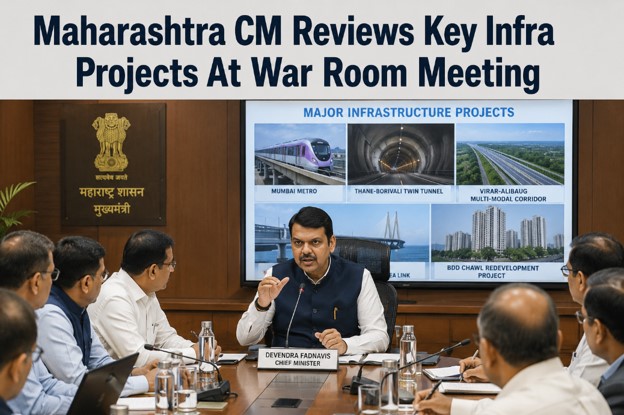
Maharashtra CM Reviews Key Infra Projects at War Room Meeting
Maharashtra Chief Minister Devendra Fadnavis has sent a clear message to infrastructure agencies and contractors: major projects must not drag on for years. During a review meeting at the Chief Minister’s Infrastructure War Room at Sahyadri Guest House in Mumbai, he directed government agencies to complete key infrastructure projects within three to three-and-a-half years and warned that delays by contractors would not be accepted.
The Chief Minister said timely completion of infrastructure projects is directly linked to the state’s growth and economic strength. His direction comes at a time when Maharashtra is handling several large projects across transport, housing, urban renewal and regional connectivity. These include Mumbai Metro lines, twin tunnel projects, BDD Chawl redevelopment, Dharavi redevelopment, the Virar-Alibaug Multi-Modal Corridor and the Bandra-Versova Sea Link.
No New Contracts for Contractors with Delay Record
A major part of the review focused on contractor accountability. Fadnavis directed that future tenders should consider the track record of contractors in completing earlier projects on time. He also instructed agencies to avoid giving new work orders to contractors who have repeatedly delayed public projects.
This is an important shift because delays in public infrastructure do not only increase project costs. They also affect citizens through traffic congestion, unfinished roads, disrupted public services and slower economic activity. By linking future tenders to past performance, the state is trying to make timely delivery a measurable condition, not just a promise.
CM Says Project Delays Cause Loss to State and Nation
Fadnavis said that when contractors delay project completion, it causes losses to both the state and the country. He asked departments and project agencies to remove hurdles instead of allowing files, permissions or coordination issues to slow down work.
This approach also matches earlier reviews by the Chief Minister. In August 2025, he had asked officials to complete 30 key infrastructure projects within three years and update the status of each project on the CM Dashboard for faster monitoring. In November 2025 too, he had expressed displeasure over slow progress and said projects should not take five to six years in today’s age of technology.
Fuel Supply and Execution Risks Also Reviewed
Amid concerns over fuel supply in some parts of the state, Fadnavis also asked departments to ensure that infrastructure works do not suffer due to shortage of fuel. For large projects, even small supply disruptions can delay equipment movement, transport of material and on-site construction activity.
This shows that the review was not limited to contractor discipline. It also looked at practical problems that affect project timelines on the ground. In large infrastructure works, delays usually come from many small points: land acquisition, permissions, utilities, raw material, fuel, contractor capacity and local coordination.
Dharavi Redevelopment: GST Relief for Local Entrepreneurs Suggested
The Chief Minister also reviewed the Dharavi Redevelopment Project and asked officials to examine relief on state GST for entrepreneurs working in Dharavi. The purpose is to support local industries and help the area’s informal economy move towards a more formal economic structure.
Dharavi redevelopment is one of Mumbai’s most watched urban renewal projects. Earlier, the Maharashtra cabinet had approved stamp duty concessions for lease agreements related to the Dharavi Redevelopment Project’s special purpose vehicle. The project has also sought several exemptions, including GST-related relief, to speed up implementation.
Fadnavis also indicated that there was no need to seek fresh Cabinet approval for certain pending matters in the Dharavi redevelopment tender process. Instead, he asked the implementing agency to resolve issues through coordination with relevant departments.
Virar-Alibaug Multi-Modal Corridor Gets Fresh Push
The Chief Minister also directed officials to speed up land acquisition for the proposed Virar-Alibaug Multi-Modal Corridor. He noted that land value along the corridor is expected to rise once the project is completed and asked authorities to identify strategic locations for industrial development.
This direction shows that the corridor is being seen not only as a transport project but also as an economic corridor. If planned properly, such projects can open new industrial pockets, reduce pressure on existing urban centers and improve connectivity across the Mumbai Metropolitan Region.
BDD Chawl Redevelopment to Move Faster After Rent Compensation
Fadnavis also reviewed the redevelopment of BDD chawls at NM Joshi Marg, Naigaon and Worli. He directed officials to begin redevelopment work without delay after paying rent compensation to residents and taking possession of their existing homes.
The BDD Chawl redevelopment project is one of Mumbai’s major public housing renewal efforts. It involves shifting residents from old chawl structures into modern rehabilitation homes. Because it directly affects thousands of families, the project needs careful coordination, timely rent support and clear possession planning.
Thane-Borivali And Goregaon-Mulund Twin Tunnels Under Review
The review also covered major transport projects, including the Thane-Borivali Twin Tunnel and the Goregaon-Mulund Twin Tunnel. Fadnavis directed authorities to complete the Thane-Borivali project within its planned schedule and ensure that the Goregaon-Mulund Twin Tunnel is completed by January 2029.
The Thane-Borivali Twin Tunnel project has already seen major activity. In April 2026, Fadnavis launched a tunnel boring machine for the project, which is expected to improve east-west connectivity in the Mumbai Metropolitan Region. The project passes below Sanjay Gandhi National Park and is being executed with a focus on limiting environmental disturbance.
Bandra-Versova Sea Link Issues to Be Resolved
The Chief Minister also instructed officials to resolve pending issues affecting the Bandra-Versova Sea Link project. This project is a key part of Mumbai’s larger coastal connectivity plan and is expected to improve travel movement between the western suburbs and South Mumbai.
Transport projects such as sea links, tunnels and metro corridors are becoming central to Mumbai’s future growth. But their real value will be seen only when they are completed on time and connected properly with existing roads, metro systems and public transport networks.
Why This Review Matters for Maharashtra Infrastructure
The latest War Room meeting shows that Maharashtra wants to move from project announcements to project delivery. The focus on time-bound completion, contractor performance, land acquisition, fuel supply, GST relief, housing redevelopment and transport connectivity indicates a broader governance push.
For citizens, the message is simple: delayed projects increase daily inconvenience. For the state, delays increase costs and reduce investor confidence. For contractors, the new message is even clearer: performance history may now decide future work.
Timelines Are Now Part of Governance
Fadnavis’ 3.5-year deadline is more than an administrative instruction. It is a test of whether Maharashtra can deliver large infrastructure without endless delays. The state has several important projects in motion, from Dharavi and BDD redevelopment to twin tunnels, sea links, metro lines and regional corridors.
If agencies follow the timelines, resolve permissions faster and hold contractors accountable, Maharashtra can reduce project delays and improve public infrastructure delivery. But if execution slips again, the cost will not remain limited to budgets. It will be paid by citizens through traffic, uncertainty and delayed access to better urban services.